
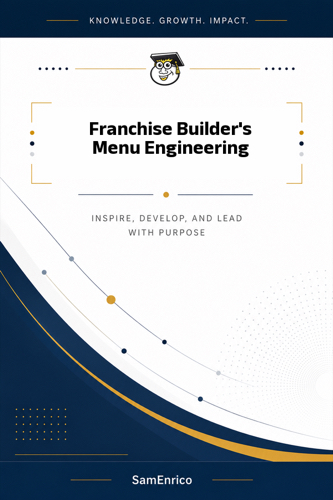
Non-FictionBiographyMenu Strategy
Franchise Builder's Menu Engineering eBook
Removed low profit items and added high margin com
Removed low profit items and added high margin combos.
Formats
Free sample
Chapter 1: The Menu Morgue--–- On a Tuesday morning in late October, a franchise owner named Rick stood in his own walk-in cooler and cried. Not because his business was failing—though it was—but because he had just realized that he was paying $47,000 per year to store, prepare, and throw away a single menu item that almost nobody wanted. The item was a grilled vegetable wrap. It required seven unique ingredients that appeared nowhere else on his menu. It took four minutes to assemble during lunch rush, which meant it single-handedly caused three to five other orders to wait.
And in the previous twelve months, it had generated exactly $8,400 in revenue against $22,100 in direct costs—not counting the labor and bottleneck drag. Rick had kept the wrap on his menu for eight years because his wife liked it and because removing it felt like admitting defeat.This book exists because Rick is not an outlier. He is the rule.Every day, across thousands of franchise locations, owners and managers make the same quiet, catastrophic decision: they choose addition over subtraction. A supplier offers a discount on a new protein, so they add a sandwich. A customer requests a gluten-free option, so they add a flatbread.
A competitor introduces a loaded fry bowl, so they add their own version. One item at a time, the menu grows. And with each addition, the kitchen slows, the inventory list expands, the training manual thickens, and the profit margin—the single number that determines whether a franchise survives or dies—shrinks.This chapter is called The Menu Morgue because that is where most menu items eventually belong. Not in a fiery, dramatic exit, but in a quiet, cold corner where they can be laid to rest without customer riots or corporate interference. Before you can build the high-margin combos that will double your store profit—before you can even understand what a "Stack" is or why D.O.G.s must be killed—you have to accept a brutal truth that most franchise owners spend years avoiding.The most profitable franchises are not the ones with the most items.
They are the ones with the fewest items that actually make money.This is not opinion. It is mathematics disguised as restaurant operations. And if you read nothing else in this book, understand this single sentence: every item on your menu is either paying rent or stealing it. There is no neutral. There is no "nice to have." There is only profit or loss, contribution or drag.The $100,000 Mistake Hanging on Your Wall Let us begin with a story that will sound familiar, even if the details differ.
Rick owned three fast-casual franchises in the Midwest. His flagship store—the one he opened first, the one he cared about most—had a menu with 142 items. He was proud of this number. He believed it meant variety, choice, abundance. He believed it meant his customers would always find something they wanted.
What he did not know was that 142 items meant 142 chances to lose money, and he was losing on most of them.When Rick finally agreed to let a consultant run a Menu Engineering Matrix on his store—the same matrix you will learn in Chapter 2—the results were devastating. Of the 142 items, only 19 were Stars (high popularity, high profit). Another 22 were Plowhorses (high popularity, low profit), which meant they were popular but barely breaking even. Twelve were Puzzles (low popularity, high profit), which were hidden gems that Rick had never promoted. And the remaining 89 items?
D.O.G.s. Deadweight on Operational Gains. Low popularity. Low profit. Slow movers that cluttered the menu, confused the kitchen, and drained cash.Eighty-nine items.Rick had been paying labor to prep ingredients for 89 items that almost nobody ordered.
He had been paying rent on cooler space for unique components that spoiled before they sold. He had been training new hires on recipes that generated less revenue per month than the cost of the training hour itself. And he had been doing this for years, convinced that variety was a virtue.After the audit, Rick made a choice that most franchise owners never make: he killed 62 items in a single quarter. He did not do it all at once. He used the five removal methods you will learn in Chapter 4.
He tested, he measured, he grieved, and he cut. Then he built four new high-margin combos—what this book calls Stacks—using the Puzzles and Stars he had ignored for years.The result, twelve months later, was a net profit increase from $18,000 to $178,000 in that same flagship store. Same location. Same staff. Same equipment.
Same customers. The only thing that changed was the menu.This is not a magic trick. This is menu engineering. And it starts with understanding the paradox that confuses almost every franchise owner.The Menu Paradox: Why More Choice Means Less Money When customers walk into a franchise restaurant, they want to believe they have options. Franchisors reinforce this belief because they think it drives satisfaction.
But here is what the data actually shows: beyond a certain point, additional menu items do not increase customer satisfaction. They decrease it.This is called choice overload, and it has been studied extensively in both laboratory and real-world settings. In one famous experiment, researchers set up a tasting booth in a gourmet grocery store. On some days, they offered 24 varieties of jam. On other days, they offered 6 varieties.
The booth with 24 jams attracted more foot traffic—but only 3 percent of those customers actually bought jam. The booth with 6 jams attracted fewer people, but 30 percent of them made a purchase. More choice led to more browsing but less buying.Your menu works the same way. When a customer stares at 100 items, their brain enters a state of decision paralysis. They scan.
They skip. They feel anxious about making the wrong choice. And sometimes—more often than franchise owners want to admit—they walk out and go somewhere simpler.But choice overload is only half of the problem. The other half is operational drag.The Mathematics of Menu Bloat Every item on your menu carries hidden costs that never appear on a supplier invoice. Let us name them, because naming is the first step to killing.Inventory Drag.
Each unique ingredient must be ordered, received, rotated, stored, and tracked. A menu with 100 items might require 300 individual SKUs in your walk-in cooler and dry storage. Each SKU has a shelf life. Each SKU takes up cubic feet that you pay for whether you use them or not. And each SKU that spoils before it sells is pure loss.
The industry average for food waste is 3 to 5 percent of total food purchases. But franchisees with high menu complexity often see waste of 8 to 12 percent—and most of that waste comes from the obscure ingredients used only for D.O.G.s.Labor Drag. Every item on your menu requires training. New hires must learn the recipe, the plating, the modifiers, and the allergies. A simple menu with 40 items can be taught in two days.
A bloated menu with 120 items takes a week or more—and even then, mistakes happen. Every wrong order, every remake…
This is the end of the free sample. Get the eBook to keep going. Buy now
About this book
Details
- Author
- Beals Shoshana
- Publisher
- SamEnrico
- Language
- English
- Genre
- Non-Fiction, Biography, Menu Strategy
- Released
- 2026-06-10
- Pages (approx.)
- 131
- Available as
- eBook, Audiobook

Read better in the ZLOADR app
Your eBooks on your phone or tablet. Sign in with your SamEnrico account and start reading.
More by Beals Shoshana
 Weekly Review HandbookBeals Shoshana$11.99
 Breath Awareness For MigraineBeals Shoshana$11.99
 Values And Mission Alignment Scaling GuideBeals Shoshana$11.99
 The Phantom of the Opera House: The Untold Story of the Paris Catacombs' Secret SocietyBeals Shoshana$11.99
 Riders of the Forgotten Trail: The Black Cowboys Who Tamed the WestBeals Shoshana$11.99
 High Rise Project ManagerBeals Shoshana$11.99
 Understanding Hypertrichotic OsteochondrodysplasiaBeals Shoshana$17.99
 How to Start a Movements for Clocks and Watches Business (Beginners Guide)Beals Shoshana$11.99
 Remote Offshore Operations PrimerBeals Shoshana$12.99
 Blockchain Health Records TechBeals Shoshana$12.99
You may also like
 Hong Kong Handover 1997Dunn Johnnie$11.99
 Zumba For Postnatal Recovery CourseNeal Christian$11.99
 Zumba for BeginnersLadner Nikia$11.99
 YouTube Comment Mining GuideHumes Pandora$12.99
 Worry Box MeditationCarlin Rudy$11.99
 Workplace Stress MeditationNguyen Lynn$11.99
 Workplace Stress and Sleep RepairHawley Ivory$11.99
 Workplace Perfectionism CureDelaney Jeffry$11.99
 Workplace Injustice Anger GuideWallen Isabelle$11.99
 Work Addiction and Burnout LinkGreenwood Ester$11.99
 Women in Yoga and WellnessBeattie Galina$11.99
 Women in Stand Up ComedyChun Evangeline$11.99