
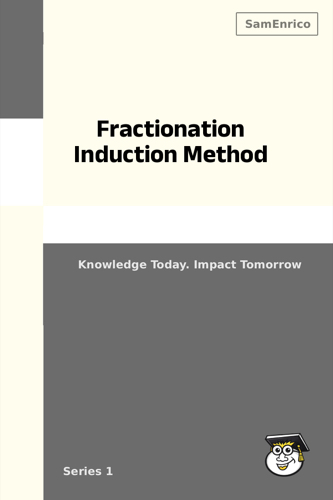
Fractionation Induction Method eBook
In and out of trance for deepening.
In and out of trance for deepening.
Formats
Free sample
Chapter 1: The Ratchet’s Secret--–- Trance is not a state you hold. It is a rhythm you ride.For most of the history of hypnotism, practitioners believed that the goal of induction was to put the subject into a trance and then keep them there. The deeper the trance, the longer the subject stayed under, the more successful the session. This assumption feels intuitive. After all, if you want to reach the subconscious mind, why would you repeatedly bring someone back to the waking state?
Wouldn't that undo your work?The answer, discovered through a century of clinical observation and later confirmed by neuroscience, is exactly the opposite. The surest way to drive a trance deeper is to repeatedly interrupt it. To bring the subject out. To let their eyes open. To let them speak.
To let them be fully awake for a few seconds. And then, without warning or ceremony, to send them back down again.This counterintuitive truth is the foundation of the fractionation induction method, and it rests on what this book calls the Ratchet Principle.A ratchet wrench is a simple mechanical tool. It allows you to turn a nut or bolt in only one direction, even though the handle moves back and forth. Each time you pull the handle backward, the internal mechanism clicks, and when you push it forward again, the nut turns tighter. The backward motion does not undo the forward progress.
It enables it.Fractionation works the same way. Each time you bring a subject out of trance, you are pulling the handle backward. Each time you re-induce, you are pushing it forward again. And just like the ratchet, the backward motion does not erase the forward progress. It deepens it.
The subject does not return to baseline. They return to a level of trance that is slightly deeper than before, with a critical faculty that is slightly more fatigued, and with neural pathways that are slightly more conditioned to rapid state switching.This chapter will dismantle the traditional assumption that trance is a continuous state. It will trace the history of the Ratchet Principle from its discovery in the laboratories of Oskar Vogt and Korbinian Brodmann in the 1890s to its modern application in clinical hypnosis. It will distinguish fractionation from simple repetition, explaining why repeating the same deepening suggestions without state shifts leads to habituation, not depth. And it will establish the core clinical insight that will guide every subsequent chapter in this book: the goal of fractionation is not to keep someone in trance, but to move them through trance states rhythmically.By the end of this chapter, you will never again think of trance as something to be maintained.
You will think of it as something to be oscillated.The Discovery That Changed Everything In 1895, a German neurologist and psychiatrist named Oskar Vogt was conducting a series of experiments on hypnotic suggestibility at the Berlin Neurological Institute. Vogt was not primarily interested in psychotherapy. His focus was on fatigue and the efficiency of mental work. He had observed that some of his subjects, after repeated hypnotic inductions, seemed to enter trance more quickly and more deeply with each subsequent induction. This was not the result of a single long trance.
It was the result of multiple short trances, separated by periods of full wakefulness.Vogt began systematically varying the intervals between inductions. He would hypnotize a subject, keep them in trance for a few minutes, then awaken them completely. He would ask them to perform a simple cognitive task to confirm they were fully alert, then re-hypnotize them. He repeated this cycle up to ten times in a single session.His findings, published in his lesser-known but foundational monographs, were remarkable. Subjects who underwent this repeated induction process showed three consistent effects.
First, the time required to achieve trance decreased with each repetition. Where the first induction might take two minutes, the fifth induction took thirty seconds. Second, the depth of trance, measured by the presence of amnesia, catalepsy, and positive hallucinations, increased with each repetition. Third, the critical faculty—the subject's ability to resist or question suggestions—diminished progressively.Vogt called this phenomenon the "residual trance state." He hypothesized that the mind does not return to full physiological and psychological baseline between hypnotic inductions. Something remains.
A trace. A neural readiness that persists even when the subject appears fully awake.This discovery was largely ignored by the clinical hypnosis community for decades. The dominant model, inherited from James Braid and continued by the Nancy School, emphasized the continuity of the hypnotic state. The goal was to deepen the trance through steady, uninterrupted suggestions. Interruption was seen as a failure, a break in rapport that would require starting over.Vogt's work might have remained an obscure footnote in the history of hypnosis were it not for two subsequent developments.
The first was the work of Korbinian Brodmann, Vogt's collaborator, who went on to map the cytoarchitectonic structure of the cerebral cortex. Brodmann's areas, still used in neuroscience today, provided a biological basis for Vogt's observations. Different cortical regions fatigue at different rates. The prefrontal cortex, seat of the critical factor, fatigues faster than the sensory and motor regions. Repeatedly engaging and disengaging the critical factor through fractionation exploits this differential fatigue rate.The second development was the translation and popularization of Vogt's methods by Dave Elman in the 1960s.
Elman, a stage hypnotist turned medical trainer, recognized that Vogt's "residual trance state" was the key to rapid, reliable deep trance induction. Elman stripped away the academic language and turned Vogt's observation into a clinical protocol. He called it fractionation, and he made it the centerpiece of his medical hypnosis training.Today, functional neuroimaging studies have confirmed what Vogt suspected. When subjects undergo fractionated induction, the default mode network—the brain system associated with self-referential thought and critical evaluation—shows reduced activity after the second fraction. The salience network, which detects novel or important stimuli, remains active but shifts its target from external to internal cues.
The brain learns to treat the trance state as a predictable, safe, and increasingly automatic shift.The Ratchet Principle is not a metaphor. It is a description of neurophysiological reality.Fractionation Versus Simple Repetition One of the most common misconceptions in hypnosis training is the belief that repeating a suggestion many times is the same as fractionation. It is not. The difference is critical and understanding it separates amateur from master practitioners.Simple repetition means saying the same thing over and over while the subject remains in the same state. "You are going deeper and deeper and deeper and deeper." This approach relies on habituation.
The idea is that the subject will eventually stop resisting because they are bored or because the suggestion has been repeated so many times that it becomes background noise.The problem with simple repetition is that habituation works both ways. Yes, the critical factor may eventually tire. But the subconscious mind also habituates. It learns to filter out the repetitive suggestion as non-informative. The subject may enter a light, passive, relaxed state—what Milton Erickson called "hypnoidal" rather than truly hypnotic.
But they will not achieve somnambulism, amnesia, or the deep physiological catalepsy required for surgical anesthesia.Fractionation, by contrast, prevents habituation…
This is the end of the free sample. Get the eBook to keep going. Buy now
About this book
Details
- Author
- Andrus Lesley
- Publisher
- SamEnrico
- Language
- English
- Genre
- Non-Fiction, Self-Help, Fractionation
- Released
- 2026-06-06
- Pages (approx.)
- 155
- Available as
- eBook, Audiobook

Read better in the ZLOADR app
Your eBooks on your phone or tablet. Sign in with your SamEnrico account and start reading.
More by Andrus Lesley
 Text Message AssertiveAndrus Lesley$11.99
 RMD Required Minimum DistributionAndrus Lesley$11.99
 Iron Overload Hemochromatosis GuideAndrus Lesley$11.99
 Birth Control And NauseaAndrus Lesley$11.99
 Senior Writing Self EsteemAndrus Lesley$11.99
 Boomer Coffee HabitsAndrus Lesley$11.99
 Difficult Conversations with ClientsAndrus Lesley$11.99
 The App Store Wars: How Apple's 30% Fees Sparked a Global UprisingAndrus Lesley$11.99
 Shadows of the Stage: Japan's Puppet Revolution (1950s-1970s)Andrus Lesley$11.99
 How to Produce Pasta MakersAndrus Lesley$11.99
 How to Produce Craft MoldsAndrus Lesley$11.99
 A Collector's Handbook to the Vauxhall AsxAndrus Lesley$11.99
You may also like
 Fractionation Self Trance Induction GuidePinkerton Digna$11.99
 Recording Fractionation ScriptsMintz Harland$11.99
 Fractional Self Hypnosis GuideSewell Judie$11.99
 The Fractionation InductionMora Maragaret$11.99
 Self Hypnosis FractionationSnead Lennie$11.99
 Self Hypnosis Fractionation CourseBolduc Roseanne$11.99