
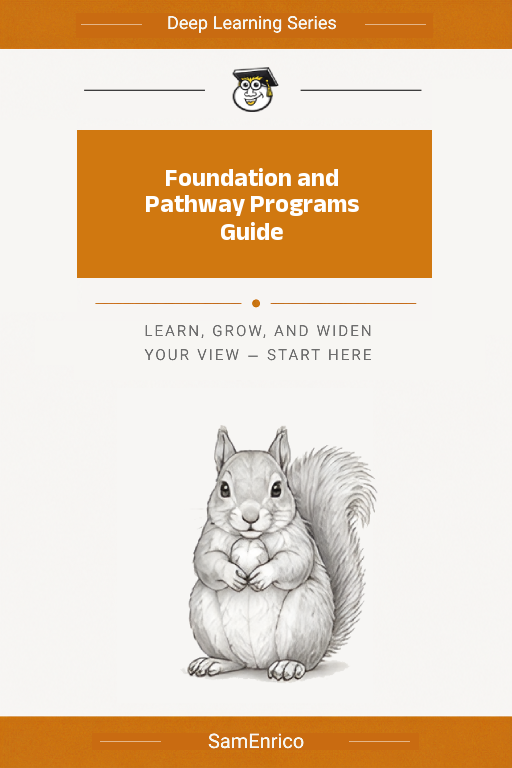
Foundation and Pathway Programs Guide eBook
Access UK foundation years, US community colleges,
Access UK foundation years, US community colleges, and Australian diploma programs for students who don't meet direct entry requirements.
Formats
Free sample
Chapter 1: The Rejection Gift--–- The envelope arrived on a Tuesday. Thin. White. The university logo embossed in the corner like a wax seal on a death warrant. You didn't even need to open it.
The weight told you everything. A thick packet meant congratulations. A single sheet meant something else entirely.You opened it anyway. "We regret to inform you..." The rest blurred into a soup of polite consonants and hollow sympathies. Your parents asked what it said.
You told them. The silence that followed was worse than any shouting.Here is what no one tells you about that moment: it feels like the end of the world, but it is actually the beginning of the only path that was ever going to work for you.This book exists because that statement is true. And because the education industry has spent decades hiding it from you.Every year, 1.2 million international students apply to universities in the United Kingdom, the United States, and Australia. Of those, nearly 400,000 are rejected outright. Another 200,000 receive conditional offers they will never meet because the English score is two points too low or the math grade is one percentage point below the cutoff.
That is more than half a million students standing at the airport gate with no boarding pass.The conventional advice tells you to try harder. Retake the exams. Spend another year in limbo. Pay for more test prep. Apply to lower-ranked universities.
Give up on your dream.The conventional advice is wrong.The students who succeed are not the ones who bang their heads against the same door until it breaks. They are the ones who walk around the building, find the door marked "Pathway," and walk through it smiling.That door leads to a foundation year in the UK. Or a community college in the United States. Or a diploma program in Australia. And here is the secret those institutions do not advertise: students who enter through that door graduate at higher rates, earn better grades in their second and third years, and report lower stress levels than their direct-entry peers.Yes, you read that correctly.
The "second chance" route is actually the strategic advantage route.This chapter will reframe everything you think you know about academic failure, rejection, and the hidden structure of international higher education. By the time you finish, you will understand why a rejection letter might be the best thing that ever happened to you—and how to use it as fuel rather than shame.The Data They Don't Want You to See Let us start with the numbers that pathway providers quietly circulate among themselves and never publish on their front pages.A 2023 study by the UK's Office for Students tracked 45,000 students across 12 universities. The researchers compared two groups: direct-entry students who met the standard A-level or IB requirements, and foundation year students who entered with lower grades but completed a one-year preparatory program. The results were striking. Foundation year students matched direct-entry students in first-year grades.
By second year, they slightly outperformed them. By third year, the gap had widened to a 6 percent advantage in overall degree classification.The same pattern appears in the United States. Research from the Community College Research Center at Columbia University followed 87,000 students who started at community colleges and transferred to four-year universities. Their graduation rates were not lower than native four-year students—they were higher. Transfer students graduated at a rate of 62 percent within six years, compared to 58 percent for students who started as freshmen at the same four-year universities.Australia's Department of Education published similar findings in 2024.
Students who entered bachelor's programs via diploma pathways had a 78 percent retention rate after the first year of university study. Direct-entry students had a 71 percent retention rate.Why does this happen? The reasons are not mysterious. Pathway programs offer smaller class sizes—typically 15 to 25 students versus 100 to 300 in a direct-entry lecture hall. They offer dedicated academic advisors who know your name.
They offer instruction in how to write essays, take notes, and reference sources—skills that direct-entry students are expected to possess but often do not.The pathway student learns how to succeed before they are thrown into the deep end. The direct-entry student learns by drowning.The Shame Paradox If the data is so clear, why do most students avoid pathways? Why do parents recoil when they hear "community college" or "foundation year"? Why do education agents sometimes steer students toward direct entry even when the odds are against them?The answer is shame.Shame is a powerful and destructive emotion. It tells you that you are not good enough.
It whispers that your rejection is a verdict on your worth as a human being. It makes you hide your true situation from friends, family, and even yourself.But shame has a second function that no one talks about. It keeps you from taking smart risks. It makes you choose the path that looks good rather than the path that works. It convinces you that a prestigious failure is better than a humble success.Consider two students.Student A applies directly to a top-50 university in the UK.
Her A-levels are BBC. The university requires ABB. She is rejected. She takes a gap year, retakes two exams, achieves ABB, and enters the university a year late. She struggles in her first semester because she never learned how to write a British academic essay.
She finishes with a lower second-class degree.Student B has the same BBC grades. She enrolls in a foundation year at a different university that has an articulation agreement with her target institution. She spends nine months learning academic writing, British referencing conventions, and seminar participation. She progresses to the same bachelor's degree with a cohort of foundation classmates who become her study group. She finishes with an upper second-class degree.Both students took the same amount of time.
Both paid roughly the same total tuition. But Student B took the path that felt like a step down and ended up a step ahead. Student A took the path that felt like glory and ended up in statistical mediocrity.The shame paradox is this: the path that triggers the most shame in the moment leads to the least shame in the long run. The path that avoids short-term embarrassment guarantees long-term regret.The Three Lies You Have Been Told Before we go further, we need to name the lies that the education industry has sold you. These lies are not malicious.
They are the result of a system designed to prioritize prestige over outcomes. But they are lies nonetheless.Lie Number One: Direct entry is the only "real" way to get a degree.This is nonsense. A bachelor's degree from the University of Manchester does not print the word "foundation" on it. A bachelor's degree from UC Davis does not mention your community college transfer. A bachelor's degree from the University of Melbourne does not say "diploma entry." The final parchment is identical.
No employer has ever asked to see your high school transcripts. No graduate school has ever rejected an applicant because they started at a community college. The only thing that matters is where you…
This is the end of the free sample. Get the eBook to keep going. Buy now
About this book
Details
- Author
- Goldsmith Dung
- Publisher
- SamEnrico
- Language
- English
- Genre
- Non-Fiction, Student's Shortcut
- Released
- 2026-05-29
- Pages (approx.)
- 146
- Available as
- eBook, Audiobook

Read better in the ZLOADR app
Your eBooks on your phone or tablet. Sign in with your SamEnrico account and start reading.
More by Goldsmith Dung
 Design Thinking for Campus PlanningGoldsmith Dung$11.99
 Virtual Whiteboard ToolsGoldsmith Dung$11.99
 Legacy Through MentoringGoldsmith Dung$11.99
 Mining Shift Sleep GuideGoldsmith Dung$11.99
 NVC for Difficult FamilyGoldsmith Dung$11.99
 Debtors Anonymous ExplainedGoldsmith Dung$11.99
 Financial Savings From QuittingGoldsmith Dung$11.99
 Parent Energy ManagementGoldsmith Dung$11.99
 Hakeem the Conqueror: The Rise of a Nigerian NBA LegendGoldsmith Dung$11.99
 Florence's Golden Light: The Inventors Who Lit Up the RenaissanceGoldsmith Dung$11.99
 Service Providers Guide to NephrologyGoldsmith Dung$11.99
 How to Produce Toy InstrumentsGoldsmith Dung$11.99
You may also like
 LSE Online Program LengthAgee Letisha$11.99
 Harvard Extension School for Working AdultsRoush Yer$11.99
 LSE Online Reading ListAshford Ludivina$11.99
 LSE Online Language RequirementsWhitten Daphine$11.99
 LSE Online Class SizeHughey Garret$11.99
 LSE Online Alumni MentorshipWild Lyla$11.99
 London School of Economics Alumni NetworkDutton Chantal$11.99
 Harvard Extension School Student SupportCantrell Christene$11.99
 Harvard Extension School Library AccessSantana Adah$11.99
 Harvard Extension School Degree CompletionBray Wyatt$11.99
 Harvard Extension School Course AuditingAbbott Craig$11.99
 Harvard Extension School Extension DiplomaNew Joane$11.99