
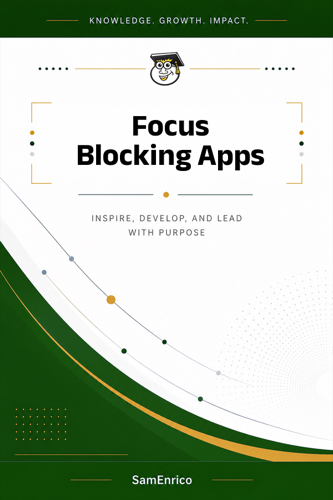
Free sample
Chapter 1: The Billion-Dollar Habit--–- The first time I realized I had a problem, I was sitting on the bathroom floor of my own home, hiding from my children.Not because I was tired. Not because I needed a moment of peace. Because I had been scrolling Twitter for forty-seven minutes while pretending to use the toilet, and I had just watched my three-year-old walk past the crack in the door holding a pair of scissors. I didn't see her in time. My wife did.
The scissors were removed. No one got hurt. But I sat there on the cold tile floor, phone still glowing in my hand, and thought: What the hell is wrong with me?The answer, I would later learn, was nothing. Nothing was wrong with me. Everything was wrong with the trillion-dollar industry that had systematically dismantled my attention span, exploited my brain's most primitive reward circuits, and turned my own psychology into a product to be sold to the highest bidder.This book is the result of that bathroom floor moment.
It is the system I built over three years of research, trial, error, relapse, and eventual recovery. It draws from the ten most influential books on digital minimalism, focus science, and habit design—synthesizing their best insights into a single, actionable 12-week protocol. And it begins with a simple, uncomfortable truth: Your distraction is not your fault. But it is your responsibility.The Confession Every Reader Secretly Shares Let me tell you what you probably won't tell anyone else. Not your spouse.
Not your therapist. Not your closest friend.You check your phone within five minutes of waking up. Sometimes within five seconds. The alarm goes off, your hand reaches out before your eyes are even open, and the first thing you see is not your partner or the morning light or the face of your child. It is a glowing rectangle filled with notifications from people who do not love you, selling things you do not need.You have tried to stop.
You have deleted apps. You have installed focus blockers. You have sworn to yourself that this time will be different. And within a week—sometimes within a day—you are back. Scrolling.
Refreshing. Scrolling again. The apps are reinstalled. The blockers are disabled. The promise is broken.You have told yourself that you lack willpower.
That you are lazy. That you are addicted in a way that normal people are not. You have felt the hot wash of shame when your screen time report arrives on Sunday morning, showing six, seven, eight hours of stare-at-glass time. You have done the math on what you could have accomplished with those hours—the books you could have read, the skills you could have learned, the relationships you could have deepened—and you have felt the quiet despair of watching your life slip through your fingers in fifteen-second increments.Here is what I need you to understand before you read another word of this book:You are not broken. You are normal.
And normal is a crisis.The average smartphone user touches their phone 2,617 times per day. The average person spends 47 seconds on any given screen before shifting their attention. The average knowledge worker loses 2.1 hours of productive focus every single day to digital distractions. And here is the statistic that should terrify you: it takes approximately 25 minutes to return to full cognitive depth after a single interruption. If you check your phone just four times during a four-hour work block, you have effectively zero minutes of deep focus.
You are spinning your wheels, burning mental energy, and producing nothing of value.This is not happening because you are weak. It is happening because you are fighting a system built by the smartest engineers in the world, funded by billions of dollars of venture capital, optimized by thousands of A/B tests, and designed for one purpose: to capture and hold your attention for as long as possible.The Attention Economy: You Are Not the Customer In 1971, the Nobel Prize-winning economist Herbert Simon made a prediction that seemed absurd at the time. He wrote: "In an information-rich world, the wealth of information means a dearth of something else: a scarcity of whatever it is that information consumes. What information consumes is rather obvious: it consumes the attention of its recipients. Hence a wealth of information creates a poverty of attention."Simon was describing a world that did not yet exist.
He was describing now.We live in the attention economy—a marketplace where your focus is the currency, your time is the product, and trillion-dollar companies are the merchants. You are not the customer of Facebook, Instagram, Tik Tok, or You Tube. You are not even the user in the way you think you are. You are the inventory. Your attention is what these companies harvest.
Your clicks, likes, shares, and dwell times are what they package and sell to advertisers. The average tech company makes approximately $200 per user per year in advertising revenue. That is the price of your attention. That is what you are worth to them.This is not a metaphor. This is the literal business model of the modern internet.
Meta (formerly Facebook) made over $113 billion in advertising revenue in 2022. Google made over $224 billion. Together, these two companies alone generate more revenue than the GDP of most countries. And every single dollar of that revenue comes from one thing: your attention.Here is what that means for you, sitting on your couch, phone in hand, scrolling through content you do not remember five minutes later. Every notification, every red dot, every pull-to-refresh, every algorithmically curated feed is not designed to help you.
It is not designed to inform you, connect you, or enrich your life. It is designed to keep you scrolling. The longer you scroll, the more ads you see. The more ads you see, the more money they make. It is that simple.
And it is that insidious.The Three Engineering Tricks That Hijack Your Brain The companies building the platforms you use every day did not stumble into addictiveness by accident. They studied human psychology. They ran thousands of experiments. They hired neuroscientists, behavioral economists, and addiction specialists. And they discovered three specific design mechanisms that reliably defeat human willpower.Trick One: Variable Rewards (The Slot Machine in Your Pocket)In 1948, the psychologist B.F.
Skinner conducted an experiment that would inadvertently explain the architecture of every social media app you use today. Skinner placed a hungry rat in a box with a lever. When the rat pressed the lever, it received a food pellet. The rat learned quickly: lever equals food. But then Skinner changed the rules.
Instead of delivering a pellet every time, he delivered pellets randomly. Sometimes the lever produced food. Sometimes it produced nothing. Sometimes it produced two pellets in a row.The rat went insane. It pressed the lever obsessively.
It pressed the lever thousands of times per hour. It ignored food elsewhere in the box. It pressed until it collapsed from exhaustion.Skinner had discovered variable rewards—the principle that rewards delivered unpredictably are far more compelling than rewards delivered on a fixed…
This is the end of the free sample. Get the eBook to keep going. Buy now
About this book
Details
- Author
- Mackay Chin
- Publisher
- SamEnrico
- Language
- English
- Genre
- Non-Fiction, Self-Help
- Released
- 2026-06-09
- Pages (approx.)
- 154
- Available as
- eBook, Audiobook

Read better in the ZLOADR app
Your eBooks on your phone or tablet. Sign in with your SamEnrico account and start reading.
More by Mackay Chin
 The Nonverbal Stress Signal GuideMackay Chin$11.99
 Mental Health Research EthicsMackay Chin$11.99
 Active Listening For ScrumMackay Chin$11.99
 Wayne Gretzky GreatMackay Chin$11.99
 Bipolar And CreativityMackay Chin$11.99
 Loving Kindness Breath PracticeMackay Chin$11.99
 Joy After Loss WorkbookMackay Chin$11.99
 The Red KettleMackay Chin$11.99
 The Forgotten Reactor: The Secret That Almost Blew Up Los AlamosMackay Chin$11.99
 The Rendlesham Forest Enigma: When the Air Force Met the UnknownMackay Chin$11.99
 The Amber King of the Baltics: How a Brewery Built a DynastyMackay Chin$11.99
 Litigation Defense StrategyMackay Chin$12.99
You may also like
 Workplace Stress MeditationNguyen Lynn$11.99
 Volcano Monitoring ScientistCox Alexis$11.99
 The Tech Professional NetAguiar Nevada$11.99
 The Morning Metta RitualCanales Anya$11.99
 The Chunking Memory TechniqueClanton Hyacinth$11.99
 The Beginner Mistake FixAmmons Cassondra$11.99
 Surrendering to What IsGrimm Reatha$11.99
 Self Hypnosis for Fear of FireBillups Eli$11.99
 Road Rage for Professional DriversBrackett Janise$11.99
 Psychiatric Ward Nurse StressDunning Wyatt$11.99
 Observation vs Evaluation NVCTimmons Alda$11.99
 Networking for Nonprofit ProfessionalsPoole Jesse$11.99