
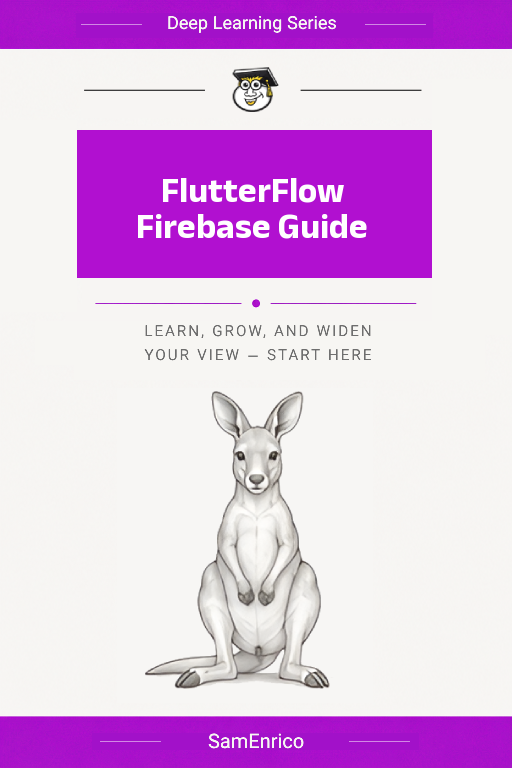
FlutterFlow Firebase Guide eBook
Connect FlutterFlow to Firebase for MVP backend. A
by Lupi Taina
Connect FlutterFlow to Firebase for MVP backend. Authentication, database, and storage.
Formats
Free sample
Chapter 1: The 30-Day Rule--–- In a small coffee shop in Austin, Texas, a first-time founder named Sarah watched her bank account dwindle to $4,000. She had spent the last eight months building a task management app for remote teams—writing every line of backend code by hand, configuring authentication systems, setting up databases, and debugging API connections. Her app worked beautifully. There was only one problem: no one had ever used it. She had built the entire product before showing a single feature to a potential customer.
When she finally launched, she discovered that her target users didn't want half the features she had painstakingly coded. The other half were missing entirely. Eight months. Thirty-two thousand dollars. Zero users.Across town, another founder named Marcus took a radically different approach.
He had an idea for a team collaboration tool, but instead of hiring developers or learning to code a backend from scratch, he opened Flutter Flow, connected it to Firebase, and built a working prototype in seven days. It had login, a task board, and the ability to comment on tasks—nothing more. He put that prototype in front of ten potential customers within two weeks. They ignored half the buttons, struggled with the comment feature, and asked repeatedly for a way to assign tasks to specific people. Marcus listened, added the assignee feature in three days, and launched his MVP to fifty paying customers on day 29.
His app wasn't beautiful. It wasn't feature-complete. But it solved a real problem, and people paid him for it.This book exists because Marcus succeeded and Sarah failed—not because Marcus was smarter or more talented, but because he understood something fundamental about building software products. He understood the 30-Day Rule.The 30-Day Rule That Changes Everything The 30-Day Rule is simple: if you cannot put a working, testable version of your product in front of real users within thirty days, your feature set is too large, your technology stack is too complex, or both. This rule is not arbitrary.
It emerges from a brutal reality that most technical founders learn too late: users cannot tell you what they want until they see what they do not want. Every day you spend building features in isolation is a day you are guessing. And guessing is expensive.Consider what happens after day thirty of development without user feedback. Your codebase has accumulated assumptions. Your database schema has baked in decisions that may be wrong.
You have emotional investment in features that no one asked for. The cost of changing direction grows exponentially with each passing week. After sixty days, pivoting feels like failure. After ninety days, it feels impossible. The 30-Day Rule forces you to stay lean, stay focused, and stay connected to the people who matter: your users.Flutter Flow and Firebase are the technological enablers of the 30-Day Rule.
Together, they compress what used to take months into days or even hours. Flutter Flow replaces the need to write hundreds of lines of UI code by hand. Firebase eliminates the need to provision servers, manage authentication systems, or worry about database scaling. When you combine them, you transform the economics of building software. A feature that might have taken a traditional development team two weeks—user authentication with social login, profile storage, and image uploads—becomes a single afternoon of drag-and-drop configuration.This book will teach you exactly how to achieve that speed without sacrificing quality or creating technical debt that will haunt you later.
But before we open a single tool or write a single line of configuration, we need to understand the landscape. We need to understand why Flutter Flow and Firebase are not just convenient choices but the optimal stack for MVP development. And we need to understand what you are actually building.Why Most MVPs Fail Before They Launch The term "Minimum Viable Product" has been abused so thoroughly that it has nearly lost its meaning. Some people think an MVP is a low-quality product—something buggy and unfinished that you apologize for releasing. Others think an MVP is a feature-reduced version of a larger vision—"We'll build the full app later; this is just the start." Both interpretations are wrong, and both lead to failure.An MVP is the smallest possible product that can complete a meaningful job for a real user and generate validated learning about that user's behavior.
Notice what this definition does not include. It does not include scalability. It does not include polish. It does not include every feature your imagination can conjure. It includes exactly one thing: the ability to test a hypothesis about what users need.Here is where most technical founders go wrong.
They build authentication before they know if anyone will sign up. They build profile pages before they know what information users actually want to share. They build admin dashboards before they have a single active user to administer. They build for scale before they have proven there is a product worth scaling. Each of these decisions adds weeks or months to development time while adding exactly zero validated learning about the core value proposition.The case studies of failed MVPs are remarkably consistent.
A food delivery startup spent three months building a recommendation engine before testing whether users would order food through an app at all. A fitness tracking app built social features, leaderboards, and achievements before verifying that users would log a single workout. A project management tool integrated with Slack, Teams, and email before confirming that teams actually wanted to switch from their existing tools. In every case, the founders mistook activity for progress. They were busy, but they were not learning.Successful MVPs do the opposite.
They start with the riskiest assumption and test it with the smallest possible investment. If you believe teams will use your app to assign tasks to each other, you do not need comments, file attachments, or recurring tasks to test that assumption. You need a list of tasks, an assignee dropdown, and a way for users to mark tasks complete. That is it. Everything else is noise until you prove that the core loop works.The Social Task App you will build throughout this book follows this philosophy precisely.
It has authentication, tasks, assignment, and comments. It does not have file attachments, recurring tasks, notifications, or team dashboards. Those features might come later, but only if real users demonstrate that they need them. By building this specific set of features, you will learn how to use Flutter Flow and Firebase to test any product hypothesis quickly.Introducing Your Guide Through This Book Before we dive into the technical details, let me tell you who I am and why I wrote this book. I have built over twenty MVPs in the last three years using Flutter Flow and Firebase.
Seven of them failed completely—zero users, zero revenue, zero learning beyond "people do not want this." Five of them generated modest revenue but never grew beyond small, loyal user bases. Three of them scaled to thousands of users before I sold them or moved on to other projects. I made every mistake you can imagine. I built features no one…
This is the end of the free sample. Get the eBook to keep going. Buy now
About this book
Details
- Author
- Lupi Taina
- Publisher
- SamEnrico
- Language
- English
- Genre
- Non-Fiction, Startup Guide, No-Code Build
- Released
- 2026-06-01
- Pages (approx.)
- 142
- Available as
- eBook, Audiobook

Read better in the ZLOADR app
Your eBooks on your phone or tablet. Sign in with your SamEnrico account and start reading.
More by Lupi Taina
 Purpose After Loss Grief GuideLupi Taina$11.99
 CrossFit Endurance Training ManualLupi Taina$11.99
 The Car Sightings PuzzleLupi Taina$11.99
 Body Scan for Body DysmorphiaLupi Taina$11.99
 The German Language Proficiency GuideLupi Taina$11.99
 The Sydney Ransomware Scandal: Australia's First Digital Heist (1948)Lupi Taina$11.99
 Machine AssistantLupi Taina$11.99
 Understanding Vasquez–hurst–sotos SyndromeLupi Taina$17.99
 Ultimate Handbook Guide to Birmingham : (United Kingdom) Travel GuideLupi Taina$11.99
You may also like
 Bubble URL Parameters GuideTierney Tatiana$12.99
 FlutterFlow vs Native DevColby Bo$12.99
 FlutterFlow Version ControlMorehead Macie$12.99
 FlutterFlow UI Design GuideFelton Zulema$12.99
 FlutterFlow Template GuideLafleur Chanel$12.99
 FlutterFlow Scaling GuideChapa Farah$12.99
 FlutterFlow Push NotificationsBenevides Liliana$12.99
 FlutterFlow Payment GuideMidkiff Deetta$12.99
 FlutterFlow MVP Development GuideNesmith Rebekah$12.99
 FlutterFlow Custom CodeWhitner Kasha$12.99
 FlutterFlow Cost GuideSweeney Brynn$12.99
 FlutterFlow CollaborationHager Temeka$12.99