
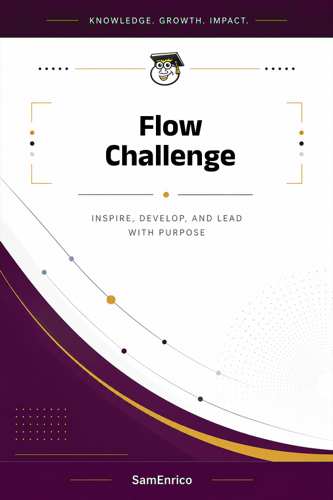
Flow Challenge eBook
Thirty days to build flow state habits.
Thirty days to build flow state habits.
Formats
Free sample
Chapter 1: The 80-Switch Hour...--The notification arrives at 9:17 AM. You don't remember picking up the phone. Your hand just moved. You read the message, swipe it away, and return to your screen. Forty-seven seconds pass.
Another notification. Another swipe. Another return. By 10:00 AM, you have switched tasks twenty-three times. By lunch, forty-eight times.
By the time you collapse into bed at night, exhausted but strangely unfulfilled, you have fractured your attention into more than eighty separate fragments. And you have no idea why you feel so fried.This is not a moral failure. It is not a lack of discipline. It is not a sign that you are lazy, stupid, or broken. It is the natural result of living inside a system that was designed—engineered, tested, and optimized—to do one thing: steal your attention.
The social media companies, the email platforms, the endless notifications, the blinking dots, the unread counts, the infinite scrolls. These are not neutral tools. They are slot machines wired into your pocket. And they are winning.But here is the truth that no one tells you: the opposite of addiction is not sobriety. It is flow.
And flow is not some mystical state reserved for monks, athletes, or geniuses. It is a biological fact. A neurological reality. A trainable skill. And you are about to learn how to access it, sustain it, and make it the default setting of your life.Welcome to the Flow Challenge.
Over the next thirty days, you will rewire your brain for peak performance. You will learn why you feel constantly distracted, how to measure the true cost of your fragmentation, and what to do about it. But first, you need to know where you stand. Because you cannot fix what you cannot measure.The Signal and the Noise Imagine you are standing in a crowded room. One hundred people are talking at once.
Someone across the room is trying to tell you your flight is boarding. Can you hear them? Of course not. That is noise. Now imagine the same room falls silent.
One person speaks. You hear every word. That is signal.Your brain operates exactly the same way. Every day, trillions of bits of information enter your senses. Your brain cannot process all of it.
So it filters. It prioritizes. It decides what matters and what does not. This filtering system is called attention, and it is the single most valuable resource you own. Not time.
Not money. Attention. Because attention is the currency of consciousness. Where you direct your attention, you direct your life.The problem is that modern life has turned the volume of noise up to eleven. Your phone buzzes.
Your email chimes. Slack pings. Twitter trends. Instagram stories. News alerts.
Calendar reminders. Group texts. Each one of these notifications is a tiny siren, screaming for your attention. And your brain, which evolved to notice novel stimuli because novel stimuli might be a predator or a food source, cannot help itself. It turns toward the siren.
Every single time.This is not a bug in your brain. It is a feature. But it is a feature that has been hijacked.The concept of "signal versus noise" comes from information theory, but it applies directly to your daily experience. Signal is any information that moves you toward a goal you actually care about. Noise is everything else.
Checking your email for a message from your boss about a project deadline? Signal. Checking your email because the little red badge is glowing? Noise. Reading a book to learn a skill?
Signal. Opening the same book, reading two paragraphs, and checking your phone? Noise interrupted by noise.The first step of the Flow Challenge is learning to distinguish between the two. Most people cannot. They mistake the frantic activity of task-switching for productivity.
They confuse the dopamine hit of a notification with the satisfaction of real progress. They end their days exhausted, having spent eight hours at their desks, and realize they cannot remember a single original thought they had. Because they didn't have any. They were not working. They were being worked.The Neuroscience of Fragmentation Let us get specific about what happens inside your skull every time you switch tasks.Your brain is not a computer.
It does not multitask. It cannot. What feels like multitasking is actually rapid task-switching, and each switch comes with a cost. When you are focused on a single task, your brain enters a state of sustained attention. Neural networks fire in coordinated patterns.
Working memory holds relevant information. The prefrontal cortex—the executive center of your brain—maintains goal-directed behavior. This is efficient. This is powerful. This is flow-adjacent.But when a notification arrives, your brain faces a choice.
Ignore it (hard) or attend to it (easy). Most of the time, it chooses easy. The act of switching triggers a cascade of neurological events. First, the orienting response: your brain pauses its current processing to assess the new stimulus. This takes about one-tenth of a second.
Then, if you decide to engage with the new task, your brain must disengage from the old one. This is called "goal shifting." Finally, your brain must activate the rules and information for the new task. This is called "rule activation." The entire process takes anywhere from a few tenths of a second to several seconds, depending on the complexity of the tasks involved.That does not sound like much. But here is the kicker: when you switch back to the original task, you do not return to where you left off. Your brain must reload the context, the goals, the relevant information, and the procedural rules.
This is called "switching cost," and it accumulates. Researchers at the University of California, Irvine, found that after a single interruption—even a brief one—it takes an average of twenty-three minutes to return to the original task with the same depth of focus. Twenty-three minutes. For one interruption.Now multiply that by the average number of times a knowledge worker checks their phone, email, or Slack in a single day. The estimates vary, but most studies converge on a number between eighty and one hundred twenty task-switches per day.
Do the math. If each interruption costs you even five minutes of recovery time, you have lost an entire workday before lunch. If the true cost is closer to twenty-three minutes, you have lost the week.This is not speculation. This is neuroscience. And it explains why you feel fried.The Distraction Log: Your First Challenge Day 1 of the Flow Challenge has only one requirement.
You do not need to change your behavior. You do not need to put your phone away. You do not need to stop checking email. You do not need to be productive. You only need to do one thing: track.Your task is to keep a Distraction Log for twenty-four hours.
Every single time you switch tasks—intentionally or unintentionally, voluntarily or involuntarily—you will make a tally mark. That is it. No judgment. No shame. Just data.You can use any method that works for you.
A small notebook in your pocket. A note on your phone (ironic, but acceptable for today only). A piece of…
This is the end of the free sample. Get the eBook to keep going. Buy now
About this book
Details
- Author
- Ouellette Harriette
- Publisher
- SamEnrico
- Language
- English
- Genre
- Non-Fiction, Self-Help, 30 Day
- Released
- 2026-06-09
- Pages (approx.)
- 147
- Available as
- eBook, Audiobook

Read better in the ZLOADR app
Your eBooks on your phone or tablet. Sign in with your SamEnrico account and start reading.
More by Ouellette Harriette
 Shame Cycle in Binge EatingOuellette Harriette$11.99
 Async Communication PrimerOuellette Harriette$11.99
 The Redemption Rights DatabaseOuellette Harriette$11.99
 Autism Partnership Stress GuideOuellette Harriette$11.99
 Bear Necessities: The Great San Francisco Zoo Breakout of 1906Ouellette Harriette$11.99
 Understanding Wellesley–carmen–French SyndromeOuellette Harriette$17.99
 ARIPO Common MistakesOuellette Harriette$12.99
 Ghana Internet for StartupsOuellette Harriette$12.99
 System AnalystOuellette Harriette$11.99
 10 Ways to Use Filfel Chuma (Recipe Book)Ouellette Harriette$11.99
You may also like
 Workplace Esteem ChallengeRife Lolita$11.99
 Jealousy ChallengeMcdougal Caprice$11.99
 Sleep Meditation ChallengeGarrison Florinda$11.99
 Purpose Challenge GuideWhittaker Luis$11.99
 Personal Ing For Success ChallengeCulver Larisa$11.99
 Creative Block ChallengeAnaya Caroyln$11.99
 Affirmation ChallengeMelvin Dorris$11.99
 Loneliness ChallengeDick Kasie$11.99
 Post Hypnotic ChallengeMcreynolds Rhiannon$11.99
 Divorce ChallengeRoby Mia$11.99
 Sleep Memory Improvement PlanHillman Zetta$11.99
 Improv ChallengeSchell Dusty$11.99