
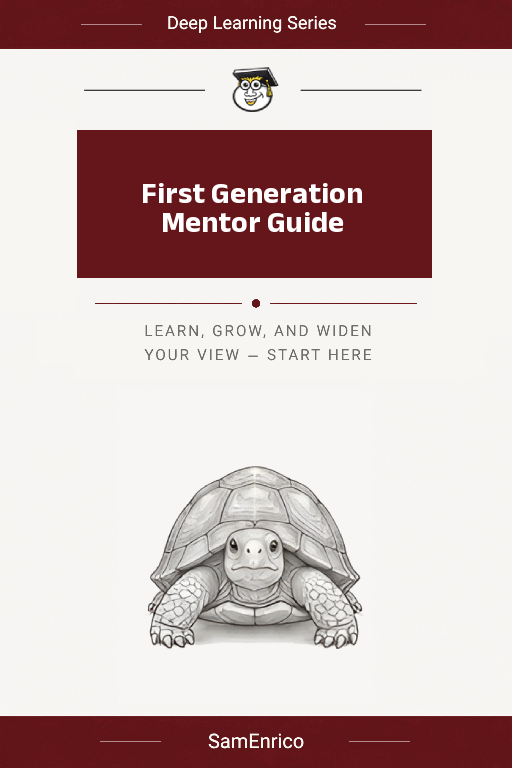
Non-FictionFirst 30 DaysFirst Generation
First Generation Mentor Guide eBook
Find mentors who understand first-generation profe
by Lowman Marth
Find mentors who understand first-generation professional challenges. Navigate workplace norms and unspoken rules.
Formats
Free sample
Chapter 1: The Blue Square...--You cannot see what you have no word for.This is not a metaphor. It is a finding from cognitive science, and it is the single most important fact that first-generation professionals never learn until it is too late. In the Himba tribe of northern Namibia, researchers conducted a simple experiment. They showed tribe members a circle of eleven green squares and one blue square. The blue square was obvious to Western eyes—a stark, unmistakable difference.
But the Himba could not pick it out. They hesitated. They guessed. They saw all twelve squares as green.Why? Because the Himba language has no distinct word for blue.
Their language carves the color spectrum differently. Without the word, the brain literally does not instruct the eye to see the difference.Now replace the blue square with your first day at a white-collar job.You walk into an office. Everyone is wearing business casual—but not the kind you read about online. The men wear quarter-zip pullovers over collared shirts. The women wear blouses with a specific kind of collar that you cannot name.
Someone makes a joke about a "Q3 deliverable," and everyone laughs. You do not laugh because you do not know what is funny. You nod. You smile. You feel the ground shift beneath your feet.You are looking at a blue square.
You call it green.This chapter is about why you feel lost even when you are competent. It is about the gap between hard work and recognition, between effort and belonging. And it introduces the framework that will guide this entire book: the 3C Framework of Competence, Commitment, and Compatibility. Most first-generation professionals (FGPs) obsess over the first two. The third—Compatibility—is where careers go to die.The Invisible Backpack Let us start with a story.Maria was the first person in her family to graduate from college.
She worked two jobs through school. She graduated with honors. She landed a role at a Fortune 500 company in their supply chain division. She arrived on day one with a new suit from an outlet mall, a notebook, and a plan: work harder than everyone else.Within three months, Maria was miserable.Her performance metrics were fine. Her manager gave her average ratings—not bad, not great.
But she could not shake the feeling that she was invisible. In meetings, her ideas were ignored. Then a colleague would say the same thing five minutes later, and everyone would nod. She stopped speaking up. She started eating lunch at her desk.
She began to wonder if she was cut out for this world.Maria is not a failure. Maria is a first-generation professional who did not know about the invisible backpack.The concept comes from privilege studies, but we are going to use it differently here. Picture two people walking into the same office on the same first day. One carries a visible backpack filled with credentials, skills, and work ethic. The other carries an invisible backpack filled with things no one ever tells you: how to write an email to a senior vice president, what to say in the elevator, how to recover when you use the wrong fork at a team dinner, whether to ask questions in a meeting or wait for the one-on-one.The first backpack gets you hired.
The second backpack gets you promoted.Maria had the first backpack. She did not know the second one existed until she was already drowning.The Bootstrap Myth American culture loves the bootstrap myth. Pull yourself up by your own bootstraps. Work hard. Keep your head down.
Merit will out. The problem is that the bootstrap myth was originally a joke. It comes from the impossible act of lifting yourself by your own shoelaces. It was meant to be absurd. Somehow, it became a national creed.For first-generation professionals, the bootstrap myth is actively dangerous.Here is why: hard work is necessary but not sufficient.
You can outwork everyone in your department and still stall at senior associate. You can stay late every night and still be passed over for the high-visibility project. You can know every technical detail of your job and still be told you are "not a culture fit."The bootstrap myth convinces you that if you just try harder, the problem will solve itself. But the problem is not effort. The problem is that you are trying to navigate a system whose rules were never written down for you.Consider the difference between explicit knowledge and tacit knowledge.
Explicit knowledge is what is in the employee handbook: your start time, your vacation policy, the reporting structure. Tacit knowledge is everything else: who actually has power, how to disagree with your boss, when to volunteer for a project and when to hide, what kind of humor is acceptable, how to dress for the client visit versus the internal offsite.Privileged peers absorb tacit knowledge over dinner tables, internships, and family networks. They do not even know they have it. They call it common sense. You call it a mystery.The 3C Framework: Competence, Commitment, Compatibility To understand where FGPs struggle, we need a framework that separates different kinds of workplace value.
The 3C Framework does exactly that.C1: Competence – Can you do the job?Competence is what you were hired for. It includes technical skills, domain knowledge, problem-solving ability, and raw intelligence. This is the easiest C to measure. It is on your resume. It is in your performance reviews.
Most FGPs are highly competent. They had to be. There was no safety net.But here is the trap: FGPs often assume that Competence is 90 percent of success. In reality, Competence is the entry ticket. Once you clear a minimum threshold, additional Competence yields diminishing returns.C2: Commitment – Will you do the job?Commitment is work ethic.
It is showing up on time, staying late when needed, meeting deadlines, and caring about the outcome. FGPs typically excel at Commitment as well. You did not get here by being lazy. You got here by grinding.But Commitment without visibility is invisible. You can work 60 hours a week in a back office, and no one will know your name.
Commitment must be channeled into the right tasks at the right time.C3: Compatibility – Do I want to work with you?This is the silent killer. Compatibility is the set of social signals that tell others whether you belong, whether you are safe, whether you are worth investing in. It includes:– Small talk: Do you know how to chat about weekend plans without oversharing or clamming up?– Humor: Do you laugh at the right jokes? Do you know what is off-limits?– Deference rituals: Do you know how to disagree with a senior person without seeming insubordinate?– Dress and grooming: Do you look like you belong in this room?– Recovery from mistakes: When you mess up, do you apologize correctly or make it worse?– Email and chat etiquette: Do you use the right salutations? Do you reply within the right window?– Meeting behavior: Do you speak at the right volume?
Do you interrupt? Do you wait to be called on?Here is the brutal truth: most FGPs fail on Compatibility first.…
This is the end of the free sample. Get the eBook to keep going. Buy now
About this book
Details
- Author
- Lowman Marth
- Publisher
- SamEnrico
- Language
- English
- Genre
- Non-Fiction, First 30 Days, First Generation
- Released
- 2026-06-01
- Pages (approx.)
- 149
- Available as
- eBook, Audiobook

Read better in the ZLOADR app
Your eBooks on your phone or tablet. Sign in with your SamEnrico account and start reading.
More by Lowman Marth
 Spaced Repetition with LociLowman Marth$11.99
 Stress And Pelvic Pain GuideLowman Marth$11.99
 Cloud Computing Investment OutlookLowman Marth$11.99
 Trauma Response in TeensLowman Marth$11.99
 Remote Review PIP TemplateLowman Marth$11.99
 The Silk Road Phantom: The Untold Story of the Dark Web's First Drug KingpinLowman Marth$11.99
 Estate PlanningLowman Marth$11.99
 Automotive ESG Performance GuideLowman Marth$12.99
 Understanding Paramyotonia Congenita of Von EulenburgLowman Marth$17.99
 How to Start a Paint (not Cement Based) Business (Beginners Guide)Lowman Marth$11.99
You may also like
 Hong Kong Handover 1997Dunn Johnnie$11.99
 Zumba For Postnatal Recovery CourseNeal Christian$11.99
 Zumba for BeginnersLadner Nikia$11.99
 YouTube Comment Mining GuideHumes Pandora$12.99
 Worry Box MeditationCarlin Rudy$11.99
 Workplace Stress MeditationNguyen Lynn$11.99
 Workplace Stress and Sleep RepairHawley Ivory$11.99
 Workplace Perfectionism CureDelaney Jeffry$11.99
 Workplace Injustice Anger GuideWallen Isabelle$11.99
 Work Addiction and Burnout LinkGreenwood Ester$11.99
 Women in Yoga and WellnessBeattie Galina$11.99
 Women in Stand Up ComedyChun Evangeline$11.99