
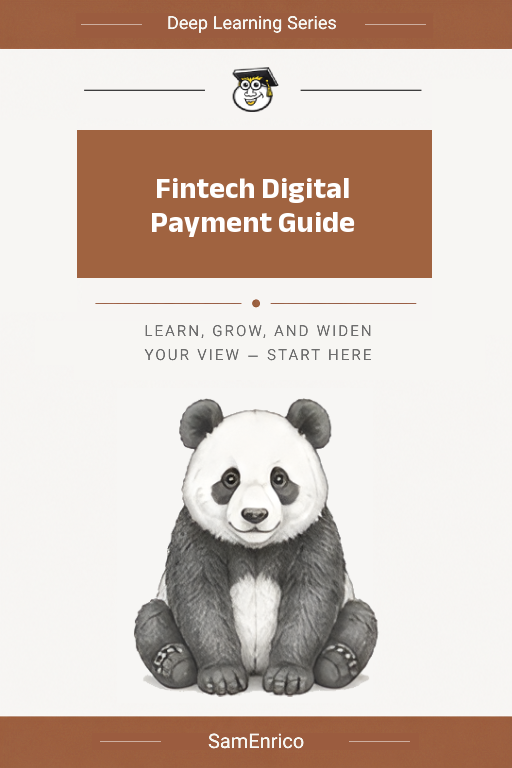
Non-FictionForecast & OutlookFintech LatAm
Fintech Digital Payment Guide eBook
Discover Pix in Brazil, CoDi in Mexico, and digita
Discover Pix in Brazil, CoDi in Mexico, and digital wallet adoption across unbanked populations.
Formats
Free sample
Chapter 1: The Cash Mirage--–- In April 2023, a 47-year-old street vendor named Maria da Silva stood behind her small wooden cart in the São Paulo neighborhood of Pinheiros, selling homemade cheese bread and fresh coconut water. She had operated this cart for eleven years, and for eleven years, she had started each day with the same ritual: a trip to the bank branch three blocks away, waiting in line for forty-five minutes, and withdrawing exactly 200 Brazilian reais (about $40) in small bills and coins. She needed the cash to make change for customers, to pay her flour supplier who only accepted cash, and to save for her daughter's school supplies, which she kept in a metal lockbox hidden under her bed. Cash was not just money to Maria. Cash was survival.
Cash was trust. Cash was the only financial instrument she had ever truly understood.On that April morning, however, something unusual happened. Her eighteen-year-old daughter, Beatriz, who was home from university for the weekend, walked with her to the cart. Beatriz pulled out her smartphone, opened a bright green banking app, and pointed it at a black-and-white square printed on a laminated card hanging from the cart's canopy. "Mãe, watch this," she said.
A customer who had just bought two cheese breads scanned the square with his own phone. Within two seconds, Beatriz's phone chirped. She turned the screen toward Maria: "R8,00received.Balance:R 8,00 received. Balance: R8,00received.Balance:R 47,50." Maria stared at the screen as if it were a magic trick. "Where is the money?" she asked.
"It's in the app, Mãe. In the Pix account." Maria reached out and touched the screen, as if expecting to feel paper. "But where is it really?" Beatriz laughed. "It's everywhere, Mãe. It's nowhere.
It's just... true."That moment—a street vendor touching a smartphone screen in confusion, a daughter trying to explain that eight reais had just traveled through the Central Bank of Brazil's payment system, settled in seconds, and become irrevocable without a single physical object changing hands—captures the essence of the invisible revolution. Maria had just participated in a transaction that would have been technologically impossible five years earlier, economically impractical for a vendor of her size three years earlier, and culturally unthinkable to her two years earlier. Yet there she stood, watching her daughter print a new QR code for the cart, already planning to stop her morning bank trips entirely by the end of the month.Maria's confusion was not ignorance. It was a perfectly rational response to a profound shift in the nature of money itself.
For five thousand years—since the first clay tokens were used in Mesopotamia to represent grain deliveries—money had been a physical object or a direct representation of a physical object. Coins, paper notes, even the cowrie shells used in ancient China: all were tangible. You could hold them. You could hide them. You could burn them, lose them, or have them stolen.
But you could never, ever wonder "where" they were. They were either in your hand or they were not. Digital payments changed this fundamental ontology of value. When money becomes a series of bits updated on a centralized ledger, it exists nowhere and everywhere simultaneously. It is, as Beatriz said, "just true." And that truth is maintained not by gold reserves or bank vaults but by cryptography, consensus protocols, and the collective trust of millions of users and dozens of financial institutions operating under a common set of rules.This chapter is about that shift—not as an abstract technological trend, but as a lived reality for billions of people who, like Maria, are waking up to find that the financial world they understood has been replaced by something faster, cheaper, and completely invisible.
It is about why digital payments have become the essential infrastructure of the twenty-first-century economy, why the COVID-19 pandemic compressed a decade of adoption into eighteen months, and why the future of finance is not merely digital-first but, for the majority of the global population, mobile-only. But it is also about what this shift is not. It is not the death of cash, despite what breathless headlines proclaim. Cash is not dying; it is retreating. It is not becoming obsolete; it is becoming specialized.
Understanding the difference between cash as a daily transaction tool and cash as a store of value is the first and most important distinction this book will draw—and it is a distinction that nearly every popular account of digital payments gets wrong.The Great Distinction: Spending Cash vs. Hoarding Cash Let us begin by clearing away the most persistent misconception in fintech journalism. If you search the phrase "cash is dying" in Google News, you will receive more than 1,500 results from the past year alone. Headlines from reputable publications announce "The War on Cash," "The Cashless Society is Coming," and "Why the Penny, Nickel, and Dime Are Headed for Extinction." These headlines are not entirely wrong, but they are misleading in a way that matters for anyone trying to build, invest in, or regulate digital payment systems. The truth is more nuanced, and the nuance matters because it tells us where the real opportunities lie.The correct distinction is between cash used for daily transactions (buying coffee, paying a street vendor, tipping a delivery driver) and cash held as a store of value (money stuffed in a mattress, hidden in a safe, or kept in a jar for emergencies).
These two uses of cash are behaviorally distinct, economically different, and moving in opposite directions.Consider the data on daily transaction cash. In the United States, the share of in-person payments made with cash fell from 32% in 2016 to 18% in 2022, according to the Federal Reserve's Diary of Consumer Payment Choice. In Sweden, cash now accounts for less than 10% of all retail transactions. In Brazil, Pix alone now processes more daily transactions than the entire cash economy for purchases under 100 reais (about $20). The number of ATMs worldwide peaked in 2019 and has declined every year since, with the steepest drops in precisely the countries that have adopted instant payment systems most rapidly.
The COVID-19 pandemic accelerated this trend dramatically: between March 2020 and March 2021, cash usage for in-person transactions fell by 40% in the United Kingdom, 35% in Canada, and 30% in Australia, according to a Bank for International Settlements working paper. Merchants who had resisted digital payments for years installed QR code readers because customers stopped carrying cash. Street vendors who had never accepted cards began accepting Pix because the alternative was losing sales entirely.Now consider the data on cash hoarding. Despite the decline in cash usage, the total value of physical currency in circulation has increased in almost every major economy over the same period. The U.S.
dollar has more than 2.2trillioninphysicalcurrencyoutstanding,upfrom2.2 trillion in physical currency outstanding, up from 2.2trillioninphysicalcurrencyoutstanding,upfrom1.5 trillion in 2015. The euro has 1.5 trillion euros in circulation, an all-time high. The Swiss franc, Japanese yen, and British pound all show similar patterns. Where is all this cash going? It is not being spent.
It is being hoarded. The Federal Reserve estimates that somewhere between 60% and 80% of all U.S. currency is held…
This is the end of the free sample. Get the eBook to keep going. Buy now
About this book
Details
- Author
- Rosales Walker
- Publisher
- SamEnrico
- Language
- English
- Genre
- Non-Fiction, Forecast & Outlook, Fintech LatAm
- Released
- 2026-05-30
- Pages (approx.)
- 145
- Available as
- eBook, Audiobook

Read better in the ZLOADR app
Your eBooks on your phone or tablet. Sign in with your SamEnrico account and start reading.
More by Rosales Walker
 Silent Anxiety DischargeRosales Walker$11.99
 Fiverr Order Completion RateRosales Walker$11.99
 Breath Awareness For ProcrastinationRosales Walker$11.99
 The Breath and RelationshipsRosales Walker$11.99
 The Geo Arbitrage VPN Security PrimerRosales Walker$11.99
 The Last Voyage of the SS Great Britain: A Ship That Defied the DeepRosales Walker$11.99
 How to Become a Laser-beam-trim OperatorRosales Walker$11.99
 Understanding Lupus Anticoagulant, FamilialRosales Walker$17.99
 Haggertyite MiningRosales Walker$11.99
 Executive Summary Problem StatementRosales Walker$12.99
You may also like
 Hong Kong Handover 1997Dunn Johnnie$11.99
 Zumba For Postnatal Recovery CourseNeal Christian$11.99
 Zumba for BeginnersLadner Nikia$11.99
 YouTube Comment Mining GuideHumes Pandora$12.99
 Worry Box MeditationCarlin Rudy$11.99
 Workplace Stress MeditationNguyen Lynn$11.99
 Workplace Stress and Sleep RepairHawley Ivory$11.99
 Workplace Perfectionism CureDelaney Jeffry$11.99
 Workplace Injustice Anger GuideWallen Isabelle$11.99
 Work Addiction and Burnout LinkGreenwood Ester$11.99
 Women in Yoga and WellnessBeattie Galina$11.99
 Women in Stand Up ComedyChun Evangeline$11.99