
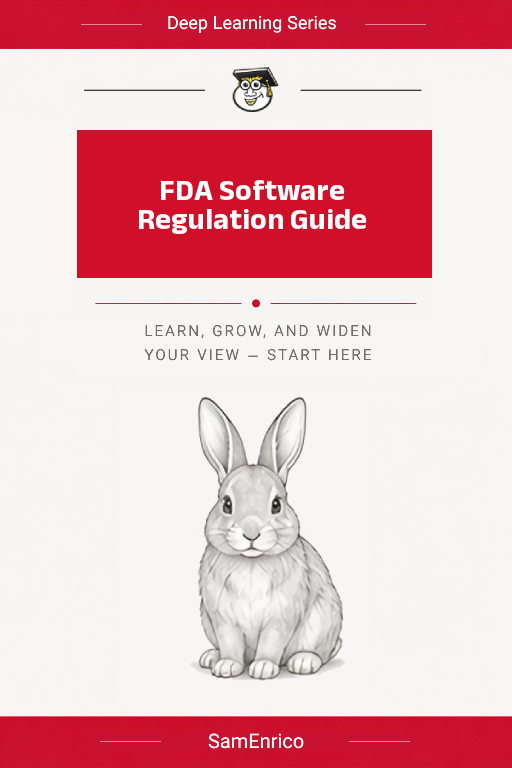
Non-FictionAnnual CheckupHealthtechFDA
FDA Software Regulation Guide eBook
Determine if your healthtech software requires FDA
Determine if your healthtech software requires FDA clearance including SaMD classification and premarket submission paths.
Formats
Free sample
Chapter 1: The Half-Million Dollar Sentence--–- The email arrived at 11:47 AM on a Tuesday. The founder, a former emergency medicine physician turned entrepreneur, had just finished a celebratory lunch with his team of eight. Their mobile app—a sleek, AI-powered tool that analyzed smartphone camera images of skin lesions—had crossed fifty thousand downloads the previous night. Investors were circling. A Series A term sheet sat in his inbox.
Then he opened the email. It was from the FDA’s Center for Devices and Radiological Health. Subject line: "RE: Classification Determination for Derm AI." The body was four paragraphs long. The last paragraph contained the sentence that would change everything: "Based on the intended use described in your marketing materials, Derm AI meets the definition of a medical device under section 201(h) of the Federal Food, Drug, and Cosmetic Act. Any further distribution without premarket clearance or approval constitutes a violation of the law."The founder stared at the screen.
Fifty thousand downloads. Eight employees. A term sheet. And now, the realization that his software required a 510(k)—a process that would take eight months and cost roughly four hundred thousand dollars in consulting, testing, and submission fees. He had not budgeted for this.
He had not planned for this. He had assumed, like so many before him, that software was different. That regulation applied to "real" medical devices—hardware, implants, scalpels. Not to lines of code. He was wrong.
And by the time he finished reading that email, his company was, for all practical purposes, dead. It just didn't know it yet.This chapter is about ensuring you never receive that email. It is about understanding when software becomes a medical device, why the rules exist, and how to recognize—early, cheaply, and accurately—whether your product requires FDA clearance. The half-million dollar sentence is not a hypothetical. It is a regulatory reality that has destroyed dozens of promising healthtech startups.
But it is also entirely avoidable. By the end of this chapter, you will know exactly what questions to ask, which exclusions might save you, and why the traditional software development mindset is the single greatest threat to your regulatory future.The Fundamental Incompatibility: Move Fast and Break Patients Silicon Valley runs on a simple, powerful mantra: move fast and break things. Iterate. Deploy continuously. Fail fast, learn faster.
These principles have produced trillion-dollar companies, transformed entire industries, and created software that improves billions of lives. They are, for most applications, virtuous and effective. But they are, for medical devices, catastrophically wrong.The difference is not philosophical. It is physical. When a social media app breaks, users see an error message or lose a photo.
When a consumer website deploys a bug, shopping carts empty or pages fail to load. When a ride-sharing app fails, a driver might not show up. Annoying, yes. Harmful, occasionally. But rarely life-threatening.
When a medical device fails—when an insulin pump delivers the wrong dose, when an ECG algorithm misclassifies a lethal arrhythmia as normal, when a sepsis prediction model overlooks a patient crashing in the ICU—people die. Not metaphorically. Not in a product roadmap sense. Actually, irreversibly, families-getting-phone-calls-at-3-AM die.This is not hyperbole. In 2019, a faulty software update in a widely used infusion pump caused a series of over-infusion events that led to patient injuries and at least one reported death.
In 2020, a machine learning algorithm used to prioritize radiology reads was found to systematically deprioritize patients based on their insurance status—not because the algorithm was malicious, but because the training data reflected real-world disparities. In 2022, a cybersecurity vulnerability in a cloud-connected pacemaker programmer allowed researchers to theoretically modify patient therapy settings remotely. No one died in that specific case, but the vulnerability existed in the field for eighteen months before discovery.These failures share a common root cause: software was developed using traditional, fast-iteration practices without the guardrails of medical device regulation. Teams moved fast. They broke things.
And when those things broke, patients were harmed. The FDA's regulatory framework exists not to slow innovation, but to prevent this specific pattern of harm. It is not bureaucracy for bureaucracy's sake. It is a set of evidence-based requirements designed to ensure that when software makes a claim about health, that claim is backed by objective evidence. The half-million dollar sentence is not a punishment.
It is the cost of having skipped the line.The Landscape: Where Software Is Today in Healthcare Before diving into regulations, it is worth understanding just how pervasive software has become in modern healthcare. The shift is staggering. In 2010, the FDA cleared approximately fifty software-based medical devices per year. By 2023, that number exceeded five hundred. The agency has now cleared or approved more than two hundred AI/ML-enabled devices, with the vast majority coming to market in the last four years.
These are not experimental toys. They are real, clinical tools used in hospitals, clinics, and patients' homes every single day.Consider what software now does. AI algorithms detect diabetic retinopathy from retinal photographs with accuracy matching fellowship-trained ophthalmologists. Mobile apps capture high-quality ECGs using nothing but two fingers on a smartphone. Cloud-based clinical decision support systems analyze sepsis risk in real time, alerting nurses before a patient's condition deteriorates.
Surgical robots translate a surgeon's hand movements into microscopic precision, filtering out tremors and scaling motion. At-home monitoring devices collect continuous glucose data, automatically adjusting insulin delivery through closed-loop systems once called "artificial pancreases."Each of these innovations required FDA clearance or approval. Each underwent design controls, verification, validation, risk management, and premarket review. Each proved, through objective evidence, that its benefits outweighed its risks. And each took longer to reach market than its founders initially hoped.
This is the trade-off. Regulation slows the path to market in exchange for confidence that the product will not kill patients. There is no shortcut around this trade-off. There is only the choice of whether to accept it or pretend it does not apply to you. The founders who received that Tuesday morning email had tried the second option.
It did not work.The Terminology That Will Save Your Career The FDA uses precise, specific language to describe software's role in medicine. Understanding these terms is not academic pedantry. It is the difference between correctly identifying your regulatory status and making a half-million-dollar mistake. Four terms matter most.Device Software Functions (DSF) is the broadest category. It refers to any software function that is intended for use in the diagnosis, cure, mitigation, treatment, or prevention of disease, or that is intended to affect the structure or function of the body.
If software is intended for a medical purpose, it contains Device Software Functions. This includes both software that runs on dedicated medical hardware and software that runs on general-purpose computing platforms like smartphones, tablets, or laptops. The platform does not matter. The intended use does. A heart rate display on a smartwatch intended for wellness tracking is not a DSF.
The same heart rate display on a smartwatch intended to diagnose atrial fibrillation is absolutely a DSF. The code can be identical. The label changes everything.Software in a Medical Device (Si MD) refers to software that is…
This is the end of the free sample. Get the eBook to keep going. Buy now
About this book
Details
- Author
- Shaffer Ressie
- Publisher
- SamEnrico
- Language
- English
- Genre
- Non-Fiction, Annual Checkup, Healthtech, FDA
- Released
- 2026-06-01
- Pages (approx.)
- 141
- Available as
- eBook, Audiobook

Read better in the ZLOADR app
Your eBooks on your phone or tablet. Sign in with your SamEnrico account and start reading.
More by Shaffer Ressie
 Metta for Healthcare Workers GuideShaffer Ressie$11.99
 Social Connection Longevity PlanShaffer Ressie$11.99
 Recovery Sponsee GuideShaffer Ressie$11.99
 Self Talk Rewiring GuideShaffer Ressie$11.99
 Beginner Mindfulness for Cancer PatientsShaffer Ressie$11.99
 The Great Chocolate Heist: How a Kid Outsmarted the WorldShaffer Ressie$11.99
 How to Become a Die-drawing CheckerShaffer Ressie$11.99
 Maintenance AttendantShaffer Ressie$11.99
 Türkiye Scholarships GuideShaffer Ressie$12.99
 Understanding Degos DiseaseShaffer Ressie$17.99
You may also like
 Hong Kong Handover 1997Dunn Johnnie$11.99
 Zumba For Postnatal Recovery CourseNeal Christian$11.99
 Zumba for BeginnersLadner Nikia$11.99
 YouTube Comment Mining GuideHumes Pandora$12.99
 Worry Box MeditationCarlin Rudy$11.99
 Workplace Stress MeditationNguyen Lynn$11.99
 Workplace Stress and Sleep RepairHawley Ivory$11.99
 Workplace Perfectionism CureDelaney Jeffry$11.99
 Workplace Injustice Anger GuideWallen Isabelle$11.99
 Work Addiction and Burnout LinkGreenwood Ester$11.99
 Women in Yoga and WellnessBeattie Galina$11.99
 Women in Stand Up ComedyChun Evangeline$11.99