
Non-FictionCompliance & Risk ArchiveCompliance Gaps
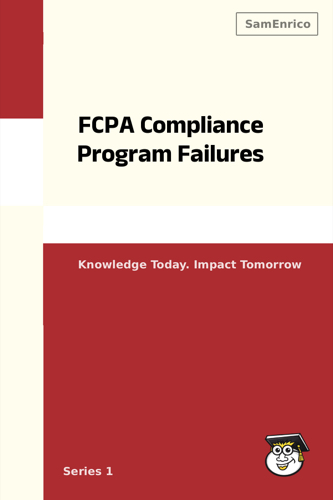
FCPA Compliance Program Failures eBook
Analyzes enforcement resulting from inadequate cor
Analyzes enforcement resulting from inadequate corporate compliance systems.
Formats
Free sample
Chapter 1: The 200-Page Lie--The general counsel of a Fortune 500 company sat across a conference table from two prosecutors from the Department of Justice and one enforcement attorney from the Securities and Exchange Commission. On the table between them sat a three-ring binder. It was two hundred pages thick. The cover read: *Global Anti-Corruption Compliance Manual – Version 4.2 – Approved by the Board of Directors.*The lead prosecutor slid the binder back across the table."We've read it," she said. "Now show us who read it."The general counsel reached for a second binder.
Then stopped. She did not have training attendance logs. She did not have email receipts acknowledging policy review. She did not have a single terminated employee file showing that someone had been held accountable for violating the manual's provisions. She had the binder.
She had board approval. She had a signature page from the CEO. She had nothing else.That binder cost the company an estimated three million dollars to produce, translate into fourteen languages, and distribute across fifty-two countries. The absence of evidence that anyone had ever used it cost the company forty-seven million dollars in fines, a three-year independent monitorship, and the general counsel's job.This chapter is about that gap. It is about the difference between a compliance program that exists and a compliance program that works.
It is about the single most expensive mistake that well-intentioned companies make: mistaking paper for protection.The "Check-the-Box" Trap For thirty years, the conventional wisdom among compliance professionals was simple. Write a policy. Train on it. Enforce it. In that order.
But somewhere along the way, many companies stopped at the first step. They wrote beautiful policies. They hired consultants to draft model language. They benchmarked against industry peers. They produced binders so thick they could stop a bullet.
Then they filed those binders on a shelf or posted a PDF on an internal server and declared victory.The Department of Justice has a name for this. They call it the "check-the-box" approach to compliance. And in the 2024 update to its Evaluation of Corporate Compliance Programs guidance, the DOJ made something unmistakably clear: checking boxes is not compliance. It is the illusion of compliance. And the DOJ has become exceptionally skilled at seeing through that illusion.The 2024 guidance, which builds on versions released in 2019, 2020, and 2023, represents a fundamental shift in how prosecutors evaluate corporate compliance programs.
The old question was: "Does the company have a compliance program?" The new question is: "Is the company's compliance program adequately designed, effectively implemented, and actually working?"That shift from existence to effectiveness has profound implications. A policy that sits unread on a shared drive is not a compliance program. It is a liability. A training module that employees click through while checking their email is not a training program. It is a waste of bandwidth.
A hotline that no one trusts is not a reporting mechanism. It is a suggestion box in a burning building.The DOJ now looks for evidence of what prosecutors call "operationalization." This is a wonky term for a simple concept: have you embedded your compliance policies into the actual workflows, decisions, and incentives of your business? Have you translated them into local languages? Have you tailored them to specific transaction types? Have you tested them through audits?
Have you held anyone accountable for violating them? Can you prove any of this with documents that are not themselves compliance policies?The company with the two-hundred-page binder could answer none of those questions. They had the policy. They had no evidence of operationalization. The DOJ treated the binder as irrelevant.
Worse, they treated the binder's existence without evidence of implementation as a form of willful ignorance. The reasoning was brutal but logical: if you wrote a policy and never checked whether anyone followed it, you chose not to know what your employees were doing. And under the FCPA, choosing not to know is legally indistinguishable from knowing.The Anatomy of Paper-Only Compliance How does a company end up with a two-hundred-page manual and no training logs? The answer is not malice. It is rarely the case that executives sit in a boardroom and decide to fake their compliance program.
The path to paper-only compliance is paved with good intentions, resource constraints, and a fundamental misunderstanding of what the government actually wants.The first symptom is policy proliferation without policy integration. A compliance department writes a new policy. Then another. Then another. Each policy is reviewed by lawyers, approved by committees, and added to the master manual.
But no one asks a simple question: who is responsible for implementing this policy in the field? Which manager in which country ensures that the policy is understood by which employees? The policy exists in the abstract. It does not exist in the daily life of the sales team in São Paulo or the procurement team in Shanghai.The second symptom is training as a compliance metric rather than a learning event. Companies proudly report that "98% of employees completed annual anti-corruption training." What that number usually means is that 98% of employees opened a link, clicked through a series of slides, and answered a few obvious questions.
It does not mean that 98% of employees can identify a red flag in their specific job function. It does not mean that 98% of employees know how to escalate a concern. It does not mean that 98% of employees have changed their behavior in any measurable way.The third symptom is the absence of consequences. In a paper-only compliance program, no one is ever fired, demoted, or even formally reprimanded for violating the policy. There are no performance review entries mentioning compliance.
There are no bonus adjustments tied to compliance failures. There are no promotion decisions that turn on a candidate's history of speaking up about ethics concerns. The policy is words on a page because the company has decided, implicitly or explicitly, that compliance is less important than revenue, relationships, or results.The fourth symptom is the separation of compliance from business processes. The compliance team writes policies in headquarters. The business team makes decisions in the field.
The two never meet. Salespeople are not asked to certify that they have reviewed the anti-corruption policy before submitting a contract for signature. Accounts payable is not trained to flag suspicious invoices. Procurement is not required to verify that new vendors have been screened for FCPA risk. Compliance is a parallel universe, not an integrated function.The DOJ's 2024 Framework: What Prosecutors Actually Look For The 2024 DOJ guidance is organized around three core questions.
Every company should be able to answer each question with specific, documented evidence. If you cannot, your program is likely paper-only.Question One: Is the compliance program well-designed? This seems straightforward, but the DOJ's interpretation is rigorous. A well-designed program is not merely a collection of policies. It is a set of controls that are reasonably capable of detecting and preventing the specific risks facing your company.
The DOJ expects companies to conduct a risk assessment that identifies where they are most vulnerable: which countries, which transaction types, which third-party relationships, which sales channels. The program must then be tailored to those risks. A generic policy…
This is the end of the free sample. Get the eBook to keep going. Buy now
About this book
Details
- Author
- Bagwell Jenae
- Publisher
- SamEnrico
- Language
- English
- Genre
- Non-Fiction, Compliance & Risk Archive, Compliance Gaps
- Released
- 2026-06-09
- Pages (approx.)
- 142
- Available as
- eBook, Audiobook

Read better in the ZLOADR app
Your eBooks on your phone or tablet. Sign in with your SamEnrico account and start reading.
More by Bagwell Jenae
 TM For PTSD RecoveryBagwell Jenae$11.99
 Itching and Discomfort in Breath PracticeBagwell Jenae$11.99Itching and Discomfort in Breath PracticeBagwell Jenae$11.99
 Gacy's Victim IdentificationBagwell Jenae$11.99
 Telepsychiatry In Rural Developing NationsBagwell Jenae$11.99
 The Addiction Cycle InterruptBagwell Jenae$11.99
 Employer Sponsored LTC GuideBagwell Jenae$11.99
 Morelos Jose MariaBagwell Jenae$11.99
 Emotionally Neglectful ParentsBagwell Jenae$11.99
 The Sleepwalker's Code: The Unsolved Mystery of the 1954 Dream Telepathy ExperimentsBagwell Jenae$11.99
 The Billionaire’s Bet: How One Man Gamed the AI Gold RushBagwell Jenae$11.99
 The Phantom General: How a Forgotten Strategist Shaped Modern WarfareBagwell Jenae$11.99
You may also like
 Hong Kong Handover 1997Dunn Johnnie$11.99
 Zumba For Postnatal Recovery CourseNeal Christian$11.99
 Zumba for BeginnersLadner Nikia$11.99
 YouTube Comment Mining GuideHumes Pandora$12.99
 Worry Box MeditationCarlin Rudy$11.99
 Workplace Stress MeditationNguyen Lynn$11.99
 Workplace Stress and Sleep RepairHawley Ivory$11.99
 Workplace Perfectionism CureDelaney Jeffry$11.99
 Workplace Injustice Anger GuideWallen Isabelle$11.99
 Work Addiction and Burnout LinkGreenwood Ester$11.99
 Women in Yoga and WellnessBeattie Galina$11.99
 Women in Stand Up ComedyChun Evangeline$11.99