
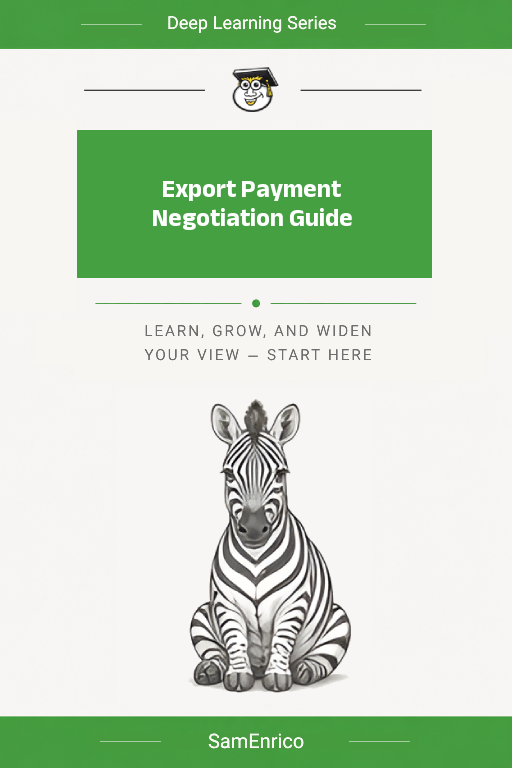
Export Payment Negotiation Guide eBook
Negotiate better payment terms with international
Negotiate better payment terms with international buyers. Advance payment, letters of credit, and open account.
Formats
Free sample
Chapter 1: The Price Delusion--–- Maria’s hands trembled as she stared at the email. Three months of work, two containers of custom-machined industrial pumps, and one simple sentence: “We regret to inform you that our company has filed for bankruptcy protection. All unsecured claims will be addressed in due course.”Due course. The phrase still made her stomach turn, even years later. She had negotiated hard on price, squeezed her margins to 8 percent, and celebrated when the buyer accepted her quote.
But she never asked about payment terms. Net 90, they said. She agreed. When the first payment was late, she sent a polite reminder. When the second passed, she called.
Then the buyer’s phone was disconnected. Then the email bounced. Then the bankruptcy notice arrived.Two hundred thousand dollars. Gone.Not because her product failed. Not because her quality slipped.
Because she had acted as an unsecured lender to a stranger six thousand miles away, and that stranger had defaulted.This chapter is about why that happens—and how to make sure it never happens to you.The Most Expensive Mistake in Exporting Walk into any export seminar, and you will hear the same advice: know your product, research your market, price competitively. All of that is true, and all of it misses the point. You can have the best product in the world, the most thorough market research, and the most aggressive pricing strategy, and still go bankrupt if you do not control how and when you get paid.The most expensive mistake in exporting is not setting the wrong price. It is negotiating price before negotiating payment.Think about the anatomy of a typical export deal. A buyer emails an inquiry.
You respond with a quote. The buyer asks for a discount. You come down 5 percent. The buyer asks for 10 percent. You settle at 7 percent.
Then the buyer says, “Great. Our standard terms are Net 90.” And you say, “Fine.”You just gave away far more than 7 percent.Here is the math that most exporters never do. Suppose your annual cost of capital—what you pay to borrow money or what you lose by not having cash available—is 10 percent. A buyer who pays in 90 days is effectively getting an interest-free loan from you for a quarter of a year. That 90-day delay costs you 2.5 percent of the invoice value in lost opportunity.
A buyer who pays in 30 days costs you 0.8 percent. A buyer who pays in advance costs you nothing.Now add risk. A buyer who pays in 90 days has three months to experience financial trouble, political instability, or simple dishonesty. The probability of default increases with every day you wait. According to data from the International Trade Administration, the average default rate for uninsured Open Account exports is approximately 1.5 percent for Net 30, but rises to nearly 4 percent for Net 90.
That is another hidden cost.So when you accept Net 90 without adjusting your price, you are effectively giving the buyer a discount of 3 to 5 percent—even if your invoice price never changed. Meanwhile, you were proud of the 7 percent discount you negotiated. You actually gave away 10 to 12 percent.This is the Price Delusion: the false belief that unit price is the only lever that matters in a negotiation.The Ladder of Risk To understand why payment terms matter more than price, you need a mental model. Throughout this book, we will refer to the Ladder of Risk—a visual framework that ranks payment methods from safest to riskiest for the exporter.Think of a ladder with five rungs.At the very top, safest for you but hardest to sell, is Cash-in-Advance (CIA) . The buyer pays before you ship.
You have zero risk of non-payment. Your cash flow is positive from day one. The downside? Many buyers will refuse, especially for large orders or long-term relationships.One rung down is Letter of Credit (L/C) . A bank guarantees payment, provided you present exactly the right documents at exactly the right time.
Your risk is low—assuming the bank is reputable and you comply perfectly. But L/Cs are complex, expensive, and slow. A single typo can delay payment for weeks.Another rung down is Documents against Payment (D/P) . Your bank sends shipping documents to the buyer’s bank, and the buyer’s bank releases them only when the buyer pays. You retain title to the goods until payment is made.
This is the forgotten middle child of trade finance—safer than Open Account, cheaper than L/Cs, and almost never discussed in export seminars.One more rung down is Documents against Acceptance (D/A) . The buyer receives the documents (and thus the goods) after signing a time draft—a promise to pay on a future date. You have released your goods but still hold a legal promise. This is significantly riskier than D/P because the buyer can simply refuse to honor the draft.At the very bottom, riskiest for you but most attractive to buyers, is Open Account (O/A) . You ship the goods, invoice the buyer, and wait to be paid—usually 30, 60, or 90 days later.
You have no guarantee, no bank involvement, and no recourse except legal action if the buyer defaults. This is the default method for domestic sales in most developed countries, and many international buyers will demand it.The Ladder of Risk is not a value judgment. Each rung is appropriate in certain situations. Cash-in-Advance is right for first-time buyers in risky countries. Open Account is right for trusted, long-term partners with strong credit.
The mistake is climbing down the ladder without knowing you are doing so—or without adjusting your price to compensate.Why Price Negotiation Is a Trap Here is the uncomfortable truth that most export sales training ignores: buyers are trained to negotiate on price because it is safe for them. Price is easy to compare across suppliers. Price is easy to justify internally. And price discounts have no immediate impact on the buyer’s cash flow.Payment terms, by contrast, have a massive impact on the buyer’s cash flow. A buyer who pays in 90 days instead of 30 days has effectively received an interest-free loan for two extra months.
For a buyer with a cost of capital of 8 percent, that is worth about 1.3 percent of the invoice value. A buyer who pays in advance instead of Net 30 loses that benefit.So when a buyer pushes you on price, they are often deflecting from the real negotiation: payment terms. They want you to focus on the visible, negotiable number (price) so they can secure invisible, valuable concessions (terms).Consider two offers to a buyer:Offer A: $100 per unit, Net 30Offer B: $97 per unit, Net 90Which is better for the buyer? Most would reflexively say Offer B because the price is lower. But calculate the buyer’s true cost.
Under Offer A, they pay 100butmustarrangefinancingfor30days.Under Offer B,theypay100 but must arrange financing for 30 days. Under Offer B, they pay 100butmustarrangefinancingfor30days.Under Offer B,theypay97 but have free use of that cash for 90 days. If the buyer’s cost of capital is 10 percent, Offer B is actually cheaper—even though the unit price is higher.Wait, did I reverse that? Let me clarify.Offer…
This is the end of the free sample. Get the eBook to keep going. Buy now
About this book
Details
- Author
- Blanco Verline
- Publisher
- SamEnrico
- Language
- English
- Genre
- Non-Fiction, Business Brief, Fintech Guide
- Released
- 2026-06-01
- Pages (approx.)
- 140
- Available as
- eBook, Audiobook

Read better in the ZLOADR app
Your eBooks on your phone or tablet. Sign in with your SamEnrico account and start reading.
More by Blanco Verline
 The Body Image Resentment GuideBlanco Verline$11.99
 Technology Fail Anger CourseBlanco Verline$11.99
 Social Anxiety Improv CureBlanco Verline$11.99
 Wendy Williams How You DoingBlanco Verline$11.99
 Financial Shame RecoveryBlanco Verline$11.99
 Baba Yaga’s Forbidden Forest: The Witch Who Walks Between WorldsBlanco Verline$11.99
 Understanding Radiation LeukemiaBlanco Verline$17.99
 How to Start a Organic Coated Steel Sheet Business (Beginners Guide)Blanco Verline$11.99
 Oracle Sales-Led GuideBlanco Verline$12.99
 Growth Marketing SpecialistBlanco Verline$11.99
You may also like
 Wise for African Exporters GuideNeumann Sylvie$12.99
 USDT for African ExportersPetit Keeley$12.99
 USD Receiving for African ExportersPeak Berenice$12.99
 Stripe for African Exporters GuideSprague Nakia$12.99
 PayPal for African Exporters GuideJorgenson Chana$12.99
 Payment Gateways African ExportersHandy Bibi$12.99
 Multi Currency Accounts AfricaBlunt Lesia$12.99
 Mobile Money Export PaymentsMast Jimmie$12.99
 International Transfer Fee Reduction GuideSoriano Margorie$12.99
 Hedging African Export GuideSpaulding Elly$12.99
 Ghana Dropshipping Payment Processing PlaybookLai Velva$12.99
 GBP Receiving African ExportersLiles Sheron$12.99