
Non-FictionInformativeEducational
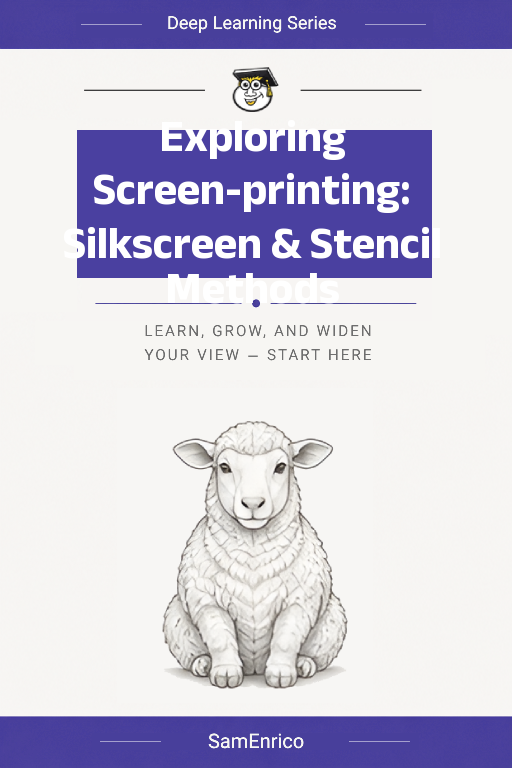
Exploring Screen-printing: Silkscreen & Stencil Methods eBook
This publication, published by SamEnrico, covers E
This publication, published by SamEnrico, covers Exploring Screen-printing: Silkscreen & Stencil Methods
Formats
Free sample
Chapter 1: Marks That Last--–- Long before anyone stretched silk over a frame or pushed ink through mesh with a squeegee, a person pressed a hand against a cold cave wall, blew powdered pigment through a hollow bone, and left a mark. That mark—a negative space in the shape of a palm and five fingers—was not a drawing. It was a stencil. And it was the beginning of everything this book will teach you.That prehistoric handprint, found in places like Chauvet Cave in France and Cueva de las Manos in Argentina, was not merely decoration. It was a declaration: I was here.
I made this. The act of creating a stencil—cutting, blocking, or masking an opening to control where color lands—is one of the oldest human technologies. It predates the wheel. It predates written language. It may even predate spoken language as we know it.
And yet, the fundamental principle has not changed in thirty thousand years. You block part of a surface. You apply color to the unblocked part. You lift the block. A shape appears.This book, Exploring Screen-printing: Silkscreen & Stencil Methods, will take you from that ancient impulse to the modern studio, from a single paper cutout to a four-color photographic print, from a hobby to a business.
But before we talk about mesh counts and emulsion and the perfect squeegee angle, we need to talk about why stencils matter. Because if you understand the deep history of this craft—who made stencils, why, and how they transformed human expression—you will never look at a screen-printed poster or a hand-cut T-shirt design the same way again. You will see yourself in a lineage that includes cave painters, Japanese textile artists, punk rock flyer makers, and Pop Art revolutionaries. You will understand that screen-printing is not a niche craft. It is a fundamental way of seeing and marking the world.The First Stencil: A Hand on the Wall Let us begin in the dark.
Approximately 40,000 years ago, in what is now Indonesia, a person placed their left hand against a limestone wall. They held a mouthful of red ochre mixed with water or animal fat. They sprayed it through a tube—perhaps a hollow bird bone or a reed. When they pulled their hand away, the rock around it was stained red, but the shape of the hand remained the raw stone. A negative image.
A stencil.These hand stencils appear on every continent except Antarctica. They are found in the caves of Spain (El Castillo), in the rock shelters of Australia (Kimberley region), in the deserts of North America (Chaco Canyon), and in the jungles of Borneo (Lubang Jeriji Saléh). Archaeologists once believed these were mere child's play—handprints made by bored teenagers. But modern research suggests something deeper. Many of the hands show missing fingers or unusual joint positions, possibly indicating ritual mutilation or intentional gestural codes.
Some anthropologists argue that these hand stencils were signatures, territorial markers, or spiritual offerings. Others see them as the earliest form of graphic design: a reproducible image created with a reusable block.What matters for our purposes is this: the stencil was the first printing press. Before moveable type. Before woodblock printing. Before the Gutenberg Bible.
There was the hand, the pigment, and the hollow bone. And that technology—a negative mask that allows color to pass only through specific openings—has never been improved. It has only been refined. Silk screen printing is not a new invention. It is the latest iteration of a very old idea.Ancient Stencils: Egypt, China, and the Birth of Repetition As human societies grew more complex, so did their stencils.
In ancient Egypt, stencils were used to decorate mummy wrappings and sarcophagi. Embalmers cut repeating patterns of scarabs, lotus flowers, and hieroglyphs from papyrus or thin leather, then brushed pigment through the openings onto linen. This allowed for rapid, consistent decoration of burial cloths—a form of early mass production. The same stencil could be used dozens of times, producing identical sacred symbols for each body prepared for the afterlife.Around the same time, in ancient China, stencils appeared in tomb paintings and on early silk fabrics. Chinese artisans discovered that brushing a sticky resist through a stencil, then dipping the fabric into dye, created permanent patterns.
This technique, called louyin (漏印), is a direct ancestor of modern screen-printing. The stencil did not just block pigment; it guided it. And because the Chinese also invented paper around 105 CE, they had a cheap, abundant material for cutting intricate stencil designs—a luxury that Egyptian papyrus makers could not afford.But the most important ancient stencil tradition, for our purposes, came from neither Egypt nor China. It came from an island nation that would transform stenciling into a high art.The Japanese Katazome: Rice Paste and Silk Japan, circa 800 CE. A craftsman cuts a design into thick mulberry paper, connecting every shape with tiny bridges of paper fiber.
He lays this paper stencil on a length of raw silk or cotton. Then he presses a paste made from glutinous rice and rice bran through the openings using a flat wooden spatula called a katamigata. The paste lands exactly where he wants the pattern. He removes the stencil, lets the paste dry, and dips the fabric into indigo dye. The dye colors every exposed fiber but cannot penetrate the paste.
He washes the paste away. The white pattern remains, sharp and precise, on a deep blue ground.This is katazome (型染め)—literally "shape dyeing." It is the most sophisticated stencil-based textile art ever developed. And it is the direct technical ancestor of modern screen-printing.The Japanese refined every aspect of stencil making. They developed shibugami (persimmon-tanned paper), which was waterproof, durable, and flexible. They invented kenukigata (hair-cut stencils), where paper bridges were replaced by human hair woven across openings, allowing for disconnected floating shapes that would otherwise fall out.
They created tsutsugaki, a tube-based resist method that influenced later screen-printing squeegee design. By the 1600s, Japanese stencils were so precise that they could reproduce the fine lines of a brush painting—a feat that would not be matched in Europe for another two hundred years.Western traders encountered katazome stencils in the mid-19th century, when Japan opened its ports after centuries of isolation. European textile manufacturers were astonished. They had nothing like it. They began importing Japanese stencils, copying the techniques, and adapting them to mechanized production.
But one crucial step remained: moving the stencil from the fabric to a suspended mesh, and the paste from a spatula to a rubber blade. That breakthrough came from a simple observation about silk.The Industrial Birth of Screen-Printing The story of modern screen-printing begins not in an artist's studio but in a factory. Specifically, in the wallpaper factories of England and the sign-painting shops of America in the early 20th century.Wallpaper printers had long used wooden blocks and metal rollers to apply patterns, but these methods were expensive and inflexible. In 1907, a Manchester-based printer named Samuel Simon filed a patent for a new process. He took a bolt of silk fabric—fine, even mesh—and stretched it tight over a wooden frame.…
This is the end of the free sample. Get the eBook to keep going. Buy now
About this book
Details
- Author
- Forman Jesusita
- Publisher
- SamEnrico
- Language
- English
- Genre
- Non-Fiction, Informative, Educational
- Released
- 2026-06-02
- Pages (approx.)
- 153
- Available as
- eBook, Audiobook

Read better in the ZLOADR app
Your eBooks on your phone or tablet. Sign in with your SamEnrico account and start reading.
More by Forman Jesusita
 Imposter For Students GuideForman Jesusita$11.99
 Body Position Reconstruction GuideForman Jesusita$11.99
 Parent Time Blocking GuideForman Jesusita$11.99
 Public Sector Talent RetentionForman Jesusita$11.99
 Flexible Time BlockingForman Jesusita$11.99
 The Startup Burn Rate GuideForman Jesusita$11.99
 Deep Work For EducatorsForman Jesusita$11.99
 Car Hypnosis Listening SafetyForman Jesusita$11.99
 The Lost Codex of the Silk Road: A Merchant's Secret LegacyForman Jesusita$11.99
 The Alchemists of Timbuktu: Unveiling Africa's Forgotten Scientific PioneersForman Jesusita$11.99
 How to Produce Pool Sweeps and VacuumsForman Jesusita$11.99
 How to Produce Downhill SkisForman Jesusita$11.99
You may also like
 Hong Kong Handover 1997Dunn Johnnie$11.99
 Zumba For Postnatal Recovery CourseNeal Christian$11.99
 Zumba for BeginnersLadner Nikia$11.99
 YouTube Comment Mining GuideHumes Pandora$12.99
 Worry Box MeditationCarlin Rudy$11.99
 Workplace Stress MeditationNguyen Lynn$11.99
 Workplace Stress and Sleep RepairHawley Ivory$11.99
 Workplace Perfectionism CureDelaney Jeffry$11.99
 Workplace Injustice Anger GuideWallen Isabelle$11.99
 Work Addiction and Burnout LinkGreenwood Ester$11.99
 Women in Yoga and WellnessBeattie Galina$11.99
 Women in Stand Up ComedyChun Evangeline$11.99