
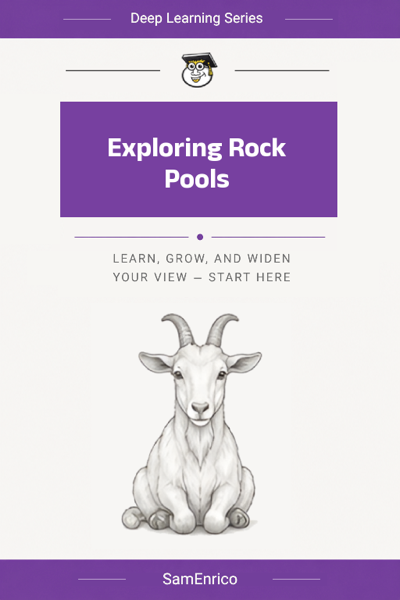
Non-FictionInformativeEducational
Exploring Rock Pools eBook
A Coursebook on Exploring Rock Pools
by Alves Janee
A Coursebook on Exploring Rock Pools
Formats
Free sample
Chapter 1: The Last Free Feast...--–- On a Tuesday afternoon in July, a six-year-old girl named Maya flipped a rock the size of a dinner plate. She had been poking at the edges with a plastic shovel for nearly a minute, her father watching from a safe distance, when the rock finally gave way. Underneath, exposed to sunlight for perhaps the first time in months, a dozen emerald shore crabs scattered like spilled jewels. One ran over her bare foot. She shrieked.
Then she laughed. Then she spent the next forty minutes turning every rock she could lift, her father now crouched beside her, both of them soaked to the knees, neither caring. Neither of them ever walked past a rock pool the same way again.This is not a story about a child. It is a story about what happens when ordinary curiosity meets an accessible frontier. The edge of the sea is the last place on Earth where anyone—regardless of age, wealth, education, or physical ability—can discover something they have never seen before, something that does not appear in their suburban backyard or their daily commute.
It is the last free feast for the hungry mind.And yet, most people walk past rock pools like they walk past a parking lot. They glance. They point. They say, "Oh, look, a crab." Then they turn away. They have no idea that the pool they just dismissed contains a predator that can digest its prey outside its own body, a fish that breathes air and remembers faces, and a worm that can regenerate an entire nervous system from a fragment smaller than a grain of rice.
They have no idea because no one ever taught them how to look.This book will teach you how to look.The Invitation Before we talk about tides, zones, barnacles, or the proper way to photograph a blenny without getting your finger bitten, let us be clear about what this book is not. It is not a dry textbook. It is not a checklist of Latin names to be memorized and forgotten. It is not a guide to collecting specimens for a "cabinet of curiosities" that will sit in a basement and gather dust. And it is absolutely not permission to harass, capture, or remove animals from their homes for your entertainment.This book is an invitation.
It is an invitation to slow down, to kneel, to get your knees wet and your hands cold and your notebook splashed with salt water. It is an invitation to see the familiar as strange again—to look at a limpet not as a "stuck-on thing" but as a gardener, a homing navigator, and a survivor of temperatures that would kill you in an hour. It is an invitation to join a community of naturalists that stretches back to the Victorian era and forward to the citizen science platforms that will archive your observations for decades to come.The rock pool does not care if you are a marine biologist with a Ph D or a kindergarten teacher on summer vacation. It reveals its secrets equally to anyone who stays still long enough to watch. That is the democracy of the intertidal zone.
That is why this book exists.The Victorian Naturalists and the Cabinet of Curiosities To understand where we are going, we must first understand where we came from. The modern practice of rock pooling—systematic observation of intertidal life—was invented in the nineteenth century by a loose network of amateur naturalists, clergymen with too much time on their hands, and eccentric aristocrats who preferred the company of crabs to the company of other aristocrats.Among the most influential was John Harper, whose 1880 book Glimpses of Ocean Life became an unexpected bestseller. Harper was not a scientist by training. He was a schoolmaster who spent his holidays walking the shores of Devon and Cornwall with a glass jar, a hand lens, and an insatiable appetite for the strange. His prose was vivid, unsentimental, and occasionally horrified: he described sea anemones as "living flowers with the appetites of wolves" and starfish as "the undertakers of the rock pool, for they take the living and the dead alike."Harper's approach, for all its charm, had a dark side.
He collected. He collected relentlessly. His cabinet of curiosities—preserved specimens in jars of alcohol, pinned crustaceans, dried seaweeds pressed between sheets of blotting paper—eventually contained over two thousand items, most of them dead. This was the Victorian way: to know something was to own it, to kill it, to possess it in perpetuity. Harper meant no harm.
He was a product of his time. But his methods, if practiced today, would empty a rock pool of its life within a single season.We have learned better. The modern naturalist does not collect specimens. The modern naturalist collects observations. A photograph lasts forever; a preserved crab lasts a few decades, and its death contributes nothing to science that a photograph could not provide.
The shift from the cabinet of curiosities to the digital field guide is not merely a technological upgrade. It is a moral one. It says: the life of this animal matters more than my desire to own it.This book stands firmly in the modern tradition. We will teach you to look, to photograph, to sketch, to record. We will never teach you to kill.What Is a Rock Pool, Really?Before we can explore rock pools, we need to define what we are talking about.
A casual observer might describe a rock pool as "a puddle on the beach." This is like describing the Sistine Chapel as "a room with paintings." Technically true. Grotesquely insufficient.A rock pool is an enclosed ecosystem with three defining characteristics. First, it has physical boundaries—rock walls that separate it from the open ocean and from neighboring pools. These boundaries are porous (water exchanges during high tide) but real (during low tide, the pool is isolated). Second, it has inhabitants—a community of species that interact through predation, competition, symbiosis, and parasitism.
Third, it has energy flows—sunlight driving photosynthesis in seaweeds, tidal currents delivering plankton and oxygen, and the constant input of organic debris from waves breaking over the surrounding rocks.But a rock pool is also something more. It is a natural laboratory for studying evolution in real time. Because the physical conditions in a rock pool change so dramatically—from underwater to exposed, from cool to hot, from salty to fresh, from oxygen-rich to oxygen-poor—the creatures that live there have evolved adaptations that would be unnecessary in the stable open ocean. These adaptations are visible, measurable, and often bizarre. They are the reason rock pooling is endlessly interesting.Consider the temperature swing.
In a typical temperate rock pool on a sunny summer day, the water temperature might be 15°C at dawn. By noon, it could be 28°C or higher. By late afternoon, as the tide returns and cold ocean water floods in, it could drop back to 16°C within an hour. That is a swing of 13°C in a single day. For comparison, the open ocean at the same latitude…
This is the end of the free sample. Get the eBook to keep going. Buy now
About this book
Details
- Author
- Alves Janee
- Publisher
- SamEnrico
- Language
- English
- Genre
- Non-Fiction, Informative, Educational
- Released
- 2026-05-08
- Pages (approx.)
- 129
- Available as
- eBook, Audiobook

Read better in the ZLOADR app
Your eBooks on your phone or tablet. Sign in with your SamEnrico account and start reading.
More by Alves Janee
 Financial Stress for Restaurant WorkersAlves Janee$11.99
 Catherine Great Postal ReformAlves Janee$11.99
 Counseling Student StressAlves Janee$11.99
 Mindfulness for Panic AttacksAlves Janee$11.99
 The Visionaries of Stone and Sand: The Architectural Genius of the Swahili CoastAlves Janee$11.99
 Logit and Probit Models WorkbookAlves Janee$12.99
 How to Produce Auto Racing Fan AccessoriesAlves Janee$11.99
 How to Become a PourerAlves Janee$11.99
You may also like
 Hong Kong Handover 1997Dunn Johnnie$11.99
 Zumba For Postnatal Recovery CourseNeal Christian$11.99
 Zumba for BeginnersLadner Nikia$11.99
 YouTube Comment Mining GuideHumes Pandora$12.99
 Worry Box MeditationCarlin Rudy$11.99
 Workplace Stress MeditationNguyen Lynn$11.99
 Workplace Stress and Sleep RepairHawley Ivory$11.99
 Workplace Perfectionism CureDelaney Jeffry$11.99
 Workplace Injustice Anger GuideWallen Isabelle$11.99
 Work Addiction and Burnout LinkGreenwood Ester$11.99
 Women in Yoga and WellnessBeattie Galina$11.99
 Women in Stand Up ComedyChun Evangeline$11.99