
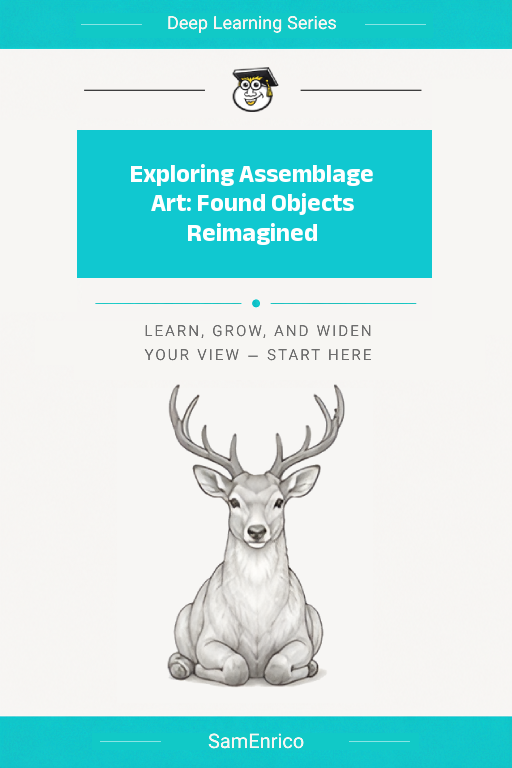
Non-FictionInformativeEducational
Exploring Assemblage Art: Found Objects Reimagined eBook
This publication, published by SamEnrico, covers E
by Aiello Carin
This publication, published by SamEnrico, covers Exploring Assemblage Art: Found Objects Reimagined
Formats
Free sample
Chapter 1: The Third Eye...–- Before you can build, you must learn to see. Not the casual glance you give a crowded shelf or a cluttered garage, but a penetrating, almost hungry gaze that pierces the veil of function and fixates on potential. This is the fundamental skill of the assemblage artist: the ability to look at a discarded object and see not what it was, but what it could become. It is a form of visual alchemy, transforming the lead of forgotten junk into the gold of artistic expression.Most people walk through the world blinded by purpose. They see a rusty gear and think “machine part.” They see a broken doll and feel a flicker of unease at its fragility.
They see a chipped teacup and register only its incompleteness. The assemblage artist, by contrast, experiences the world as a vast, un-curated museum of forms, textures, and latent narratives. The rust is not decay but a rich, warm pigment impossible to replicate from a tube. The broken doll is not a tragedy but a vessel for pathos, innocence, or the uncanny. The chipped teacup is no longer a failed vessel for liquid but a perfect cradle for a nest of forgotten keys.This chapter is an invitation to a fundamental reorientation of perception.
Before we delve into the history of the readymade, before we source a single object or cut a single piece of wood, we must train what this book calls the third eye—the artist’s ability to see the ghost of a future artwork lurking inside the husk of a discarded thing. This is not a mystical ability but a disciplined practice of looking, questioning, and re-contextualizing. It is the difference between collecting junk and curating meaning.The Tyranny of Function The greatest obstacle for the beginning assemblage artist is not a lack of materials or technical skill; it is the iron grip of function. From childhood, we are taught to categorize the world by use. A spoon is for eating.
A shoe is for walking. A key is for locking. This utilitarian framework is efficient for daily life but disastrous for artistic creation. To see an object solely by its intended purpose is to be blind to its other qualities: its shape, its texture, its color, its weight, its history, and its symbolic resonance.Consider a common padlock. Its function is to secure, to close off, to protect.
Now, look again. See the cool heft of its steel body, the wicked curve of its shackle, the tiny, intricate workings of its keyhole. Detached from a hasp, it becomes abstract sculpture. Painted red, it screams danger. Left to rust, it whispers of time and abandonment.
Attached to a child’s diary, it becomes a symbol of burgeoning privacy. The function—security—is only one of a thousand possible meanings. The assemblage artist learns to hold function loosely, to respect it as one layer of the object’s identity while refusing to let it dominate.This chapter will guide you through a series of visual exercises designed to break the tyranny of function. We will practice defamiliarization—a technique borrowed from avant-garde poetry—where we stare at a common object until its name and purpose dissolve, leaving only pure form. We will learn to ask the four questions that form the bedrock of the assemblage hunter’s mindset: What is this?
What was this? What could this be? And what does this feel like it wants to say?Seeing Texture: The Language of Surface Before an object tells a story, its surface speaks a language. Assemblage is a deeply tactile art form, and learning to read texture is as important as learning to read color. Run your fingers over a piece of driftwood smoothed by waves.
Compare it to a splinter of fresh pine. Feel the cold, oily smoothness of a vintage machine gear versus the warm, porous grain of an old leather belt. Each texture carries an emotional register.Rust: Speaks of time, neglect, industry, decay, and also of resilience. Rust is a color and a texture that cannot be faked; it is the honest record of iron’s conversation with air and moisture.Patina: The green crust on old copper or the dark sheen on aged brass. Patina suggests age, use, and a kind of quiet dignity.
It is the opposite of the shiny and the new.Chipped Paint: Layers of color—often in unexpected combinations—reveal an object’s history. A flaking toy horse might show white under the current chipped red, suggesting multiple lives and repurposings.Worn Velvet or Frayed Fabric: Speaks of luxury fading, of touch, of the passage of hands. Worn fabric carries a ghost of intimacy.This chapter includes a texture-matching exercise. Gather ten objects with radically different surfaces. Close your eyes.
Touch each one and assign it an emotion: joy, sorrow, anger, peace, fear, nostalgia. Do this without looking. Then open your eyes and see if the visual appearance matches your tactile impression. This practice trains you to select objects not just for what they depict, but for what they feel like—a crucial skill when building the emotional architecture of a piece.The Vocabulary of Forms Beyond texture and function, every object possesses a formal visual vocabulary. It has lines (straight, curved, jagged), shapes (circles, squares, organic blobs), and mass (heavy, light, dense, airy).
An assemblage is a composition of these formal elements, and the artist’s task is to orchestrate them into a visual sentence.A grouping of round objects—marbles, watch faces, buttons—creates a rhythm of circles, suggesting unity, cycles, or even the celestial. A cluster of sharp, linear objects—nails, broken glass shards, arrowheads—creates a sense of danger, aggression, or directional force. The interplay between the rigid and the organic, the geometric and the chaotic, is where the visual interest of an assemblage is born.This chapter introduces the concept of visual weight. A small, dark, dense object (like a rusted iron weight) can visually balance a much larger, lighter, brighter object (like a bleached driftwood branch). Position matters: an object placed high in the composition feels lighter than one placed low.
An object leaning left creates a different tension than one standing upright. We will practice small “sketches” on a tabletop—moving objects around without glue—to feel these forces. Think of yourself as a choreographer of things, arranging a silent ballet of shapes.The Ghost of Use: Reading Wear Patterns An object’s history is written in its wear. A pair of scissors will have polished spots where fingers gripped. A hammer’s handle will be smoother on the underside from the slide of a palm.
A wooden spoon will be worn concave on one side from decades of stirring. These wear patterns are not damage; they are biography.The assemblage artist learns to read these ghost stories. A key that is almost worn smooth has opened many doors. A child’s shoe with a scuffed toe has run many races. A paintbrush with hardened bristles has made many marks.
When you incorporate an object into an assemblage, you are incorporating this ghost biography. A piece about labor will gain…
This is the end of the free sample. Get the eBook to keep going. Buy now
About this book
Details
- Author
- Aiello Carin
- Publisher
- SamEnrico
- Language
- English
- Genre
- Non-Fiction, Informative, Educational
- Released
- 2026-05-08
- Pages (approx.)
- 119
- Available as
- eBook, Audiobook

Read better in the ZLOADR app
Your eBooks on your phone or tablet. Sign in with your SamEnrico account and start reading.
More by Aiello Carin
 Peter Higgs Boson DiscoveryAiello Carin$11.99
 Stress and Globus SensationAiello Carin$11.99
 Mismatched Libido ManagementAiello Carin$11.99
 Menopause Autoimmune ConnectionAiello Carin$11.99
 Gratitude Daily Review GuideAiello Carin$11.99
 Performance Confidence HypnosisAiello Carin$11.99
 ABCDE for ChefsAiello Carin$11.99
 The Shadow of the Sun King: Napoleon's Hidden War in EgyptAiello Carin$11.99
 The Alchemist’s Canvas: How a 17th-Century Painter Secretly Invented Modern ChemistryAiello Carin$11.99
 How to Produce an Automatic DishwasherAiello Carin$11.99
 African Export Payment Fees WorkbookAiello Carin$12.99
 Mastering Income Tax: Brackets & DeductionsAiello Carin$11.99
You may also like
 Hong Kong Handover 1997Dunn Johnnie$11.99
 Zumba For Postnatal Recovery CourseNeal Christian$11.99
 Zumba for BeginnersLadner Nikia$11.99
 YouTube Comment Mining GuideHumes Pandora$12.99
 Worry Box MeditationCarlin Rudy$11.99
 Workplace Stress MeditationNguyen Lynn$11.99
 Workplace Stress and Sleep RepairHawley Ivory$11.99
 Workplace Perfectionism CureDelaney Jeffry$11.99
 Workplace Injustice Anger GuideWallen Isabelle$11.99
 Work Addiction and Burnout LinkGreenwood Ester$11.99
 Women in Yoga and WellnessBeattie Galina$11.99
 Women in Stand Up ComedyChun Evangeline$11.99