
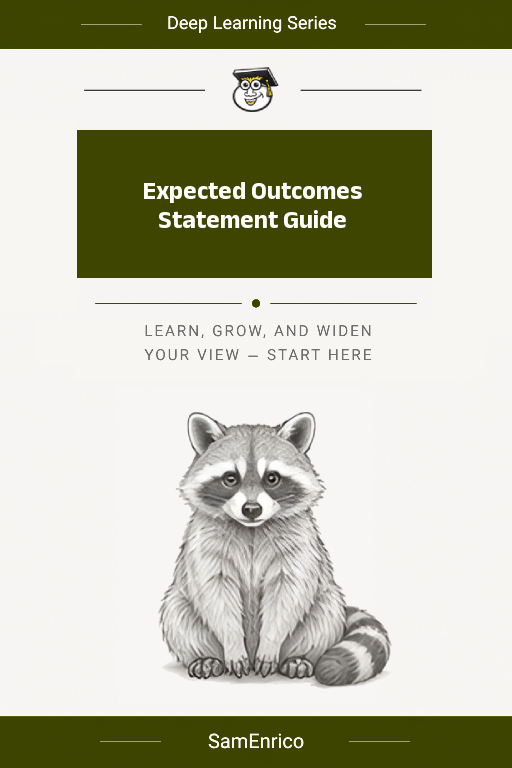
Non-FictionStudent's ShortcutOutcomes WritingSignificance Guide
Expected Outcomes Statement Guide eBook
Write expected outcomes and significance sections
Write expected outcomes and significance sections that convince reviewers your research matters for the field.
Formats
Free sample
Chapter 1: The Rejection Epidemic--Dr. Sarah Chen had done everything right. Her preliminary data were solid – six months of painstaking experiments, replicated twice. Her literature review was exhaustive, citing 147 papers including the three most recent from the journal's editorial board. Her budget was lean, her timeline realistic, her collaborators distinguished.
When she clicked "submit" on her R01 application to the National Institutes of Health, she allowed herself a small, private smile. This was the one. She could feel it.Eight weeks later, the review came back. Not a summary statement. Not a request for revisions.
A straight rejection.The comments were polite, almost gentle. "The applicant is clearly a skilled investigator." "The preliminary data are promising." "The research question is of interest to the field." And then the killer: "However, the expected outcomes are not clearly articulated, and the significance of the proposed work is not well established."Sarah read that sentence seventeen times. She had written an entire section labeled "Expected Outcomes." She had written another section labeled "Significance." What did they mean, "not clearly articulated"? The words were right there on the page. She had used the word "novel" four times.
She had called the work "important" in three different paragraphs. What more did they want?What Sarah did not know – what no one had ever taught her – was that she had committed the single most common fatal error in grant writing. She had written her Expected Outcomes section for an audience that already believed her research mattered. But reviewers are not that audience. Reviewers are gatekeepers of scarcity, trained to find reasons to say no.
And her outcomes section, for all its technical correctness, had handed them that reason on a silver platter.This chapter is about understanding that error so you never make it again. It is about the psychology of rejection, the hidden logic of peer review, and the single most important diagnostic tool you will ever use to test whether your Expected Outcomes will convince a skeptic or bore them to sleep.The Dirty Secret of Peer Review Here is something that grant officers will never say aloud, but every experienced reviewer knows to be true: Most proposals are rejected not because the science is bad, but because the significance is poorly argued.Technical correctness is table stakes. It gets you into the room. It does not get you funded.Think about what a reviewer actually does. She receives ten proposals.
She has three hours to read them all. She is overworked, underpaid, and slightly resentful that she said yes to this review assignment. She is looking for reasons to eliminate proposals quickly. She is not looking for reasons to love your work. That is your job.The first thing she reads – after the title and abstract – is almost always the Expected Outcomes or Specific Aims section.
She reads it with one question in mind: "Why should I keep reading?" If your outcomes section does not answer that question within the first sixty seconds, you have lost her. She will skim the rest, find three polite reasons to reject, and move on to the next proposal.This is not cruelty. This is efficiency. Reviewers are gatekeepers of scarcity. A typical NIH study section funds about 10-15% of proposals.
A typical NSF panel funds about 20%. For every proposal they fund, they must reject four to nine others. They are not looking for reasons to say yes. They are looking for permission to say no. Your Expected Outcomes section is where you take that permission away.The Gap That Most Researchers Miss Most researchers write outcomes for an audience of peers who already share their assumptions.
They write things like:"We expect to find a correlation between X and Y.""This study will investigate the role of Z.""We hope to demonstrate that A is associated with B."These sentences are not wrong. They are just irrelevant. They answer questions that no reviewer is asking.The reviewer is not asking: "What will you look at?" The reviewer is asking: "Why should I care?"The reviewer is not asking: "What do you hope to find?" The reviewer is asking: "What changes if you are right?"The reviewer is not asking: "Is this technically sound?" The reviewer is asking: "Is this necessary?"This is the gap that Sarah Chen fell into. Her outcomes section described what she would do. It never described what would be different afterward.
It used the language of investigation ("examine," "assess," "explore") instead of the language of conclusion ("determine," "establish," "demonstrate"). It was a report of planned activities, not a forecast of meaningful change.And because of that, the reviewers had no choice but to reject her. Not because her science was weak. Because she had given them no reason to say yes.The Litmus Test: "So What?"There is a simple test that separates fundable outcomes from unfundable ones. It takes five seconds.
It requires no special training. And it has never, in the history of peer review, failed to identify a weak outcomes section.After you write a sentence describing an expected outcome, ask yourself: "So what?"If you can answer that question with a specific, measurable change in the world, you are on the right track. If you cannot – if your answer is a vague gesture toward "advancing knowledge" or "filling a gap" – you have failed the test.Let us apply this test to the three examples above.Example 1: "We expect to find a correlation between X and Y." So what? What does a correlation buy you? If you find it, what changes?
The answer, honestly, is "nothing." Correlations are a dime a dozen. This outcome does not pass the test.Example 2: "This study will investigate the role of Z." So what? Investigation is a process, not a result. You could investigate for five years and produce nothing of value. This outcome does not pass the test.Example 3: "We hope to demonstrate that A is associated with B." So what?
The word "hope" alone is fatal. It signals that you have not convinced yourself. And if you have not convinced yourself, why should a reviewer be convinced? This outcome does not pass the test.Now let us look at sentences that do pass the test:"We expect to demonstrate that X causes Y, enabling clinicians to screen for Y using a non-invasive test."So what? Non-invasive screening changes clinical practice.
Patients avoid biopsies. Costs go down. This outcome passes."We will establish that Z is a reliable biomarker for early-stage disease, which currently has no diagnostic test."So what? A diagnostic test for a disease that currently has none changes outcomes. Early detection saves lives.
This outcome passes."We will determine whether A is a valid predictor of B, reducing the current false positive rate from 40% to under 10%."So what? A 75% reduction in false positives changes treatment decisions. Patients avoid unnecessary procedures. Resources are reallocated. This outcome passes.Notice the pattern.
Every sentence that passes the "So what?" test does three things:It names a specific, measurable claim (causation, not correlation; validation, not exploration).It identifies a current limitation or gap (no diagnostic test; 40% false positives).It states what will be different if the…
This is the end of the free sample. Get the eBook to keep going. Buy now
About this book
Details
- Author
- Maier Danille
- Publisher
- SamEnrico
- Language
- English
- Genre
- Non-Fiction, Student's Shortcut, Outcomes Writing, Significance Guide
- Released
- 2026-06-01
- Pages (approx.)
- 152
- Available as
- eBook, Audiobook

Read better in the ZLOADR app
Your eBooks on your phone or tablet. Sign in with your SamEnrico account and start reading.
More by Maier Danille
 Gaming Disorder Recovery CourseMaier Danille$11.99
 Deal Financing Fee DatabaseMaier Danille$11.99
 Parental Addiction and ResilienceMaier Danille$11.99
 Bariatric Surgery Mindful Eating GuideMaier Danille$11.99
 Gluten Free Travel Survival GuideMaier Danille$11.99
 Love in the Time of Ice: The Frozen Romance of the Franklin ExpeditionMaier Danille$11.99
 Blood and Silk: The Empress Wu Zetian’s Rise to PowerMaier Danille$11.99
 10 Ways to Use Chapati Flour (Recipe Book)Maier Danille$11.99
 Business Credit for VeteransMaier Danille$12.99
 Understanding Cataract Congenital Dominant Non NuclearMaier Danille$17.99
 Learning Pod TeacherMaier Danille$11.99
You may also like
 Hong Kong Handover 1997Dunn Johnnie$11.99
 Zumba For Postnatal Recovery CourseNeal Christian$11.99
 Zumba for BeginnersLadner Nikia$11.99
 YouTube Comment Mining GuideHumes Pandora$12.99
 Worry Box MeditationCarlin Rudy$11.99
 Workplace Stress MeditationNguyen Lynn$11.99
 Workplace Stress and Sleep RepairHawley Ivory$11.99
 Workplace Perfectionism CureDelaney Jeffry$11.99
 Workplace Injustice Anger GuideWallen Isabelle$11.99
 Work Addiction and Burnout LinkGreenwood Ester$11.99
 Women in Yoga and WellnessBeattie Galina$11.99
 Women in Stand Up ComedyChun Evangeline$11.99