
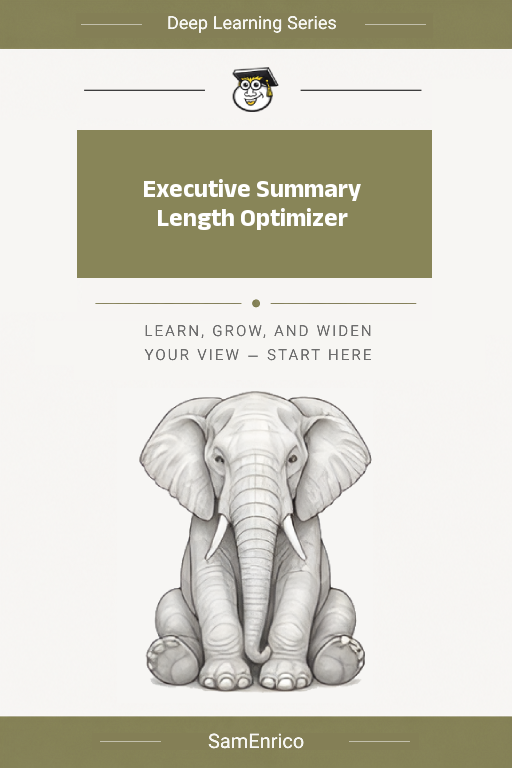
Executive Summary Length Optimizer eBook
Determine ideal executive summary length by docume
by Tovar Bart
Determine ideal executive summary length by document type. One page rule and when to break it.
Formats
Free sample
Chapter 1: The 90-Second Kill Zone--–- The $2 million proposal landed in Sarah Chen's inbox at 8:47 AM on a Tuesday. By 8:48 AM, she had deleted it. Not because the analysis was flawed. Not because the price was too high. Not because she disagreed with the recommendation.
She deleted it because the executive summary was three pages long.Sarah was the Chief Operating Officer of a mid-sized logistics firm. She had exactly seventeen minutes between back-to-back meetings to review proposals for a new warehouse management system. She opened the first attachment, saw three dense pages of text, and made a judgment that took less than three seconds: "If they couldn't summarize this in one page, they haven't thought it through."The winning bid came from a competitor whose executive summary fit on a single page. The COO of that company later told Sarah, "We spent two weeks editing that one page. The report behind it was two hundred pages.
But we knew you'd never read the report unless the summary worked."This is not an outlier story. This is the daily reality of executive decision-making.The Attention Economy You Didn't Know You Were Losing Every executive summary you write enters a battlefield. On the other side of that battlefield is a human being with limited time, competing priorities, a smartphone buzzing with notifications, and a cognitive architecture that was never designed for the information load of the twenty-first century.The neuroscience is unforgiving. According to research from the University of California, Irvine, the average knowledge worker's attention shifts every forty to ninety seconds. Gloria Mark, a professor of informatics who has studied attention spans for decades, found that in 2004, the average screen attention was two and a half minutes.
By 2012, it had dropped to seventy-five seconds. By 2023, some studies placed it as low as forty-seven seconds.Here is what that means for your executive summary: You have approximately ninety seconds before your reader's brain automatically shifts from focused reading to skimming mode. This is not a character flaw in your reader. This is not a sign of disrespect or laziness. This is how the human brain works when faced with information density.The distinction between reading and scanning is not merely semantic; it is the difference between your summary being acted upon and your summary being ignored.
Reading is linear, sequential, and detail-oriented. The reader processes each word in order, builds a mental model, and retains specific information. Scanning is non-linear, pattern-based, and selective. The eye jumps to headings, bullet points, bolded terms, the top-left corner of the page, and anything that looks like a conclusion.Your executive summary must be optimized for scanning because your executive will almost never read it word-for-word.The 80% Problem In 2019, a consortium of business communication researchers surveyed five hundred C-suite executives across technology, finance, healthcare, and manufacturing. The question was simple: "If an executive summary exceeds one page, what do you do?"The results were devastating for anyone who has ever written a multi-page summary.
Eighty percent of respondents said they ignore any summary beyond one page entirely. Not "they skim it." Not "they read the first page and then decide." They ignore it completely. The summary might as well not exist.The remaining twenty percent said they would read the first page and then decide whether to continue based on the quality of that first page. Zero percent said they routinely read multi-page summaries in full.Let that sink in. Zero percent.The study's authors followed up with qualitative interviews to understand why.
The responses clustered around three themes:First, signal of incompetence. Executives reported that a multi-page summary signals that the writer either does not understand the material well enough to distill it or does not respect the executive's time enough to try. As one VP of product put it, "If you can't explain it on one page, you don't understand it well enough to recommend it."Second, decision friction. Multi-page summaries require the executive to hold information across page turns, to flip back and forth between sections, and to mentally synthesize disparate points. This cognitive friction slows decision-making.
In a world where speed matters, executives reject proposals that create friction.Third, comparison impossibility. When evaluating multiple proposals, executives want to lay them side by side. A one-page summary fits on a single screen or a single sheet of paper. A two-page summary does not. The executive cannot easily compare Proposal A (two pages) with Proposal B (two pages) without scrolling, flipping, or printing.
Most will not bother.The Neuroscience of the Ninety-Second Window To understand why ninety seconds matters, we need to understand what happens in the brain during that window.When you first encounter a document, your brain enters what neuroscientists call "focused mode." The prefrontal cortex, responsible for executive function and deliberate reasoning, activates. Working memory—the mental scratchpad where you hold and manipulate information—engages. In this mode, you can process complex arguments, follow logical chains, and evaluate evidence.Focused mode is metabolically expensive. It consumes glucose, generates neural noise, and cannot be sustained indefinitely. After approximately sixty to ninety seconds, the brain automatically begins to transition to "diffuse mode." This is the scanning state.
The eyes move faster. The brain looks for patterns rather than details. The prefrontal cortex partially disengages, and subcortical structures take over.In diffuse mode, you are not reading. You are foraging for meaning. You are looking for the conclusion, the recommendation, the bottom line.
If you cannot find it in a few seconds, you move on.This is not a bug in human cognition. It is a feature. Evolution did not design the human brain to sit still and read long documents. It designed the brain to scan the environment for threats, opportunities, and patterns. The executive summary that succeeds is the one that works with this cognitive architecture, not against it.The practical implication is straightforward: Your executive summary must deliver its core message within the first ninety seconds of reading.
For a one-page document, ninety seconds is approximately the time it takes to read the first paragraph, scan the headings, and glance at any bullet points. That is all the time you have.The Respect Argument There is a moral dimension to summary length that most business writing guides ignore. Long-windedness is not merely inefficient. It is disrespectful.Consider what you are asking of an executive when you send a multi-page summary. You are asking them to spend five, ten, or fifteen minutes of their limited attention on your document.
You are asking them to do work that you could have done—the work of distillation, prioritization, and synthesis. You are, in effect, saying that your time is more valuable than theirs.No executive will say this aloud. But they feel it. And they act on it, often unconsciously, by privileging summaries that respect their time.The counterargument, of course, is that some topics are genuinely complex and cannot be reduced to a single page. This objection appears in every workshop, every consulting engagement, and every writing seminar.
It is almost always wrong.Complexity is a reason to write a better summary, not a longer one. The most complex topics in human history—quantum…
This is the end of the free sample. Get the eBook to keep going. Buy now
About this book
Details
- Author
- Tovar Bart
- Publisher
- SamEnrico
- Language
- English
- Genre
- Non-Fiction, Professional's Cheat Sheet, Business Writing
- Released
- 2026-06-01
- Pages (approx.)
- 152
- Available as
- eBook, Audiobook

Read better in the ZLOADR app
Your eBooks on your phone or tablet. Sign in with your SamEnrico account and start reading.
More by Tovar Bart
 TikTok Algorithm DecodedTovar Bart$11.99
 Professor Imposter SyndromeTovar Bart$11.99
 The Mirror Exposure Therapy GuideTovar Bart$11.99
 Alcohol Detox Success RatesTovar Bart$11.99
 SOC 2 Report TrendsTovar Bart$11.99
 The Vanishing Act: The Disappearance of the Soviet Union's Lost CosmonautTovar Bart$11.99
 Understanding Primary Pulmonary HypertensionTovar Bart$17.99
 Certification Marketing for ExportsTovar Bart$12.99
 How to Become a Tunnel-elastic Operator - ChainstitchTovar Bart$11.99
You may also like
 Executive Summary Template HandbookDodson Meda$12.99
 Executive Summary for Strategic PlansHiggins Tiffany$12.99
 Executive Summary for Sales TeamsArchuleta Verdell$12.99
 Executive Summary for Project ManagersWeeks Annita$12.99
 Executive Summary for Investors GuideBonilla Edra$12.99
 Executive Summary for Internal ReportsKeyes Gavin$12.99
 Executive Summary for HR PlansCanty Marcel$12.99
 Executive Summary for Executive AssistantsParr Landon$12.99
 Executive Summary for Due DiligenceBonner Reita$12.99
 Executive Summary for Crisis ResponseMayhew Mikel$12.99
 Executive Summary for ConsultantsBertram Malinda$12.99
 Executive Summary for Annual ReportsHardesty Jay$12.99