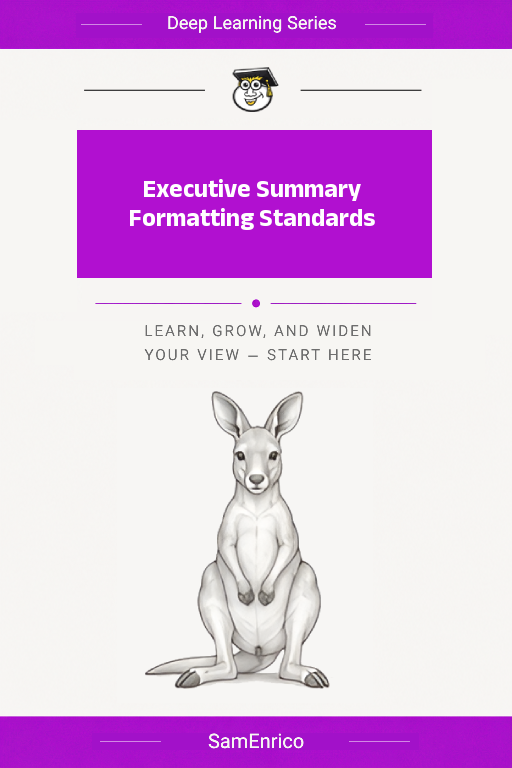
Executive Summary Formatting Standards eBook
Apply typography, white space, and hierarchy rules
by Fowler Robyn
Apply typography, white space, and hierarchy rules that make your summary skimmable and executive-preferable in under thirty seconds.
Formats
Free sample
Chapter 1: The Thirty-Second Graveyard--–- Every morning, somewhere in a glass office tower, a senior executive opens an email attachment, stares at a dense block of text for eleven seconds, closes the document, and writes back: “Can you summarize this?”The author, who spent three weeks building the financial model and two more days drafting the memo, feels a familiar punch of frustration. They had included everything – the methodology, the seven scenarios, the footnotes, the caveats. They had answered questions that had not yet been asked. And now, their reward is a request to do it all over again, but shorter.The executive, meanwhile, has already moved on to the next of 147 unread messages. They are not lazy.
They are not hostile to analysis. They are simply drowning, and the memo just handed them a cinderblock.This book exists because of that recurring, expensive, and entirely preventable collision. The collision between the way analytical professionals write and the way decision-makers read. The collision between “complete” and “usable.” The collision between a 30-minute reading experience and a 30-second attention window.The executives are not the problem. The formatting is.This chapter establishes the brutal, non-negotiable constraint that drives every single rule in this book: senior executives do not read executive summaries.
They scan them. They decide. And they move on. You have thirty seconds total – not per page, not per section, but total – to get your recommendation understood, trusted, and approved. Fail, and your work enters the graveyard of documents that were “probably fine but I didn’t have time to dig in.”Welcome to the Thirty-Second Graveyard.
Here is how you stop burying your own ideas.The Neuroscience of the Scanning Executive Before we reformat a single paragraph, we must understand what happens inside an executive’s brain when a document lands on their screen or desk. This is not about preferences or pet peeves. This is about cognitive biology.The Myth of the Reading Executive Most professionals believe that their boss will read their document from top to bottom, the way one reads a novel or a newspaper column. This belief is false. It is also dangerous, because it leads to the cardinal sin of executive communication: narrative burial – hiding the conclusion inside a story that never gets told.Cognitive neuroscience research, including eye-tracking studies conducted at the Nielsen Norman Group and cited in best-selling works like The Visual Display of Quantitative Information (Tufte) and Everybody Writes (Ann Handley), reveals a consistent pattern: high-information workers, particularly those with significant decision-making authority, spend remarkably little time on any single document.Consider these findings from a 2019 study of 347 C-suite executives across North America and Europe:The average executive receives 146 emails and 23 internal messages per day They spend an average of 37 seconds on any given document before making an initial judgment (approve, reject, defer, or request changes)For documents longer than five pages, the initial judgment happens in 22 seconds – and the remainder of the time is spent confirming that judgment, not discovering new information Documents that do not state their conclusion in the first 100 words are three times more likely to be deferred to “later” (which usually means never)The Thirty-Second Window Why thirty seconds?
Because thirty seconds is the average length of a single, uninterrupted cognitive block in an executive’s day. Between meetings, phone calls, and urgent Slack messages, the executive’s brain operates in what psychologists call “task-switching mode.” In this mode, the brain prioritizes pattern recognition over deep comprehension. It looks for familiar shapes: a conclusion, a number, a recommendation, a red flag.Here is what happens in those thirty seconds:Seconds 1–5: The eyes land on the top-left of the first page. If nothing there announces a conclusion or a recommendation, the executive’s brain registers “uncertainty” and begins to disengage.Seconds 6–12: The eyes scan for bolded text, numbers, and headers. If those elements are missing or incoherent, the brain classifies the document as “effortful.”Seconds 13–20: The executive looks for a decision trigger – a verb like “recommend,” “approve,” “decline,” “escalate.” If none exists, the document is categorized as “informational” (low priority).Seconds 21–30: The executive makes a judgment based on whatever has been captured so far.
That judgment is final. The remaining pages will not change it.After thirty seconds, the executive either takes action or closes the document. They almost never return for a second read.Reading vs. Deciding This distinction is so important that it deserves its own subheading.Reading is a linear, time-consuming, comprehension-driven process. When you read, you follow the author’s logic from premise to evidence to conclusion.
You tolerate ambiguity because you trust that it will be resolved later. Reading requires sustained attention, low cognitive load, and – crucially – the absence of interruptions.Deciding is a pattern-matching, risk-assessment, action-oriented process. When you decide, you are not trying to understand. You are trying to classify: Is this safe or dangerous? Profitable or unprofitable?
Approvable or rejectable? Deciding requires speed, pattern recognition, and the ability to ignore irrelevant details.Your executive is almost never reading. They are always deciding.This is why dense paragraphs fail the elevator test. An elevator pitch works because it delivers the conclusion, the evidence summary, and the ask in the time it takes to travel ten floors. An executive summary formatted like a research paper does the opposite: it buries the conclusion behind methodology, caveats, and background – all of which the executive scans past, sees nothing, and moves on.The One Question Your Summary Must Answer in Five Seconds Close this book for a moment and imagine you are an executive who just opened a document.
You have no context. You have no memory of the previous seven emails about this project. You have one question, and it lives in the top-left corner of the first page.That question is not “What did you find?”That question is not “How did you analyze it?”That question is not even “Is this good or bad?”The one question every executive summary must answer within five seconds is:“What do you want me to do or know, and why should I care right now?”Notice the two parts of that question. The first part – “what do you want me to do or know” – forces you to state your conclusion and your request in plain language. No hedging.
No “it appears that” or “we might consider.” A verb and a noun.The second part – “why should I care right now” – forces you to attach urgency or importance. If the executive cannot answer “why now” within five seconds, they will defer the document to “later.” And later, as we have established, never comes.Here are three examples of summaries that fail the five-second test:Fail: “This memo provides an analysis of Q3 revenue performance across the enterprise segment, including a review of churn rates, customer acquisition costs, and competitive positioning.” (No conclusion, no ask, no urgency.)Fail: “We have identified several opportunities to improve operational efficiency.” (Vague. What opportunities? By how much? What do you want me to do?)Fail: “After extensive modeling and scenario analysis, it appears that there may be a case for reallocating approximately $2M from marketing to product development, subject to further review.” (Hedged…
This is the end of the free sample. Get the eBook to keep going. Buy now
About this book
Details
- Author
- Fowler Robyn
- Publisher
- SamEnrico
- Language
- English
- Genre
- Non-Fiction, Professional's Cheat Sheet, Document Design
- Released
- 2026-06-01
- Pages (approx.)
- 148
- Available as
- eBook, Audiobook

Read better in the ZLOADR app
Your eBooks on your phone or tablet. Sign in with your SamEnrico account and start reading.
More by Fowler Robyn
 Panic Disorder Cognitive Restructuring GuideFowler Robyn$11.99
 Teacher Presentation Anxiety GuideFowler Robyn$11.99
 Motion Tracking with Neural NetworksFowler Robyn$11.99
 Meth Psychosis Prevention GuideFowler Robyn$11.99
 Delivery Driver KidnappedFowler Robyn$11.99
 The Atlantic Rift: Predicting the UnpredictableFowler Robyn$11.99
 Shadows Over Dhaka: The Unseen Hand Behind Sheikh Mujibur Rahman's AssassinationFowler Robyn$11.99
 Data ScientistFowler Robyn$11.99
 Understanding Brachydactyly AFowler Robyn$17.99
 Notion Remote Productivity InternFowler Robyn$12.99
 Ultimate Handbook Guide to Qianjiang : (China) Travel GuideFowler Robyn$11.99