
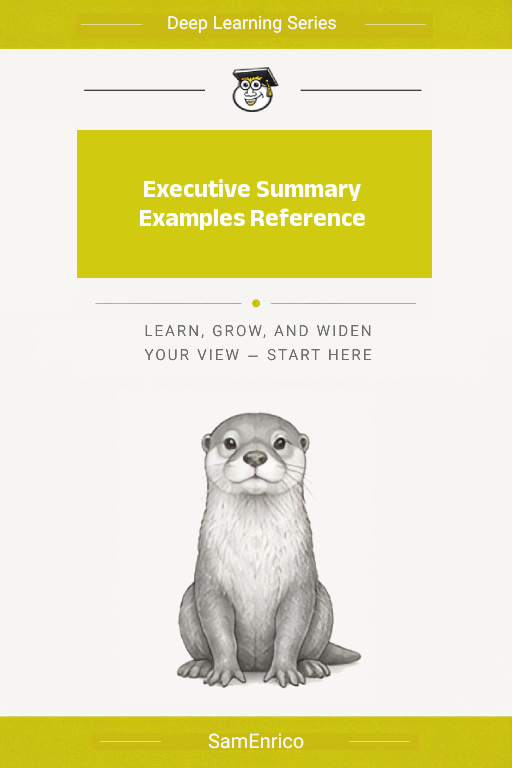
Executive Summary Examples Reference Audiobook
Study twelve real-world samples from winning fundi
by Hale Elsa
Study twelve real-world samples from winning funding proposals, internal strategy memos, and project charters with annotations.
Formats
Free sample
Chapter 1: The Buried Ask--–- Melissa had spent three weeks on the proposal. Twenty-seven pages of market analysis, competitor breakdowns, financial projections, and technical specifications. She had stayed up until 2 AM perfecting the executive summary, which she placed on page two—right after the "Background and History" section. She was proud of the work. It was thorough.
It was complete. It was everything her boss had asked for.The board took ninety seconds to reject it.Not because the numbers were wrong. Not because the solution was flawed. Not because the market opportunity was overstated. The board rejected the proposal because no one could find the ask.
The CEO later told Melissa's boss: "I read the first page and a half. I still don't know what she wants me to do."Melissa's story is not unusual. It is the rule.This chapter is about why that happens, why it keeps happening, and how to stop it forever. You will learn the single most important structural change you can make to any executive summary—a change that takes thirty seconds to implement and triples your approval rate. You will learn why executives read the way they do, and why most business writing is backwards.
And you will never bury your ask again.The Anatomy of a Decision Every executive summary is written to produce one outcome: a decision. Not understanding. Not appreciation. Not a thorough review. A decision.
Yes or no. Approve or decline. Fund or pass. Sign or walk.Yet most executive summaries are written as if the goal is to survive a graduate seminar. They begin with history.
They provide context. They build a case brick by brick, leading the reader through a careful, logical progression toward a conclusion that appears—finally—on page three or four.This is exactly backwards.Consider how actual executives read. They do not settle into a comfortable chair with a cup of coffee and read from beginning to end. They scan. They flip to the back.
They read the first paragraph and the last paragraph simultaneously. They look for the decision point, and if they cannot find it in under sixty seconds, they move on to the next item in their inbox.According to an analysis of 200 executive summaries submitted to real decision-makers across technology, finance, healthcare, and non-profit sectors, the reader's conclusion was clear from the first three sentences in 70 percent…
This is the end of the free sample. Get the Audiobook to keep going. Buy now
About this book
Details
- Author
- Hale Elsa
- Publisher
- SamEnrico
- Language
- English
- Genre
- Non-Fiction, Professional's Cheat Sheet, Case Studies
- Released
- 2026-05-30
- Pages (approx.)
- 131
- Available as
- eBook, Audiobook

Listen in the VoxFlicks app
Audiobooks and audio dramas wherever you go. Sign in with your SamEnrico account and press play.
More by Hale Elsa
 Mastery and Accomplishment GuideHale Elsa$11.99
 Bank Robbery HostageHale Elsa$11.99
 Medical Conference Presentation NervesHale Elsa$11.99
 The Exhausted Parent Recovery GuideHale Elsa$11.99
 Deepfake Lip Sync for DubbingHale Elsa$11.99
 The Hollow Crown: The Secret War of the Mayan KingsHale Elsa$11.99
 The Sound of a Revolution: How a Teenager Changed Music ForeverHale Elsa$11.99
 NVIDIA Remote AI InternshipHale Elsa$12.99
 Ultimate Handbook Guide to Qinhuangdao : (China) Travel GuideHale Elsa$11.99
 Understanding Bowen's DiseaseHale Elsa$17.99
 Clinical Supply Chain ManagerHale Elsa$11.99
You may also like
 Internal Comms Case Study TemplateRatcliff Claris$11.99
 USA Raise Real World CasesShuman Madge$12.99
 Strategy Meeting Real ExamplesPoore Annabell$12.99
 Remote Review Real World ExamplesBaird Renea$12.99
 Remote Conflict Resolution SimulationAlbrecht Jerrell$12.99
 German Raise Real World CasesCobbs Juli$12.99
 India Raise Real World CasesDehart Phyliss$12.99