
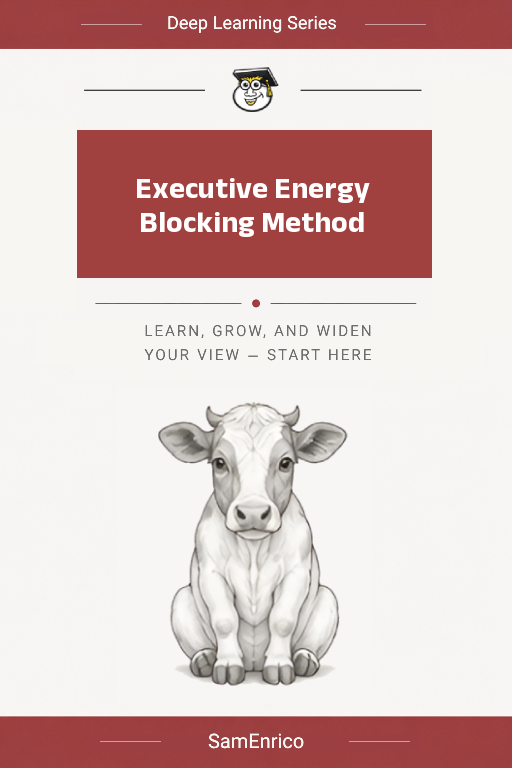
Non-FictionProfessional's Cheat SheetEnergy Management
Executive Energy Blocking Method eBook
Aligns time blocks with natural energy rhythms, ma
by Coe Ronald
Aligns time blocks with natural energy rhythms, matching high-focus work to peak mental performance periods.
Formats
Free sample
Chapter 1: The Linear Lie--–- On a Tuesday morning in Chicago, a 44-year-old CEO named Sarah sat down at her desk at 8:45 AM with a triple-shot espresso, a back-to-back calendar of eleven meetings, and the quiet conviction that she was failing. She had read all the productivity books. She time-blocked religiously. She woke up at 5:30 AM to get ahead of email. And yet, by 3:00 PM every single day, her brain felt like wet cement.
She made decisions she regretted. She snapped at her direct reports. She pushed her deepest strategic work to 10 PM, when she was too tired to do it well, then fell asleep anxious about the next day. Sarah was not lazy. She was not undisciplined.
She was fighting her own biology—and losing.This chapter dismantles the most damaging myth in executive performance: the belief that a successful workday means working steadily from 9 AM to 6 PM with equal focus throughout. That myth is not only false; it is biologically dangerous. Drawing on circadian neuroscience, ultradian rhythm research, and decision-fatigue studies, this chapter introduces the foundational concept of the Energy Arc—Peak, Trough, and Recovery—and reveals the startling cost of ignoring your body’s natural clock. By the end of this chapter, you will understand why your current schedule is working against you and why the solution is not more discipline, but better alignment.The Myth and Its Origins The linear workday is a relatively recent invention. Before the Industrial Revolution, human work followed natural light and biological need.
Farmers worked intensely at dawn, rested during the hottest part of the day, and returned to lighter tasks in the late afternoon. Artisans worked in bursts, not marathons. The idea that a human being should sit at a desk from nine to six, producing the same quality of output every hour, emerged from factory efficiency models—not from any understanding of the human brain.In the late nineteenth century, Frederick Winslow Taylor introduced scientific management, which treated workers as interchangeable machines. Taylorism assumed that if you gave a person a desk, a chair, and a task, they would produce at a steady rate for eight to ten hours. That assumption was wrong then and it is wrong now.
But it has calcified into the default structure of modern white-collar work. Most executives inherit this schedule without questioning it. They build time-blocked calendars that ignore their own energy fluctuations, then blame themselves when they hit the proverbial wall at 2:30 PM.The cost of this self-blame is enormous. When executives fail to focus in the afternoon, they assume they need more caffeine, more willpower, or a stricter calendar. They rarely consider that their brain is following a predictable biological pattern that no amount of discipline can override.
This chapter renames that pattern the Energy Arc and gives you the language to understand why your afternoon slump is not a personal failing but a physiological fact.The Energy Arc: Peak, Trough, Recovery Every human body follows a predictable 24-hour pattern of alertness, governed by the suprachiasmatic nucleus—a tiny region in the hypothalamus that acts as the body’s master clock. This clock regulates the release of cortisol, melatonin, and other neurotransmitters that determine when you feel sharp, foggy, or something in between. For the vast majority of people, that pattern follows a three-part structure that we call the Energy Arc.The Peak is your window of highest cognitive function. It typically occurs in the late morning, roughly two to four hours after natural awakening. During the Peak, your brain releases optimal levels of cortisol and acetylcholine, which enhance working memory, cognitive flexibility, and inhibitory control—the three pillars of executive function.
In plain language, the Peak is when you are best equipped to solve complex problems, make strategic decisions, and process new information. For most people, this window lasts between two and three hours. For early risers (Lions), it may come earlier; for night owls (Wolves), it may shift toward late morning or even early afternoon. But regardless of chronotype, the Peak is a finite resource.The Trough is the post-lunch dip, and it is not caused by lunch. Many executives believe that eating a heavy meal causes the afternoon slump, and they try to solve it with salad, no carbs, or intermittent fasting.
While meal composition matters, the Trough is primarily driven by your circadian rhythm. Between roughly 1:00 PM and 4:00 PM, your body temperature drops slightly, melatonin rises (yes, in the afternoon), and your brain shifts toward a lower arousal state. This is not a bug; it is a feature. The Trough is evolution’s way of conserving energy for the second half of the day. But in a modern office, it feels like a betrayal.
Your ability to focus, reason, and resist distraction can drop by as much as 50 percent during this window. Complex tasks take longer. Errors increase. And emotional regulation—the capacity to stay patient and empathetic—erodes significantly.The Recovery is a secondary, milder rise in energy that occurs in the late afternoon, typically between 4:00 PM and 6:00 PM. Unlike the Peak, which is analytical and linear, the Recovery is associative and creative.
During the Recovery, your brain shifts away from focused, detail-oriented thinking and toward diffuse, pattern-matching cognition. This is when you are most likely to have sudden insights, creative breakthroughs, or solutions to problems that seemed unsolvable earlier. The Recovery is not as sharp as the Peak, but it is far from useless. In fact, many executives waste the Recovery by continuing to grind through analytical work, when they would be better served shifting to brainstorming, collaboration, or reflective thinking.The Energy Arc is not a theory; it is a measurement. Hundreds of studies using actigraphy, f MRI, and salivary cortisol have confirmed that human cognitive performance follows this three-part shape across nearly all ages, cultures, and professions.
The only variables are the timing and intensity of each phase, which depend on your chronotype, age, and sleep quality. But the existence of the Arc itself is universal.The 20-Point IQ Drop What happens when you ignore the Energy Arc and try to force analytical work into your Trough? The data are alarming. A landmark study from the University of Michigan’s Sleep and Performance Research Center found that circadian misalignment—working against your body’s natural rhythm—can lower executive function scores by the equivalent of 20 IQ points. To put that in perspective, a 20-point drop is the difference between a sharp, strategic leader and someone who struggles to follow a multi-step instruction.
It is the difference between catching an error in a financial model and signing off on a multimillion-dollar mistake.Executive function comprises three components: working memory (holding information in mind while manipulating it), cognitive flexibility (switching between tasks or perspectives), and inhibitory control (resisting distractions and impulsive responses). All three deteriorate during the Trough. A study published in the journal Cognition found that participants tested at 3:00 PM made significantly more errors on a complex reasoning task than the same participants tested at 10:00 AM, even when controlling for sleep, food intake, and caffeine. Another study from the Federal Reserve Bank of New York analyzed judicial decisions and found that judges were…
This is the end of the free sample. Get the eBook to keep going. Buy now
About this book
Details
- Author
- Coe Ronald
- Publisher
- SamEnrico
- Language
- English
- Genre
- Non-Fiction, Professional's Cheat Sheet, Energy Management
- Released
- 2026-05-28
- Pages (approx.)
- 143
- Available as
- eBook, Audiobook

Read better in the ZLOADR app
Your eBooks on your phone or tablet. Sign in with your SamEnrico account and start reading.
More by Coe Ronald
 Task Triage Emergency MethodCoe Ronald$11.99
 French Resistance Priest NetworksCoe Ronald$11.99
 Oven Phobia Cooking Low Temp PlanCoe Ronald$11.99
 Self Assessment AI PromptsCoe Ronald$11.99
 The Eisenhower Matrix Productivity GuideCoe Ronald$11.99
 The Silk Weavers of Lyon: Threads of a Textile RevolutionCoe Ronald$11.99
 Understanding Maternal HyperphenylalaninemiaCoe Ronald$17.99
 Remote Review Future TrendsCoe Ronald$12.99
 PapermacheCoe Ronald$11.99
 How to Become a Trust-vault ClerkCoe Ronald$11.99
You may also like
 Hong Kong Handover 1997Dunn Johnnie$11.99
 Zumba For Postnatal Recovery CourseNeal Christian$11.99
 Zumba for BeginnersLadner Nikia$11.99
 YouTube Comment Mining GuideHumes Pandora$12.99
 Worry Box MeditationCarlin Rudy$11.99
 Workplace Stress MeditationNguyen Lynn$11.99
 Workplace Stress and Sleep RepairHawley Ivory$11.99
 Workplace Perfectionism CureDelaney Jeffry$11.99
 Workplace Injustice Anger GuideWallen Isabelle$11.99
 Work Addiction and Burnout LinkGreenwood Ester$11.99
 Women in Yoga and WellnessBeattie Galina$11.99
 Women in Stand Up ComedyChun Evangeline$11.99