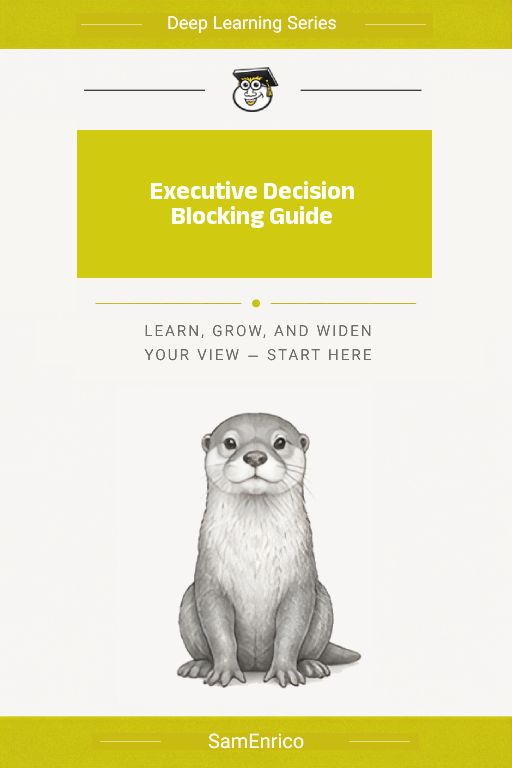
Executive Decision Blocking Guide eBook
Reserves specific blocks for high-stakes decisions
Reserves specific blocks for high-stakes decisions, using preparation and follow-up windows to improve choice quality.
Formats
Free sample
Chapter 1: The 35,000 Decision Trap--–- The email arrived at 7:42 AM on a Tuesday. Within ninety seconds, the CEO had skimmed it, sighed, and fired off a reply approving a 2.3millionvendorcontractchange.Thedecisiontooklesstimethanbrewingacupofcoffee.Sixmonthslater,thatsamedecisioncostthecompany2.3 million vendor contract change. The decision took less time than brewing a cup of coffee. Six months later, that same decision cost the company 2.3millionvendorcontractchange.Thedecisiontooklesstimethanbrewingacupofcoffee.Sixmonthslater,thatsamedecisioncostthecompany4.7 million in remediation, legal fees, and lost customer goodwill. When asked what he was doing at 7:42 AM on that Tuesday, the CEO couldn't remember.
"Probably checking email while walking to the car," he said. "It seemed straightforward at the time."This is not an unusual story. It is, in fact, the single most common failure mode of modern executive leadership: making irreversible decisions in reversible states of mind.The Arithmetic of Cognitive Collapse Let us begin with a number that will either frighten you or make you feel profoundly seen: 35,000.According to decision research compiled in Bulletproof Decisions and validated by multiple longitudinal studies of knowledge workers, the average executive makes approximately 35,000 decisions per day. The vast majority are trivial—what to eat, which email to answer first, whether to approve a routine expense report. But nestled inside that avalanche of triviality are the decisions that matter: the acquisitions, the hiring of key executives, the strategic pivots, the million-dollar vendor selections, the public statements that shape market perception.Here is the problem that this entire book exists to solve: the human brain cannot distinguish between trivial and consequential decisions when it is exhausted, interrupted, or rushed.The neurological machinery that processes "which shirt should I wear" is the same machinery that processes "should we acquire this competitor for $50 million." The difference is not in the hardware—it is in the context.
And context is the first casualty of the always-on executive culture.Consider the research on decision fatigue, pioneered by social psychologist Roy Baumeister and later popularized in business literature. When a person makes a series of decisions in rapid succession, the quality of each subsequent decision degrades. This is not a character flaw; it is a biological fact. Glucose depletion, cognitive load accumulation, and the sheer exhaustion of constant choice all conspire to turn a brilliant executive into a mediocre one by 3:00 PM.Yet the modern leadership playbook celebrates exactly this degradation. We admire the executive who answers emails at 11:00 PM, who takes calls during dinner, who "crushes it" by moving from meeting to meeting without a breath.
We have mistaken velocity for velocity, and in doing so, we have normalized a decision-making environment that is perfectly designed to produce bad outcomes.The Firefighter and the Fortress Builder Before we go any further, I want to introduce two archetypes that will appear throughout this book. You will recognize one of them immediately because you have been living inside that person's calendar for years. The other may feel aspirational, even slightly impossible. It is not. I have seen hundreds of executives make the transition, and the ones who do never go back.The Firefighter wakes up already behind.
Their calendar is a patchwork of back-to-back meetings with no gaps, no buffers, no white space. They make decisions in the hallway between calls, in the elevator on the way to a presentation, while scanning Slack during a budget review. They are proud of their responsiveness—"I never let anything sit for more than an hour"—and they wear their exhaustion like a medal. The Firefighter confuses activity with progress, responsiveness with leadership, and speed with wisdom. Their high-stakes decisions are made in low-stakes conditions: tired, distracted, and often while doing something else entirely.The Firefighter's team loves them for their accessibility and hates them for their inconsistency.
Because decisions made in haste are often reversed in remorse. A Firefighter might approve a project on Tuesday morning and kill it on Thursday afternoon, having forgotten the context of the original approval. This oscillation creates chaos, erodes trust, and forces everyone else to work twice as hard to compensate for the executive's lack of discipline.The Fortress Builder operates by a completely different set of rules. They protect their cognitive reserves the way a banker protects capital reserves—not because they are selfish, but because they understand that depletion leads to failure. The Fortress Builder says no to meetings without agendas, no to last-minute requests without context, and no to the dopamine hit of immediate responsiveness.
They have learned that the best answer to most requests is "I will get back to you by Thursday," not because they are slow, but because they are deliberate.The Fortress Builder distinguishes sharply between reversible decisions (low stakes, easy to undo) and irreversible decisions (high stakes, costly or impossible to reverse). For the former, speed is acceptable. For the latter, speed is a trap. And they have built their entire professional life around ensuring that when an irreversible decision arrives, they have the time, energy, and focus to make it well.This book is the instruction manual for retiring the Firefighter and becoming the Fortress Builder. The remaining eleven chapters will give you the specific tools, frameworks, and habits to make this transition.
But it begins with a single, uncomfortable question: how many high-stakes decisions did you make last week while exhausted, distracted, or between meetings?If the answer is more than zero, you are operating a Firefighter system. And Firefighter systems eventually burn down.The Reversibility Matrix: Your First and Most Important Tool Let us now introduce the foundational framework upon which everything else in this book rests. It is simple enough to draw on a napkin and profound enough to transform your career.The Reversibility Matrix is a 2x2 grid. The vertical axis measures the stakes of a decision (low to high). The horizontal axis measures the reversibility of a decision (easy to undo to costly or impossible to undo).
Most decisions fall into one of four quadrants.Quadrant 1: Low Stakes, Reversible. These are the trivial choices of daily life and work. Which font should we use on this slide? Should the team lunch be sandwiches or salads? Do we reply to this email now or after the next meeting?
These decisions require almost no cognitive investment. Delegate them, automate them, or make them quickly and move on.Quadrant 2: High Stakes, Reversible. This is the quadrant where most operational decisions live. Hiring a mid-level manager is high stakes but reversible—a bad hire can be fired (with difficulty, but it can be done). Launching a new feature is high stakes but reversible—you can roll it back.
Entering a new geographic market is high stakes but reversible—you can exit. These decisions deserve attention and process, but they do not demand the full Fortress treatment.Quadrant 3: Low Stakes, Irreversible. This quadrant is almost empty in well-run organizations. The only truly low-stakes irreversible decision is a rare bird, like a public statement that cannot be retracted or a customer interaction that cannot be undone. Most executives spend very little time here.Quadrant 4: High Stakes, Irreversible.
This is the danger zone. Acquiring another company. Firing a beloved senior executive. Making a public commitment to a controversial strategy. Betting the company on a new product line.
Accepting a government settlement. These decisions cannot be undone, or can only be undone at catastrophic cost. They deserve the…
This is the end of the free sample. Get the eBook to keep going. Buy now
About this book
Details
- Author
- Marchand Mammie
- Publisher
- SamEnrico
- Language
- English
- Genre
- Non-Fiction, Professional's Cheat Sheet, Decision Making
- Released
- 2026-05-28
- Pages (approx.)
- 146
- Available as
- eBook, Audiobook

Read better in the ZLOADR app
Your eBooks on your phone or tablet. Sign in with your SamEnrico account and start reading.
More by Marchand Mammie
 LGBTQ Conversion Therapy Attempt SurvivorMarchand Mammie$11.99
 Nuclear War Fear Simulation FactMarchand Mammie$11.99
 Norwegian Fishermen Mine SweepersMarchand Mammie$11.99
 Twitch Streaming Addiction GuideMarchand Mammie$11.99
 The Chronic Stress Menopause SeverityMarchand Mammie$11.99
 The Last Stand of the Turtle King: A Forgotten Warrior's RiseMarchand Mammie$11.99
 PaperhangerMarchand Mammie$11.99
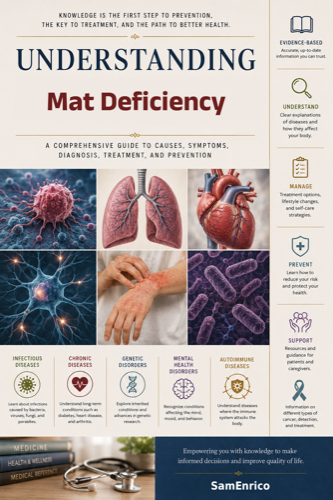 Understanding Mat DeficiencyMarchand Mammie$17.99
 Remote Review Stakeholder AlignmentMarchand Mammie$12.99
 How to Become a DiverMarchand Mammie$11.99