
Non-FictionStudent's ShortcutBinary Models
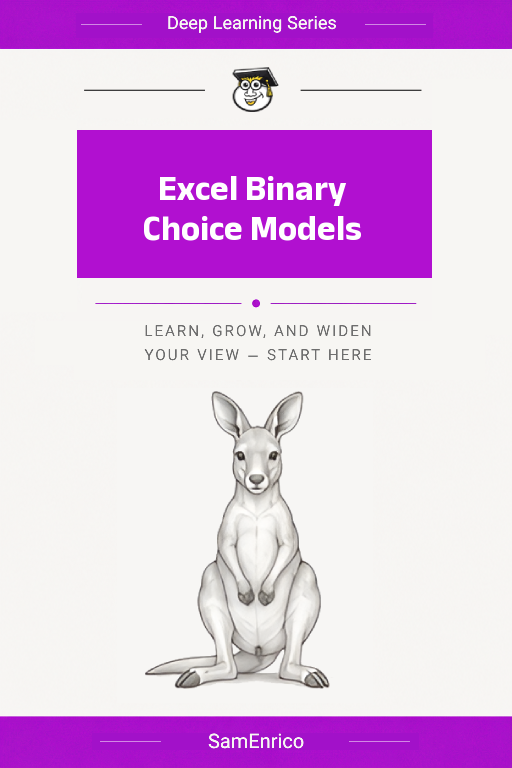
Excel Binary Choice Models eBook
Models binary economic decisions (buy/sell, work/n
by Finley Gayle
Models binary economic decisions (buy/sell, work/not work) using linear probability models and logit approximations in Excel.
Formats
Free sample
Chapter 1: The Prediction Trap--Every day, millions of business decisions hinge on a single, deceptively simple question: yes or no? Should we approve this loan? Will this customer buy? Is this transaction fraudulent? Will this employee quit?
These are binary choice problems, and most organizations answer them with gut instinct, rule of thumb, or expensive intuition dressed up as expertise.The result is billions of dollars in avoidable losses.This book exists because you already own the most powerful tool for solving these problems correctly. You have Microsoft Excel on your computer right now. You have data sitting in spreadsheets that could predict customer behavior, reduce risk, and improve decisions. And until now, you have been told that predicting "yes or no" requires expensive statistical software, programming skills in Python or R, or a graduate degree in econometrics.That is simply false.This chapter will show you why standard approaches fail when the answer is binary, why the solution is more intuitive than you think, and how the next eleven chapters will transform you from a person who guesses into a person who knows. You will learn why your boss's favorite metric—the straight-line trend—becomes a dangerous liar when the outcome is a choice, and you will see the first glimpse of the elegant "S" curve that saves the day.
No formulas yet. No Excel heavy lifting. Just a fundamental shift in how you see prediction problems.By the end of this chapter, you will understand why you have been losing the prediction game and why that is about to change.The $100 Million Mistake Most Companies Make Let me tell you about a telecom company I consulted with several years ago. We will call them Telco Atlantic. They had a problem: customers were leaving at an alarming rate.
The marketing department had a theory: price sensitivity. The operations department had a different theory: poor customer service. The finance department had a third theory: contract terms were too rigid.Everyone had a theory. No one had a prediction.The CEO demanded action. The marketing team proposed a blanket discount for all customers—a $15 million gamble that would reduce prices across the board.
The logic seemed sound: if price is the problem, fix the price. But here is what they did not know: which customers were actually at risk of leaving. They treated every customer the same, spending millions to retain people who were never going to leave while doing too little for the ones who were.The discount launched. Churn dropped slightly. Profits dropped dramatically.
The company had spent $15 million to lose money on customers who would have stayed anyway.This is the Prediction Trap in action: making expensive decisions without knowing the probability of the outcome you care about.Now imagine an alternative. What if, before launching that discount, Telco Atlantic had built a model that took each customer's data—monthly bill, service calls, contract type, tenure, usage patterns—and produced a single number: the probability that this specific customer will leave in the next thirty days?With those probabilities, they could have targeted only the high-risk customers. They could have offered discounts only to people who were actually considering leaving. They could have saved tens of millions of dollars.This is what binary choice models do. They take data you already have and transform it into actionable probabilities for yes/no decisions.
And the remarkable thing is that Excel—the software already on your computer—can build these models.The Great Confusion: Quantity Prediction vs. Choice Prediction Before we build anything, we need to understand why predicting a choice is fundamentally different from predicting a quantity. This distinction is the source of most failed prediction efforts, and understanding it will save you years of frustration.When you predict a quantity—say, next month's sales in dollars, tomorrow's temperature in degrees, or a house's price in thousands—you are working with continuous numbers. Sales can be 100,000or100,000 or 100,000or101,000 or $99,500. Temperature can be 72 degrees or 73 degrees or 71.5 degrees.
There are infinite possibilities between the extremes.When you predict a choice, you are working with binary outcomes. A customer either buys or does not buy. A loan either defaults or does not default. An employee either quits or stays. There are exactly two possibilities: 0 or 1, yes or no, true or false.This difference seems trivial.
It is not. It changes everything about how prediction works.The Line That Lies Here is the core problem: most of us learn prediction through the lens of the straight line. In school, we learn linear regression as the default tool for prediction. In business, we draw trendlines through scatterplots. Our brains are wired to see patterns as lines.For continuous outcomes, the line works beautifully.
Plot advertising spend against sales revenue, and you will see points clustering around a straight line. Draw that line through the cloud of points, and you can predict sales for any level of advertising. The line might be slightly off—no prediction is perfect—but it will be directionally correct.For binary outcomes, the straight line becomes a liar.Imagine you are trying to predict whether a customer will buy a product based on their income. You have data on one hundred customers. For each customer, you know their income and whether they purchased (1) or did not purchase (0).
You plot the data. What do you see?You do not see a cloud of points around a line. You see two horizontal lines: one at 1 (the buyers) and one at 0 (the non-buyers). All the buyers are scattered along the top of the chart. All the non-buyers are scattered along the bottom.
There is nothing in between.Now draw a straight line through this. The line will slope upward from left to right—higher income, higher probability of purchase—but it will also go places it should not. Extend the line far enough to the left, and it will predict negative probabilities. Extend it far enough to the right, and it will predict probabilities above 100 percent.Negative probability is nonsense. Probability above 100 percent is nonsense.
But the straight line produces nonsense inevitably.Why Your Intuition About Probability Is Wrong Even without math, most people have a flawed intuition about probability. We tend to think of probability as something that changes by constant increments. For example, we might think that if a 10discountincreasespurchaseprobabilityby5percentagepoints,thena10 discount increases purchase probability by 5 percentage points, then a 10discountincreasespurchaseprobabilityby5percentagepoints,thena20 discount should increase it by 10 percentage points. This is the logic of the straight line.But real probability does not work this way. The relationship between a driver (like discount size) and a probability is almost always curved.
It follows an "S" shape.Here is why. Imagine a customer who is extremely unlikely to buy—say, a 1 percent probability. A small discount might increase that probability to 2 percent. That is a doubling of the probability, but only a 1 percentage point increase. Now imagine a customer who is already very likely to buy—say, an 90 percent probability.
The same small discount might increase that probability to 92 percent. Again, only a 2 percentage point increase.Now imagine a customer in the middle—a 50 percent probability. The same small…
This is the end of the free sample. Get the eBook to keep going. Buy now
About this book
Details
- Author
- Finley Gayle
- Publisher
- SamEnrico
- Language
- English
- Genre
- Non-Fiction, Student's Shortcut, Binary Models
- Released
- 2026-05-29
- Pages (approx.)
- 128
- Available as
- eBook, Audiobook

Read better in the ZLOADR app
Your eBooks on your phone or tablet. Sign in with your SamEnrico account and start reading.
More by Finley Gayle
 King vs FBI SurveillanceFinley Gayle$11.99
 Interfaith Couple Self EsteemFinley Gayle$11.99
 Kigali Founder Failure StoriesFinley Gayle$11.99
 The Boredom Spending Fix GuideFinley Gayle$11.99
 Seated Body Scan MeditationFinley Gayle$11.99
 Ipsus: The Bloodbath That Shattered Alexander's LegacyFinley Gayle$11.99
 Understanding PseudohypoaldosteronismFinley Gayle$17.99
 Dungeon KeeperFinley Gayle$11.99
 Gender Discrimination TrapFinley Gayle$12.99
 How to Become a Opener IiFinley Gayle$11.99
You may also like
 Hong Kong Handover 1997Dunn Johnnie$11.99
 Zumba For Postnatal Recovery CourseNeal Christian$11.99
 Zumba for BeginnersLadner Nikia$11.99
 YouTube Comment Mining GuideHumes Pandora$12.99
 Worry Box MeditationCarlin Rudy$11.99
 Workplace Stress MeditationNguyen Lynn$11.99
 Workplace Stress and Sleep RepairHawley Ivory$11.99
 Workplace Perfectionism CureDelaney Jeffry$11.99
 Workplace Injustice Anger GuideWallen Isabelle$11.99
 Work Addiction and Burnout LinkGreenwood Ester$11.99
 Women in Yoga and WellnessBeattie Galina$11.99
 Women in Stand Up ComedyChun Evangeline$11.99