
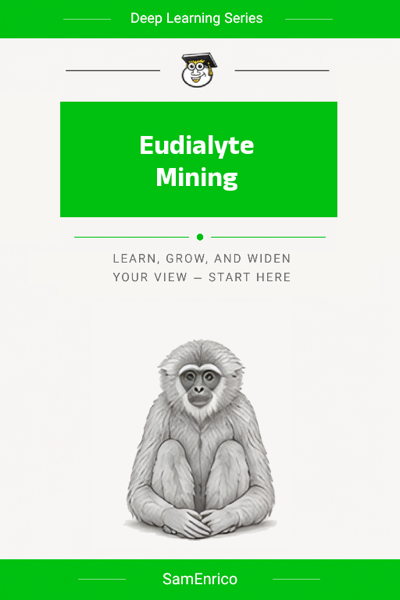
Eudialyte Mining Audiobook
A Coursebook on Eudialyte Mining
A Coursebook on Eudialyte Mining
Formats
Free sample
Chapter 1: The Radioactive Lie...--For fifty years, the world has been told a simple story about rare earth elements. You cannot mine them without accepting radioactive waste. The bastnäsite deposits of China’s Inner Mongolia, the monazite sands of Australia and Brazil, the weathered clays of southern China—all of them carry thorium and uranium as unavoidable companions. Every ton of rare earth concentrate produced from these ores generates approximately 1.4 tons of radioactive tailings. These tailings must be stored forever, monitored for centuries, and kept away from groundwater, crops, and human habitation.
The industry has accepted this as the cost of doing business. Environmental regulators have accepted it as the price of green technology. And the public has largely remained unaware that the magnets in their electric vehicles and wind turbines were born from radioactive feedstock.But what if the story was incomplete? What if there existed a rare earth mineral that contained almost no thorium, almost no uranium, and yet could be processed into the same neodymium, dysprosium, and terbium that power the clean energy revolution? What if this mineral had been known to mineralogists for more than two centuries, yet dismissed as too low-grade, too difficult, too obscure to ever matter?
What if the only reason it remained in the shadows was not because it was technically impossible to process, but because the world had organized its rare earth supply chain around a different, dirtier, cheaper source and never looked back?This book is about that mineral. Its name is eudialyte. And its story is one of geological accident, Cold War secrecy, metallurgical stubbornness, and a belated realization that the environmental cost of our green future may not be as inevitable as we have been led to believe.The Strategic Silence Around Radioactivity To understand why eudialyte matters, one must first understand the radioactive burden of conventional rare earth mining. Bastnäsite, the mineral that underpins China’s dominance of the global rare earth market, typically contains between 0.3 and 0.5 percent thorium oxide by weight. Monazite, another common source, can contain 4 to 12 percent thorium oxide plus measurable uranium.
These numbers may seem small, but they accumulate catastrophically at industrial scale. The Bayan Obo mine in Inner Mongolia, the world’s largest rare earth deposit, has produced hundreds of millions of tons of tailings containing an estimated 200,000 tons of thorium. There is no permanent disposal solution for this material.…
This is the end of the free sample. Get the Audiobook to keep going. Buy now
About this book
Details
- Author
- Dominguez Mammie
- Publisher
- SamEnrico
- Language
- English
- Genre
- Non-Fiction, Informative, Educational
- Released
- 2026-06-02
- Pages (approx.)
- 150
- Available as
- eBook, Audiobook

Listen in the VoxFlicks app
Audiobooks and audio dramas wherever you go. Sign in with your SamEnrico account and press play.
More by Dominguez Mammie
 Imposter Syndrome in Creative FieldsDominguez Mammie$11.99
 TM ADHD Focus AidDominguez Mammie$11.99
 Async Meeting Notes Culture GuideDominguez Mammie$11.99
 Opioid Tapering from Chronic UseDominguez Mammie$11.99
 EQ for Social JusticeDominguez Mammie$11.99
 The Poisoned Peaks: The Medieval Alpinist Who Unlocked the Secrets of the AlpsDominguez Mammie$11.99
 How to Start a Breadboards Made of Wood Business (Beginners Guide)Dominguez Mammie$11.99
 Flash Sale Zero Tool GuideDominguez Mammie$12.99
 Going Dark Clause UpdateDominguez Mammie$12.99
 Understanding Cranio OsteoarthropathyDominguez Mammie$17.99