
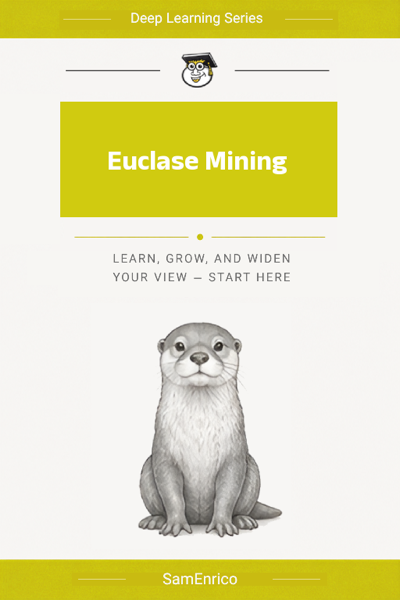
Non-FictionInformativeEducational
Euclase Mining eBook
A Coursebook on Euclase Mining
by Custer Cruz
A Coursebook on Euclase Mining
Formats
Free sample
Chapter 1: The Stone That Would Not Die...--–- In the autumn of 1792, a Russian peasant named Stepan made a discovery that would haunt the gem world for more than two centuries. He was not looking for treasure. He was not a miner, a prospector, or even particularly interested in rocks. He was a simple man trying to get home before a storm, and the mountain had other plans for him.The Urals in October are unforgiving. The days are short, the nights are cold enough to freeze water in a leather bottle, and the weather can turn from clear to deadly in the space of an hour.
Stepan had been traveling from the village of Mursinka to Yekaterinburg, carrying a small sack of copper ore samples for a merchant who had promised him five rubles upon delivery. He knew the route well. He had walked it a dozen times before. But on this day, a fog rolled down from the higher slopes, and then the fog turned to rain, and then the rain turned to a downpour so violent that Stepan could not see ten paces in front of him.He sought shelter in the only place available: a narrow fissure in a granite outcrop, barely wide enough for a man to squeeze through. The fissure angled downward at a steep slope, and Stepan had to crawl on his hands and knees to get out of the rain.
He dragged his sack of ore behind him, cursing under his breath. The fissure opened after a few body lengths into a small cavity, perhaps the size of a bread oven, lined with crystals that glowed blue in the light of his candle.Stepan had never seen anything like them. He had seen quartz crystals before—the mountains around Mursinka were full of them—but these were different. They were blue, for one thing, a deep, intense blue that reminded him of the sky just after sunset. They were transparent, or nearly so, and they caught the candlelight and threw it back in a way that made his eyes water.
He reached out and touched the largest of them, a crystal about the length of his thumb, and it came away from the cavity wall with a gentle twist of his fingers.He held it in his palm and examined it by candlelight. The crystal was prismatic, elongated, with a strange chisel-shaped termination at one end and a rough, broken surface at the other. Its faces were marked by fine parallel lines that ran the length of the crystal, like the grooves on a plowed field. And it was cold, colder than the air around it, as if it had been waiting in the darkness for a very long time.Stepan filled his pockets with the loose crystals, the ones that came away easily. He did not know that he was handling them with extraordinary care.
He only knew that they felt precious, and precious things should not be forced. When he could fit no more into his coat, he crawled back out of the fissure, retrieved his sack of ore, and continued toward Yekaterinburg. The rain had stopped. The fog had lifted. The sun was setting behind the mountains, and Stepan walked into the golden light with his pockets full of stones he did not understand.Three days later, he spread his finds on a merchant's table in Yekaterinburg.
The merchant, a German named Friedrich Müller who had been buying and selling minerals from the Ural mines for twenty years, examined the crystals with a jeweler's loupe and a growing sense of confusion. They were not sapphires, despite their blue color; sapphires are harder and heavier. They were not beryl, despite their prismatic habit; beryl does not break with a light tap, and Müller discovered this by accidentally knocking one of the crystals off the table, where it struck the wooden floor and split cleanly in two. They were not topaz, despite their clarity and luster; topaz is harder and has a different crystal structure.Müller offered Stepan twenty rubles for the lot. Stepan accepted.
He had never held twenty rubles in his life. He returned to his village, bought a cow, and never went back to the mountain. The crystals passed into Müller's inventory, then into the collection of a Russian nobleman, then into the Imperial Academy of Sciences in Saint Petersburg, where they sat in a wooden cabinet for three decades, confounding every mineralogist who examined them.The cabinet was labeled simply "Unknown Blue Mineral from the Ural Mountains." It was a name that revealed nothing and everything. The stone would not be named because the stone would not be understood. And the stone would not be understood because it refused to behave like any other mineral the academy's curators had ever seen.The Curse of Perfect Cleavage What the academy's curators could not know—what they had no way of knowing without the benefit of X-ray crystallography, which would not be invented for another century—was that the stone's strange behavior was a consequence of its internal structure.
Euclase, as the French mineralogist René Just Haüy would eventually name it, possesses a property called perfect cleavage. This means that its crystal structure contains planes of weakness along which the atoms are bonded less strongly than in other directions. When a force is applied to a crystal, it tends to break along these planes, producing flat, smooth surfaces that reflect light with a pearly luster.Perfect cleavage is not unique to euclase. Diamond has perfect cleavage in four directions. Topaz has perfect cleavage in one direction.
Mica has perfect cleavage in one direction so pronounced that the mineral can be split into sheets thinner than a human hair. But euclase's perfect cleavage is different. It is not just perfect; it is aggressive. The force required to cleave a euclase crystal along its {010} plane—the plane parallel to the prism faces and perpendicular to the striations—is lower than the force required to cleave almost any other gemstone.Quantifying this is difficult, because the force required depends on the size of the crystal, the orientation of the applied force, and the presence of any microscopic flaws. But mineralogists who have studied the problem estimate that a euclase crystal one centimeter in length can be cleaved by a force as low as one newton.
That is approximately the force required to hold a hundred-gram apple in your hand. A drop of thirty centimeters onto a hard surface can generate forces many times that.This is why Stepan's crystal broke when it fell from Müller's table. This is why the miners of Ouro Preto learn to handle euclase with the same care they would give to eggshells. This is why the sorters wear padded gloves and use tweezers with rubber tips. This is why the cutters reject most of the rough they are sent.
The stone does not want to be cut. It does not want to be set. It does not want to be touched. It wants to be left alone in the dark cavities where it formed, and if you insist on bringing…
This is the end of the free sample. Get the eBook to keep going. Buy now
About this book
Details
- Author
- Custer Cruz
- Publisher
- SamEnrico
- Language
- English
- Genre
- Non-Fiction, Informative, Educational
- Released
- 2026-06-02
- Pages (approx.)
- 130
- Available as
- eBook, Audiobook

Read better in the ZLOADR app
Your eBooks on your phone or tablet. Sign in with your SamEnrico account and start reading.
More by Custer Cruz
 King Holiday CreationCuster Cruz$11.99
 Seniors Conversation GuideCuster Cruz$11.99
 Rural vs Urban GamersCuster Cruz$11.99
 Body Scan For Writers BlockCuster Cruz$11.99
 The Breathing Space MBSR TechniqueCuster Cruz$11.99
 Constantine the Great: Architect of ByzantiumCuster Cruz$11.99
 How to Start a Musical Instruments (commission Agent) Business (Beginners Guide)Custer Cruz$11.99
 Salesforce GuideCuster Cruz$12.99
 Ecommerce Marketing One Page PlanCuster Cruz$12.99
 Understanding Pterygium Syndrome X LinkedCuster Cruz$17.99
You may also like
 Hong Kong Handover 1997Dunn Johnnie$11.99
 Zumba For Postnatal Recovery CourseNeal Christian$11.99
 Zumba for BeginnersLadner Nikia$11.99
 YouTube Comment Mining GuideHumes Pandora$12.99
 Worry Box MeditationCarlin Rudy$11.99
 Workplace Stress MeditationNguyen Lynn$11.99
 Workplace Stress and Sleep RepairHawley Ivory$11.99
 Workplace Perfectionism CureDelaney Jeffry$11.99
 Workplace Injustice Anger GuideWallen Isabelle$11.99
 Work Addiction and Burnout LinkGreenwood Ester$11.99
 Women in Yoga and WellnessBeattie Galina$11.99
 Women in Stand Up ComedyChun Evangeline$11.99