
Non-FictionInformativeEducational
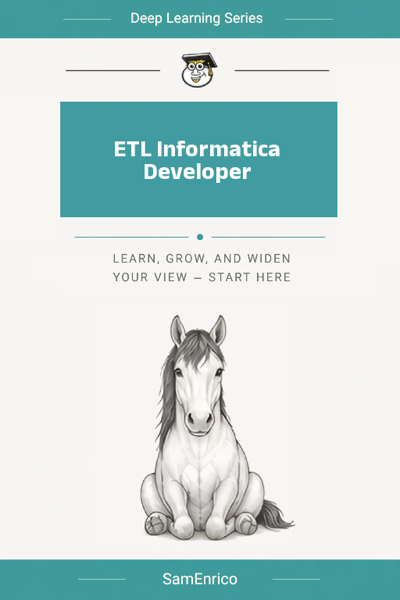
ETL Informatica Developer eBook
A Coursebook on ETL Informatica Developer
A Coursebook on ETL Informatica Developer
Formats
Free sample
Chapter 1: Beyond the Pipeline--The most dangerous phrase in data integration is not “the server crashed” or “the query is too slow.” It is this: “It worked on my machine.” I have watched brilliant developers spend weeks building complex mappings in isolation, only to discover that their carefully crafted logic fails the moment it touches production data. Not because the code was wrong, but because they misunderstood the fundamental role of an ETL developer. They thought the job was about moving data from point A to point B. In reality, the job is about architecting trust. Every row, every transformation, every workflow is a promise to the business that the numbers on the dashboard reflect reality.
Break that promise once, and regaining trust takes months. Break it twice, and you are looking for a new job.This book exists because the gap between “knowing Informatica” and “being a professional Informatica developer” is vast and unbridgeable by reference manuals alone. You can memorize every transformation, every configuration property, and every error code, and still be utterly unprepared for the first day on a real project. What separates a junior from a senior is not technical trivia—it is judgment. When to use a cached lookup versus an uncached one.
When to push logic to the database versus keep it in the engine. When to refactor a fragile mapping versus patch it for one more release. These decisions have no single correct answer, but they have many wrong ones. This chapter lays the foundation for developing that judgment.You are about to build a complete data warehouse for a fictional but brutally realistic company: Global Retail Group (GRG). GRG operates 450 stores across 12 countries, processes 2.3 million transactions per day, and generates over 300 gigabytes of operational data weekly.
Their existing reporting system is a mess of Excel spreadsheets, email attachments, and manual reconciliations. The CFO has demanded a centralized data warehouse within four months. You are the lead ETL developer. There is no plan B.The False Comfort of the “ETL Developer” Title Let us dispense with a dangerous myth immediately: you are not merely a developer. If you write Python scripts to move CSV files, you are a coder.
If you configure Informatica mappings by following a runbook written by someone else, you are an operator. An ETL developer—a real one—is equal parts software engineer, data architect, systems administrator, and business analyst. You do not just write mappings. You design data models. You diagnose network latency between database servers.
You explain to a vice president why the sales numbers changed between yesterday and today. You document lineage for auditors who assume you are hiding something.This multidimensional role explains why Informatica Power Center has survived for over two decades despite the rise of cloud-native competitors. Power Center is not the fastest tool, the cheapest tool, or the easiest tool to learn. But it is the most complete tool for enterprise-scale data integration. It handles heterogeneous sources natively—Oracle, SQL Server, DB2, Teradata, flat files, XML, web services—without requiring separate connectors or custom code.
It provides metadata-driven lineage out of the box, which auditors love. It supports graceful recovery from failures at the row level, not just the session level. Most importantly, it has a decade of institutional knowledge embedded in thousands of companies. Replacing Power Center means rewriting thousands of production mappings, a cost most organizations will never bear.Your task is not to defend Power Center against cloud tools. Your task is to know when Power Center is the right tool and when it is not.
That judgment comes from understanding its architecture intimately, which begins in this chapter.The Architecture Beneath the Interface Every Power Center developer starts in the Designer, dragging transformations and linking ports. It feels like playing with building blocks. But beneath that friendly interface lies a complex, distributed architecture that determines how your mappings behave in production. Ignore the architecture, and your mappings will fail in ways that make no sense from the Designer alone.The Domain, Nodes, and Services Hierarchy At the top level is the Domain, an administrative boundary that contains one or more Nodes (physical or virtual machines). Within the Domain, two services run:The Repository Service manages connections to the metadata database.
When you open the Designer and connect to a repository, you are communicating with this service. It handles authentication, object locking (preventing two developers from editing the same mapping), and metadata queries. The Repository Service has no role in data movement—it only serves metadata.The Integration Service is where data movement happens. When you start a workflow, the Integration Service reads the mapping metadata from the repository, connects to sources and targets, and begins processing rows. You can run multiple Integration Services on different nodes for workload isolation.
In enterprise deployments, it is common to have one Integration Service for development, one for QA, and one for production, each with different memory allocations and concurrent execution limits.Why this matters to you: When a mapping runs slowly, the problem is often in the Integration Service configuration, not the mapping logic. Perhaps the Integration Service has insufficient memory for a large lookup cache. Perhaps it is configured to use only two threads for partitioning. These settings are invisible from the Designer. You must know where to look—in the Workflow Manager, under Integration Service properties—to diagnose and fix them.The Repository: Your Metadata Heart The Repository is a standard relational database (Oracle, SQL Server, DB2, or Postgre SQL) containing hundreds of tables that store every object you create: source definitions, target definitions, mappings, workflows, sessions, and connections.
You never query these tables directly, but understanding their existence is crucial for three reasons:Backup and Recovery. If your repository database corrupts, you lose every mapping, every workflow, every configuration. Backing up the repository database is not optional. In most organizations, the DBA handles this, but you must verify that backups are occurring and test restores periodically.Version Control Integration. Power Center has no built-in version control comparable to Git.
The standard enterprise pattern is to export repository objects to XML files and store those XML files in Git. Chapter 11 covers this process in detail, but the prerequisite is understanding that XML export captures a snapshot of the repository at a point in time.Impact Analysis. When a source system changes—a column renames, a table partitions—you need to know which mappings will break. The repository stores lineage information: which source columns feed which target columns through which transformations. You can query this lineage through the Repository Manager or through SQL queries on the repository tables (if you have database access).
This is a superpower that scripting-based ETL tools lack entirely.The Client-Server Divide All Power Center client tools (Designer, Workflow Manager, Repository Manager, Monitor) run on your local machine and communicate with the server over TCP/IP. The server hosts the Domain, Repository Service, and Integration Service. This separation has profound implications:Your laptop does not need direct database access. The Integration Service connects to sources and targets. As long as your laptop can reach the server (typically over VPN), you can develop mappings without direct database credentials.
This is a security best practice.Performance is not limited by your network. The Integration Service runs on the server, which…
This is the end of the free sample. Get the eBook to keep going. Buy now
About this book
Details
- Author
- Carnes Chanda
- Publisher
- SamEnrico
- Language
- English
- Genre
- Non-Fiction, Informative, Educational
- Released
- 2026-06-02
- Pages (approx.)
- 132
- Available as
- eBook, Audiobook

Read better in the ZLOADR app
Your eBooks on your phone or tablet. Sign in with your SamEnrico account and start reading.
More by Carnes Chanda
 Cosmetics Paraben Free GuideCarnes Chanda$11.99
 Body Scan For Creative BlocksCarnes Chanda$11.99
 Middle East Gamer ProfileCarnes Chanda$11.99
 Teen Conversation StartersCarnes Chanda$11.99
 The Walking Meditation MBSR GuideCarnes Chanda$11.99
 The Kidnapping of Charley Ross: America's First High-Profile Child AbductionCarnes Chanda$11.99
 How to Become a Comparator OperatorCarnes Chanda$11.99
 B2C Marketing One Page PlanCarnes Chanda$12.99
 Biometrics for Express EntryCarnes Chanda$12.99
You may also like
 Hong Kong Handover 1997Dunn Johnnie$11.99
 Zumba For Postnatal Recovery CourseNeal Christian$11.99
 Zumba for BeginnersLadner Nikia$11.99
 YouTube Comment Mining GuideHumes Pandora$12.99
 Worry Box MeditationCarlin Rudy$11.99
 Workplace Stress MeditationNguyen Lynn$11.99
 Workplace Stress and Sleep RepairHawley Ivory$11.99
 Workplace Perfectionism CureDelaney Jeffry$11.99
 Workplace Injustice Anger GuideWallen Isabelle$11.99
 Work Addiction and Burnout LinkGreenwood Ester$11.99
 Women in Yoga and WellnessBeattie Galina$11.99
 Women in Stand Up ComedyChun Evangeline$11.99