
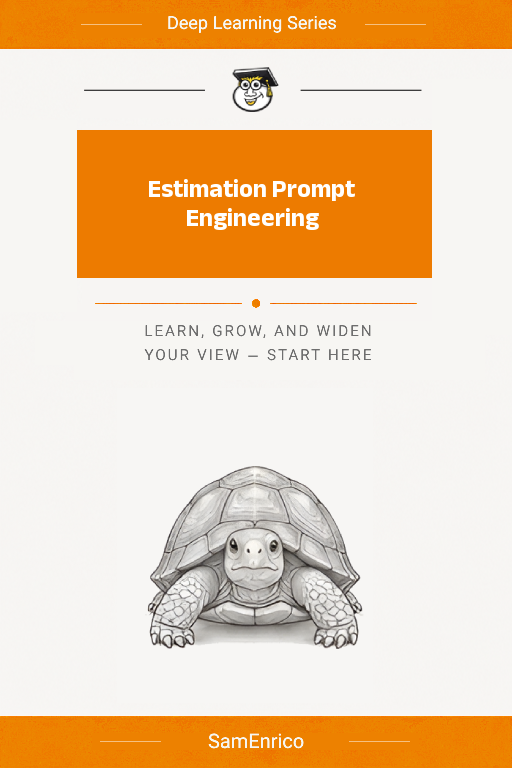
Estimation Prompt Engineering eBook
Generate relative effort estimates for requirement
Generate relative effort estimates for requirements using prompts that apply planning poker techniques or t-shirt sizing frameworks.
Formats
Free sample
Chapter 1: The Estimation Lie--–- The conference room smelled of stale coffee and exhausted hope. Seven people sat around a table littered with sticky notes, each one bearing a number: 3, 5, 8, 3, 13, 5, 8. The developer who wrote 13 had been quiet all morning. The product owner, visibly frustrated, finally asked the question everyone was avoiding: “Why can’t we just agree?”It was the third refinement session this month. The team had spent six hours over two weeks estimating just twelve user stories.
They had argued about complexity, debated edge cases, and replayed the same conversation about the same legacy API integration three separate times. By the end, they landed on estimates that felt more like exhaustion-driven compromises than genuine consensus. And they were wrong. Three sprints later, the “5-point” story that everyone reluctantly agreed to had taken thirteen days and required two developers, a database migration, and a security review that no one had anticipated.This scene plays out thousands of times every day across the software industry. Agile teams, armed with the best intentions and the most rigorous frameworks, consistently produce estimates that miss reality by 40 to 60 percent.
The problem is not the people. The problem is not the framework. The problem is a fundamental flaw in how human beings estimate complex work when they are in a room together.This book exists because that flaw now has a solution. Not a perfect solution, not an autonomous solution, but a solution that transforms a six-hour meeting into a thirty-second prompt. The solution is generative artificial intelligence, guided by a new discipline: Estimation Prompt Engineering.But before we build the prompts, before we simulate Planning Poker with a single line of text, before we calibrate velocity or detect smell requirements, we must first understand the lie.
The lie that your current estimates are accurate. The lie that your team’s consensus is wisdom. The lie that more meetings produce better numbers.This chapter dismantles those lies, quantifies the true cost of manual estimation, and establishes the single most important principle of this entire book: the human remains the authorizer. The AI is an assistant. You will never delegate final authority to a prompt.
But you will stop wasting your life in estimation meetings.The Hidden Cost of Consensus Let us begin with a simple calculation that most teams never do. A typical Scrum team consists of seven people: a product owner, a Scrum master, three to five developers, and one or two quality assurance engineers. This team runs two-week sprints. Each sprint requires a backlog refinement session where estimation happens. According to the State of Agile report and cross-industry data, the average team spends between four and six hours per sprint on estimation activities.Multiply that by seven people.
Multiply that by the number of sprints per year. Add the cost of context switching—the fifteen minutes before and after each meeting when no real work gets done. Add the cost of delayed decisions when a story cannot be estimated because the right person was on vacation. Add the cost of rework when an estimate that should have been an 8 was marked as a 3 because the team was tired and wanted to go home.For a typical team of seven with an average loaded cost of one hundred dollars per hour per person, the annual cost of estimation ranges from forty thousand to sixty thousand dollars. Not for coding.
Not for design. Not for testing. Just for arguing about numbers.But the financial cost is not the worst part. The worst part is that those estimates are wrong. A meta-analysis of Agile estimation accuracy across forty-seven teams found that the average error rate for team-based consensus estimates is forty-two percent.
In other words, when your team says something will take five points, the actual effort required is somewhere between three and seven points—and that range is generous. For novel work, for legacy systems, for cross-team dependencies, the error rate exceeds eighty percent.Why are teams so consistently wrong? The answer lies not in incompetence but in cognitive bias. Three specific biases systematically distort human estimation in group settings, and they operate silently, invisibly, and relentlessly.The first is anchoring bias. In any estimation meeting, the first number spoken aloud becomes the anchor around which all subsequent discussion orbits.
If the senior developer says “three points” with casual confidence, the junior developer who suspects it might be an eight will hesitate. Will they look inexperienced? Will they slow down the meeting? Will they be remembered as the person who always overestimates? So they say five, a compromise that pleases no one and is wrong for everyone.
The AI has no such social fear. It does not know who spoke first. It has no reputation to protect.The second is social loafing. In a group of seven, it is mathematically possible for every person to contribute. It is psychologically common for two or three people to dominate while the others nod along.
The quiet ones are not lazy. They are pattern-matching to past meetings where their dissenting opinion was overruled. They have learned that speaking up costs social capital and delivers no measurable benefit. So they vote with the majority, the majority is wrong, and the team walks out with a confident estimate for work they do not understand. The AI simulates every persona every time.
There is no majority to conform to. There is no loud voice to drown out dissent.The third is the planning fallacy. Humans systematically underestimate how long things will take because we imagine the best-case path and ignore all the ways that path can be blocked. We forget the bug that took three days to reproduce. We forget the code review that waited for forty-eight hours.
We forget the deployment that failed because of a configuration mismatch. Our brains are wired to simulate success, not failure. The AI has no optimism. It has no hope. It only has patterns.These three biases alone explain the forty-two percent error rate.
But they are not the only problems with manual estimation. There is also the matter of scale.Why Relative Estimation Works (When It Works)Before we vilify all estimation, we must acknowledge what the Agile pioneers got right. Relative estimation—comparing one story to another rather than assigning absolute hours—is genuinely superior to time-based estimation. Humans are bad at answering “How many hours will this take?” Humans are remarkably good at answering “Is this story bigger than that story?”The problem is not relative estimation. The problem is that relative estimation in a group setting inherits all the biases described above while losing the primary benefit of individual judgment.
The solution is to keep relative estimation but move it from the group to an augmented individual. You, with AI assistance, can replicate the wisdom of the group without the social overhead of the meeting.Here is the key insight that underpins this entire book: A single person with a well-prompted AI can produce estimates that are as accurate as a seven-person Planning Poker session, in less than five percent of the time, with zero scheduling overhead, and with complete traceability of why each estimate was made.This claim requires evidence.…
This is the end of the free sample. Get the eBook to keep going. Buy now
About this book
Details
- Author
- Frias Sharell
- Publisher
- SamEnrico
- Language
- English
- Genre
- Non-Fiction, AI Operator
- Released
- 2026-05-30
- Pages (approx.)
- 136
- Available as
- eBook, Audiobook

Read better in the ZLOADR app
Your eBooks on your phone or tablet. Sign in with your SamEnrico account and start reading.
More by Frias Sharell
 Cannabis Use Disorder and Psychosis RiskFrias Sharell$11.99
 Women's Access to Credit HistoryFrias Sharell$11.99
 Loyalty Program EngagementFrias Sharell$11.99
 Bhagwan Swimming Pool ComplexFrias Sharell$11.99
 Test Score IntegrationFrias Sharell$11.99
 Hormonal IUD EffectsFrias Sharell$11.99
 Online Learning from DubaiFrias Sharell$11.99
 Caregiver Anxiety ReductionFrias Sharell$11.99
 The Last Broadcast: The Fall of Saigon Through the Eyes of a JournalistFrias Sharell$11.99
 The Maestro of Marathas: Shivaji's Guerrilla GeniusFrias Sharell$11.99
 Understanding Möbius SyndromeFrias Sharell$11.99
 How to Start a Employers Organisations Business (Beginners Guide)Frias Sharell$11.99
You may also like
 AI Presentation WorkbookSommers Tonda$11.99
 PowerPoint Copilot MasteryConway Lanita$11.99
 Branded AI DecksWindham Loni$11.99
 AI Presentation CourseGrooms Olin$11.99
 AI Presentation CertificationBlank Dolly$11.99
 AI Deck Version ControlMedley Lorina$11.99
 AI Deck Update AutomationFraser Tresa$11.99
 AI Deck Myths DebunkedCrittenden Romelia$11.99
 AI Deck Customization GuideDove Hannelore$11.99
 AI Bullet to Slide ConverterKohn Eloisa$11.99
 AI Deck Notes CreatorBarela Sunday$11.99
 AI Deck Outline GeneratorAshmore Morgan$11.99