
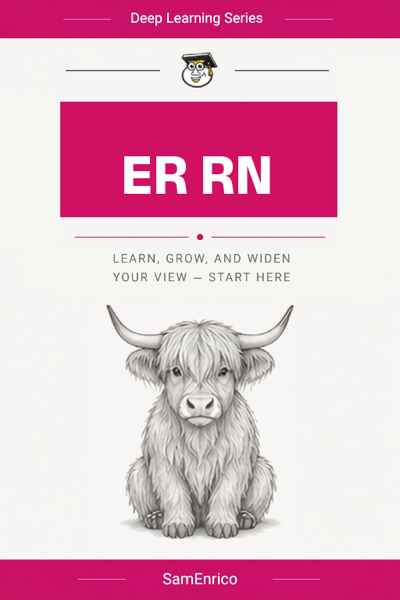
Non-FictionInformativeEducational
ER RN Audiobook
A Coursebook on ER RN
by Obryan Kyung
A Coursebook on ER RN
Formats
Free sample
Chapter 1: The Hidden Toolkit...--–- You are standing in the hallway of your first emergency department orientation, and the charge nurse has just handed you a pager, a set of trauma shears, and a piece of paper with four patient rooms scribbled on it. “Room 3 is crushing chest pain, Room 7 is a possible stroke, Room 12 is a psych hold who threw a chair at breakfast, and the waiting room has thirty-seven people who have been waiting an average of four hours. Go.”You look down at your new running shoes, touch the dark chocolate bar you stuffed in your pocket that morning, and realize that every textbook you read in nursing school did not prepare you for this specific moment. The beeping, the fluorescent lights, the family member crying two rooms down, the smell of antiseptic mixed with coffee and fear – this is the emergency department, and you are now one of its nurses.This chapter is not about pathophysiology. It is not about the Krebs cycle or nursing theory or the proper way to write a nursing diagnosis.
This chapter is about survival. It is about understanding the physical environment you have just entered, the tools you will need to find in the dark at three in the morning, the medications you will push before you have time to look up their side effects, and the unspoken rules that keep you safe, sane, and employed. Welcome to the hidden toolkit of the ER nurse. Everything in this chapter assumes you have already read the introduction, which established why ER nursing is fundamentally different from floor nursing – the undifferentiated patient, the compressed timeline, the chaos. Now let us put tools in your hands.The Geography of Chaos: Understanding Your ER's Zones Every emergency department is designed around a simple but often invisible logic: patients move from sickest to least sick, and so should you.
Before you can save anyone, you need to know where you are. Most ERs are divided into four zones, though the names vary by hospital. Learn yours on day one, not day thirty.The first zone is Resuscitation – commonly called Resus, the trauma bay, or Rooms 1-2. This is where the sickest patients go: cardiac arrests, multi-system trauma, respiratory failure, any patient who could die in the next five minutes. Resus bays are usually the closest rooms to the ambulance bay and the trauma elevator.
They have the most equipment – a dedicated crash cart, a rapid infuser for blood products, a video laryngoscope, an…
This is the end of the free sample. Get the Audiobook to keep going. Buy now
About this book
Details
- Author
- Obryan Kyung
- Publisher
- SamEnrico
- Language
- English
- Genre
- Non-Fiction, Informative, Educational
- Released
- 2026-05-08
- Pages (approx.)
- 137
- Available as
- eBook, Audiobook

Listen in the VoxFlicks app
Audiobooks and audio dramas wherever you go. Sign in with your SamEnrico account and press play.
More by Obryan Kyung
 US Gaming Market DemographicsObryan Kyung$11.99
 First Date Conversation GuideObryan Kyung$11.99
 King and Malcolm X DebateObryan Kyung$11.99
 Body Scan For Flight AnxietyObryan Kyung$11.99
 The Eight Week MBSR Course GuideObryan Kyung$11.99
 The Silent Champions: Europe's First Adaptive Athletes and the Birth of Paralympic SpiritObryan Kyung$11.99
 Understanding Pterygium ColliObryan Kyung$17.99
 SpaceX Hiring GuideObryan Kyung$12.99
 Customer Retention One Page PlanObryan Kyung$12.99
 How to Become a CompensatorObryan Kyung$11.99
You may also like
 Hong Kong Handover 1997Dunn Johnnie$11.99
 Zumba For Postnatal Recovery CourseNeal Christian$11.99
 Zumba for BeginnersLadner Nikia$11.99
 YouTube Comment Mining GuideHumes Pandora$12.99
 Worry Box MeditationCarlin Rudy$11.99
 Workplace Stress MeditationNguyen Lynn$11.99
 Workplace Stress and Sleep RepairHawley Ivory$11.99
 Workplace Perfectionism CureDelaney Jeffry$11.99
 Workplace Injustice Anger GuideWallen Isabelle$11.99
 Work Addiction and Burnout LinkGreenwood Ester$11.99
 Women in Yoga and WellnessBeattie Galina$11.99
 Women in Stand Up ComedyChun Evangeline$11.99