
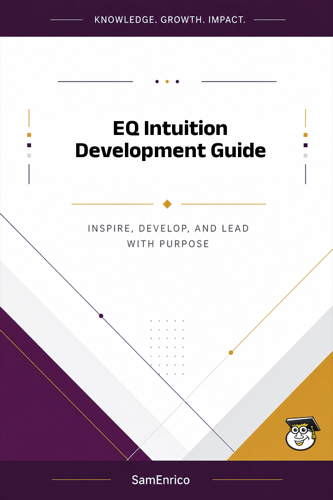
EQ Intuition Development Guide eBook
Sharpen emotional intuition to read rooms and peop
by Shanks Queen
Sharpen emotional intuition to read rooms and people more accurately.
Formats
Free sample
Chapter 1: The Pre-Game Reset--You are about to walk into a room. It could be a conference room with twelve executives, a coffee shop where you are meeting a potential romantic partner, or your own kitchen where a teenager is about to tell you where they have actually been tonight. In every case, you believe you are walking in to observe others. You are wrong.You are walking in to observe yourself first.This is the single most counter-intuitive truth about emotional intuition, and it is the reason most books on reading people have failed you. They hand you a catalog of body language cues—crossed arms mean defensive, dilated pupils mean attraction, looking left means lying—and send you into the world armed with lists.
You try to use these lists. You watch for the tells. And you are wrong again and again, not because the cues are false, but because you are trying to read a room through a dirty lens.Your own unprocessed internal state—anxiety, hunger, exhaustion, attraction, resentment, or simply the argument you had in the car—is that dirty lens. It does not just affect your mood. It actively changes what you see.
A neutral face becomes hostile. A tired colleague becomes passive-aggressive. A date who is genuinely nervous becomes deceptive. You are not reading the room. You are reading your own reflection bouncing off the walls.This chapter introduces the foundational ritual of this entire book: The Pre-Game Reset.
It is a thirty-second practice that you will perform before every high-stakes interaction for the rest of your life. It takes less time than tying your shoes. It will save you from more mistakes than any list of micro-expressions ever could.Most people are either too introspective or too analytical. The introspective type is deeply aware of their own feelings but blind to the external world. They walk into a room, feel anxious, and assume the room is anxious.
They are not reading others; they are projecting. The analytical type is the opposite. They have memorized every body language cue from every bestseller. They scan for tells like a security camera. But they miss the emotional context because they have not cleared their own static.
They see a crossed arm and call it defensive, when the person is simply cold.You need both channels. You need to track internal data—your pulse, your tension, your stomach, your biases—simultaneously with external data—their posture, their tone, their gaze, their feet. The magic is not in either channel alone. The magic is in the overlap.This book will teach you that overlap. But it starts here, with the internal channel.
Because if you cannot read yourself, you will never read anyone else accurately.The Shadow Filter Every human being walks around with what this book calls the Shadow Filter. It is the collection of unprocessed emotions, physical states, and cognitive biases that distort your perception before you even open your mouth.The Shadow Filter includes obvious things. Hunger. When your blood sugar is low, your brain prioritizes threat detection. You will see hostility where none exists.
Fatigue. When you are tired, your ability to distinguish subtle facial expressions drops by nearly forty percent. Anxiety. When you are worried about something unrelated—a deadline, a bill, a text you are waiting for—your brain will look for confirmation of that anxiety in the faces around you. Bias.
When you have a preconceived notion about someone—they are arrogant, they are incompetent, they are attractive—your brain will selectively notice evidence that confirms that story.The Shadow Filter also includes things you would never think to check. Posture. If you have been hunched over a laptop for four hours, your chest is compressed, your breathing is shallow, and your nervous system is in a low-grade stress response. You will feel threatened by neutral stimuli. Temperature.
If you are too hot or too cold, your brain allocates resources to thermal regulation, leaving fewer resources for social cognition. You will miss micro-expressions. Digestion. Your gut has its own nervous system—the enteric nervous system—and it communicates directly with your brain. A stomach ache is not just discomfort.
It is a distortion field.The most dangerous thing about the Shadow Filter is that you do not know it is there. It is like a smudge on a pair of glasses. You do not see the smudge. You see the world through the smudge and assume the world is blurry.This is why the most emotionally intelligent people in the world do something that looks strange to the rest of us. Before they enter a room, they stop.
They close their eyes for a moment. They breathe. They scan their own body. They ask themselves a series of brutal questions. And only then do they walk in.They are not being dramatic.
They are clearing the lens.Consider a case study that will sound painfully familiar to many readers. A manager named Sarah walks into her weekly team meeting. She is hungover—not severely, but enough. She is also fighting with her partner via text message. She sits down at the head of the table.
Her team is quiet. No one speaks first. Sarah looks around and feels a wave of anger. She is certain they are angry at her. She assumes they have been talking behind her back.
She opens the meeting with a sharp comment about productivity. The team remains quiet. Sarah spends the entire hour in a state of defensive irritation.After the meeting, she pulls aside her most trusted employee and asks what is going on. The employee looks confused. Nothing is going on, she says.
Everyone was quiet because they were nervous about the presentation they are giving to the CEO tomorrow. They were not angry at Sarah. They were scared for themselves. Sarah's hangover and her fight with her partner had activated her Shadow Filter. She saw threat everywhere.
There was none.This is not a story about a bad manager. This is a story about a normal human brain. Yours does the same thing. You just have not been taught to see it.The Two-Pronged Prism The solution to the Shadow Filter is not to eliminate your internal state. That is impossible.
You cannot decide not to be tired or hungry or anxious. The solution is to track it. To label it. To set it aside as a variable you are aware of, rather than a truth you are reacting to.This book calls this the Two-Pronged Prism. Imagine a prism that takes in two streams of light: internal data from your own body and external data from the room.
The prism does not reject either stream. It bends them both, and where they overlap, you see the truth.The first prong is internal sensing. You learn to notice your pulse. Your breathing. The tension in your jaw, your shoulders, your stomach.
You learn to distinguish between somatic markers—physical signals that are valid data—and cognitive noise—the stories your brain tells about those signals. You learn to ask: Is this feeling in my body, or is it in my head?The second prong is external observation.…
This is the end of the free sample. Get the eBook to keep going. Buy now
About this book
Details
- Author
- Shanks Queen
- Publisher
- SamEnrico
- Language
- English
- Genre
- Non-Fiction, Self-Help, Intuition
- Released
- 2026-06-10
- Pages (approx.)
- 126
- Available as
- eBook, Audiobook

Read better in the ZLOADR app
Your eBooks on your phone or tablet. Sign in with your SamEnrico account and start reading.
More by Shanks Queen
 Police Officer Failure FearShanks Queen$11.99
 The Caregiver Rare Disease GuideShanks Queen$11.99
 Thunberg Boat Travel Only Commitment GuideShanks Queen$11.99
 Oral Health Dementia Link GuideShanks Queen$11.99
 The Frozen Inferno: Antarctica's Volcanic Secrets RevealedShanks Queen$11.99
 Quetzalcoatl’s Flute: The Serpent God’s Melodic CreationShanks Queen$11.99
 Understanding Forbes–albright SyndromeShanks Queen$17.99
 AI Payroll ProcessingShanks Queen$12.99
 Bootstrapped Crisis PR PrimerShanks Queen$12.99
 Vacuum Truck OperatorShanks Queen$11.99
 A Beginners Guide to British baseball (Volume 1)Shanks Queen$11.99
You may also like
 Hong Kong Handover 1997Dunn Johnnie$11.99
 Zumba For Postnatal Recovery CourseNeal Christian$11.99
 Zumba for BeginnersLadner Nikia$11.99
 YouTube Comment Mining GuideHumes Pandora$12.99
 Worry Box MeditationCarlin Rudy$11.99
 Workplace Stress MeditationNguyen Lynn$11.99
 Workplace Stress and Sleep RepairHawley Ivory$11.99
 Workplace Perfectionism CureDelaney Jeffry$11.99
 Workplace Injustice Anger GuideWallen Isabelle$11.99
 Work Addiction and Burnout LinkGreenwood Ester$11.99
 Women in Yoga and WellnessBeattie Galina$11.99
 Women in Stand Up ComedyChun Evangeline$11.99