
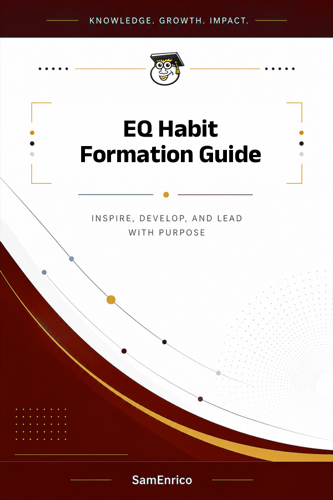
Non-FictionSelf-HelpHabit Formation
EQ Habit Formation Guide
Build emotionally intelligent habits through small
by Avila Ellena
Build emotionally intelligent habits through small daily practices and tracking.
Formats
About this book
Free sample
Chapter 1: The Habit Trap--–- You have tried to change before. Perhaps you read a bestselling book on emotional intelligence, nodding along as the author described the four quadrants—self-awareness, self-management, social awareness, relationship management. Perhaps you attended a corporate workshop where you completed a personality assessment and received a color-coded profile. Perhaps you even made a solemn promise to yourself: Starting tomorrow, I will be more patient. I will listen better.
I will not snap at my children or my colleagues.Then tomorrow came. And by 10:00 AM, you were already raising your voice in a meeting, or shutting down during a difficult conversation, or spiraling into anxious thoughts that you could not stop. By dinner, the promise felt like a distant embarrassment. By bedtime, you had decided that you were simply not an "emotionally intelligent person." Some people are born with it, you told yourself. You are not one of them.This book exists because that conclusion is not only wrong—it is dangerously misleading.
The belief that emotional intelligence is a fixed trait, something you either have or you lack, is the single greatest obstacle to actually developing it. And the reason most attempts to build EQ fail has nothing to do with your personality, your upbringing, or your capacity for self-reflection. The reason is much simpler, and much more solvable: you have been trying to change using the wrong part of your brain.The Forgetting Curve: Why Workshops Don't Work In 1885, German psychologist Hermann Ebbinghaus published a discovery that should be required reading for every corporate training department on the planet. He called it the forgetting curve. In a series of experiments, Ebbinghaus memorized lists of nonsense syllables—meaningless combinations like "ZOF" and "WID"—and then tested himself at regular intervals to see how much he retained.
The results were brutal.Within one hour, he had forgotten approximately 50 percent of what he had learned. Within 24 hours, that number climbed to 70 percent. Within 48 hours, he remembered only 20 to 25 percent of the original material. The curve was steep, unforgiving, and universal. It did not…
This is the end of the free sample. Get the eBook to keep going. Buy now
Contents
- Chapter 1
- Chapter 2
- Chapter 3
- Chapter 4
- Chapter 5
- Chapter 6
- Chapter 7
- Chapter 8
- Chapter 9
- Chapter 10
- Chapter 11
- Chapter 12
Details
- Author
- Avila Ellena
- Publisher
- SamEnrico
- Language
- English
- Genre
- Non-Fiction, Self-Help, Habit Formation
- Released
- 2026-06-08
- Pages (approx.)
- 146
- Available as
- eBook, Audiobook

Read better in the ZLOADR app
Your eBooks on your phone or tablet. Sign in with your SamEnrico account and start reading.
More by Avila Ellena
 Michael Chang Youngest WinnerAvila Ellena$11.99
 Keto For Beginners CourseAvila Ellena$11.99
 Yahoo Security Question AnswersAvila Ellena$11.99
 The Cozy Cabin Winter RetreatAvila Ellena$11.99
 The Silent Cities of the Aral: Uncovering Central Asia's Lost CivilizationsAvila Ellena$11.99
 Ragnarok and the Fox’s Curse: Loki’s Yokai GambitAvila Ellena$11.99
 Understanding Generalized Anxiety Disorder (Gad)Avila Ellena$17.99
 Adventure Travel RecoveryAvila Ellena$12.99
 Research Ops Entry PrimerAvila Ellena$12.99
 Emergency Department TechnicianAvila Ellena$11.99
 How to Start a Catsup Business (Beginners Guide)Avila Ellena$11.99
You may also like
 Hong Kong Handover 1997Dunn Johnnie$11.99
 Zumba For Postnatal Recovery CourseNeal Christian$11.99
 Zumba for BeginnersLadner Nikia$11.99
 YouTube Comment Mining GuideHumes Pandora$12.99
 Worry Box MeditationCarlin Rudy$11.99
 Workplace Stress MeditationNguyen Lynn$11.99
 Workplace Stress and Sleep RepairHawley Ivory$11.99
 Workplace Perfectionism CureDelaney Jeffry$11.99
 Workplace Injustice Anger GuideWallen Isabelle$11.99
 Work Addiction and Burnout LinkGreenwood Ester$11.99
 Women in Yoga and WellnessBeattie Galina$11.99
 Women in Stand Up ComedyChun Evangeline$11.99