
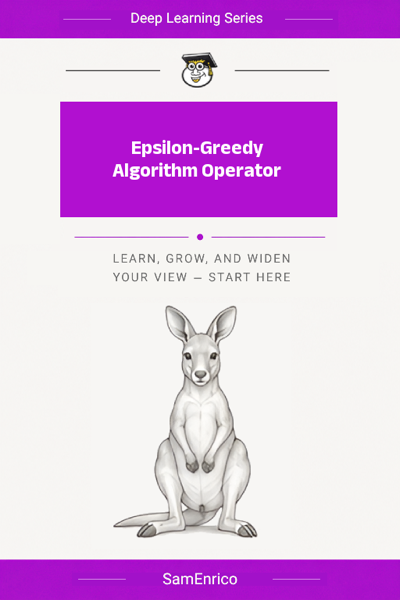
Epsilon-Greedy Algorithm Operator eBook
A Coursebook on Epsilon-Greedy Algorithm Operator
A Coursebook on Epsilon-Greedy Algorithm Operator
Formats
Free sample
Chapter 1: The Certainty Trap--–- Imagine standing in a casino with a row of slot machines stretching to your left and right. Each machine has a lever. Pull it, and coins may or may not pour out. You have one hundred pulls to maximize your winnings. Where do you start?Most people would try a few machines, see which one pays best, and then hammer that lever for the remaining pulls.
That feels obvious. That feels rational. That is also almost certainly wrong.This is the Certainty Trap—the deeply human instinct to grab what works and never let go. It feels like prudence. It feels like efficiency.
But in a world where you don't know the true value of any option, the greedy path is a slow road to obsolescence.Welcome to the life of an Operator. Your job is not to follow instructions. Your job is to make decisions when the consequences are uncertain, when feedback is noisy, and when the best choice today may not be the best choice tomorrow. You are no longer a passive consumer of rules. You are an active architect of adaptation.This book is your coursebook on becoming an Epsilon-Greedy Algorithm Operator.
By the end of these twelve chapters, you will move from pulling levers in casino simulations to deploying adaptive systems that beat video games, optimize ad auctions, and make life-critical recommendations in medicine and logistics. But before any of that, you must understand one thing: the greatest risk is not making mistakes. The greatest risk is the illusion that you already know what works.The Operator Defined Let us begin with a definition. An Operator is anyone who makes sequential decisions under uncertainty where the outcome of each decision provides feedback that can improve future decisions.You are already an Operator. Every day, you decide which route to drive to work, which email to answer first, which recipe to cook for dinner.
Each choice yields a result—arrival time, response speed, meal quality—and you use that result to adjust tomorrow's choices. The only difference between you and a formal algorithm is that you do not write your decision policy as code. Yet.In the technical world, Operators design the systems that run our digital lives. An advertising platform deciding which ad to show is an Operator. A clinical trial assigning patients to treatments is an Operator.
A recommendation engine choosing your next video is an Operator. These systems face the same dilemma you do: they cannot know the true value of any action until they try it, but every time they try a suboptimal action, they pay a cost.The Operator's job is to balance two competing forces: exploitation (choosing what seems best based on past experience) and exploration (trying something new to gain information). Too much exploitation, and you lock into a local optimum, missing better options that you never discovered. Too much exploration, and you never reap the benefits of your discoveries, wandering forever like a leaf in the wind.This balancing act is not a niche technical curiosity. It is a fundamental law of adaptive behavior, observed across evolution, economics, neuroscience, and artificial intelligence.
Honeybees explore approximately five percent of flowers outside their current patch. Young animals play—a form of pure exploration—far more than adults. Successful companies allocate a fixed percentage of resources to experimental projects. The universe has converged on a pattern: the optimal strategy is almost never pure exploitation and almost never pure exploration. The optimal strategy lives in between.The Two Types of Feedback Before we can design an Operator, we must understand the nature of the feedback loop.
In the world of machine learning, feedback comes in two fundamentally different forms: instructive and evaluative.Instructive feedback is what you receive in supervised learning. You make a prediction, and then someone tells you the correct answer. Think of a child learning arithmetic: "What is two plus two?" The child answers "five." The teacher says, "No, the correct answer is four." The child now knows exactly what the right action would have been. The feedback tells you the right direction, not just how well you did.Instructive feedback is powerful because it decouples learning from reward. You can learn from mistakes without suffering the consequences.
But in many real-world situations, instructive feedback does not exist. No teacher tells a clinical trial which treatment would have been best. No oracle tells an ad platform which ad the user would have clicked if shown a different option. The world simply gives you a reward and moves on.Evaluative feedback is what you receive in reinforcement learning. You take an action, and you observe a reward—a number that tells you how good that action was in that specific instance.
But you never learn what would have happened if you had taken a different action. If the ad platform shows ad A and the user clicks, that is a reward of +1. But what about ad B? Would it have gotten a click? A click plus a purchase?
No click at all? The platform will never know.This is the crux of the Operator's dilemma. With evaluative feedback, the only way to learn about an action is to take it. And every time you take an action to learn about it, you are not taking the action that currently seems best. There is a direct trade-off between gaining information and earning reward.The epsilon-greedy algorithm exists precisely to navigate this trade-off.
It is the simplest solution to the problem of evaluative feedback, and it is the foundation upon which all more sophisticated reinforcement learning methods are built.The Restless Bandit: A Narrative Anchor Let us make the problem concrete with a story. This story will return in Chapter 12, but for now, consider it a glimpse of the full journey ahead.Imagine you are responsible for a news website. Every time a user visits, you must choose which article to display at the top of the page. You have hundreds of articles to choose from. Your goal is to maximize clicks—or better yet, time spent reading.You start with no information.
You show Article A. It gets ten clicks. You show Article B. It gets twelve clicks. You show Article C.
It gets three clicks. After a thousand users, you have a clear pattern: Article B seems best. So you start showing Article B to almost everyone.Then the news changes. A major event happens. Suddenly, Article B—yesterday's top performer—is stale.
Users have already read it. They want breaking news. But your algorithm does not know this because it has been exploiting Article B for hours, never exploring to discover that new articles have emerged.This is the Restless Bandit problem. The reward distribution is not stationary. The value of each action changes over time.
What was best yesterday is not best today. And if your Operator does not continue exploring, it will fall permanently behind.Most of this book assumes a simpler world—the stationary bandit, where each arm's reward distribution stays constant. We make this assumption because it is the necessary foundation. But Chapter 12 will return to the Restless Bandit and show you…
This is the end of the free sample. Get the eBook to keep going. Buy now
About this book
Details
- Author
- Sander Genaro
- Publisher
- SamEnrico
- Language
- English
- Genre
- Non-Fiction, Informative, Educational
- Released
- 2026-06-02
- Pages (approx.)
- 150
- Available as
- eBook, Audiobook

Read better in the ZLOADR app
Your eBooks on your phone or tablet. Sign in with your SamEnrico account and start reading.
More by Sander Genaro
 Pelvic Floor after VacuumSander Genaro$11.99
 Lavender Field SleepSander Genaro$11.99
 Accountability for ComparisonSander Genaro$11.99
 Learning New Skill Brain HealthSander Genaro$11.99
 The Coping With Emotions GuideSander Genaro$11.99
 Youssef Chahine: The Rebel Who Redefined Egyptian CinemaSander Genaro$11.99
 Non Resident LLC Accountant GuideSander Genaro$12.99
 Kigali Startup Success StoriesSander Genaro$12.99
 The Breeder's Guide to Dorking ChickensSander Genaro$11.99
 How to Become a GeologistSander Genaro$11.99