
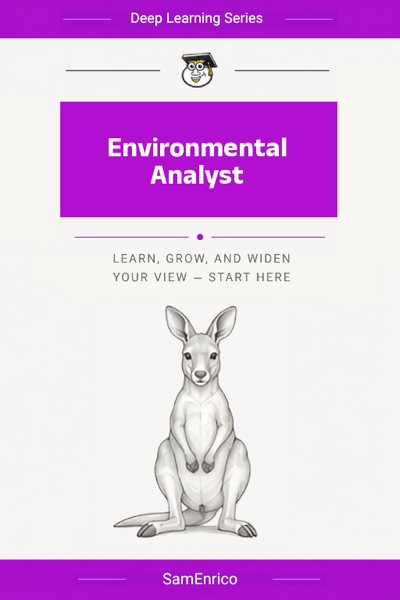
Non-FictionInformativeEducational
Environmental Analyst eBook
A Coursebook on Environmental Analyst
A Coursebook on Environmental Analyst
Formats
Free sample
Chapter 1: The Day the River Burned--–- On June 22, 1969, the Cuyahoga River in Cleveland, Ohio, caught fire. Flames reached five stories high. A railroad bridge was nearly destroyed. Photographs showed a river—a major American waterway—burning like a gasoline-soaked rag. The fire lasted barely thirty minutes, but it seared itself into the national consciousness.
It was not the first time the Cuyahoga had burned. That honor belonged to 1868, then 1883, then 1912, then 1936, then 1941, then 1952. Each time, the city shrugged. Each time, the river was declared “improved.” But 1969 was different. Something in the American psyche had shifted.
The first Earth Day was ten months away. The Environmental Protection Agency would be created in seventeen months. The Clean Water Act was three years out, the Endangered Species Act four. The burning river became a symbol—not because it was the worst pollution event in American history, but because it arrived at the exact moment people were finally ready to see.The Analyst Who Wasn't There Here is what no photograph captured: the person who should have been standing on that riverbank, clipboard in hand, calculating flow rates, sampling water, tracing the origin of the oil slick. That person did not exist in 1969.
The role of “environmental analyst” did not exist. There were chemists who tested water samples. There were engineers who designed wastewater treatment plants. There were inspectors who wrote citations. But no one had the job of sitting at the intersection of science, policy, and business—of taking raw data and transforming it into a story that a mayor could understand, a factory manager could act on, or a citizen could use to demand change.That job was invented by necessity.
It was invented because the old model failed.The old model was simple: pollute first, clean up later. It was called “end-of-pipe” compliance. A factory would emit whatever it wanted into the air, dump whatever it wanted into the river, and then—only if caught, only if sued, only if regulated—bolt on a filter, a scrubber, a treatment pond. The analyst’s predecessor was the compliance inspector: the person who showed up after the damage was done, measured the damage, wrote a report, and left. The report went into a file.
The file gathered dust. The river kept burning.The Birth of a New Profession The transformation began in the 1970s, accelerated through the 1980s and 1990s, and reached full speed in the twenty-first century. It moved through three distinct phases, each demanding a different kind of analyst.Phase One: The Detector (1970–1990)The first generation of environmental professionals were detectives. They asked: What is out there, and how much of it exists? They deployed monitoring stations.
They collected samples. They built the first inventories of emissions and discharges. Their tools were basic: gas chromatographs, colorimeters, flow meters. Their victories were foundational: the discovery that lead in gasoline was poisoning children, that chlorofluorocarbons were destroying the ozone layer, that acid rain was killing forests from the Adirondacks to the Black Forest.The detective analyst’s signature document was the Environmental Impact Statement (EIS), mandated by the National Environmental Policy Act (NEPA) of 1969. The EIS asked: before you build that dam, that highway, that refinery—what will it do to the environment?
The answer was often a thousand pages of data, dense with tables and appendices, read by almost no one. But the requirement itself was revolutionary. For the first time, a proposed action had to justify itself environmentally before it could proceed.Phase Two: The Modeler (1990–2010)The second generation moved from measurement to prediction. They asked: What will happen if we continue on this path? They built computer models of atmospheric chemistry, ocean circulation, and population dynamics.
They learned to simulate the future. Their tools were sophisticated: FORTRAN code running on university mainframes, geographic information systems (GIS) that could overlay pollution maps onto population maps, life cycle assessment software that could track a product from raw material extraction to final disposal.The modeler analyst’s signature achievement was the integrated assessment model (IAM), which linked economic activity to energy use to climate change. The most famous IAMs—DICE, PAGE, FUND—were used by the Intergovernmental Panel on Climate Change (IPCC) to project global warming under different policy scenarios. For the first time, an analyst could say: If we adopt Policy A, the global average temperature will rise X degrees by 2100. If we adopt Policy B, it will rise Y degrees.But modeling had limits.
Models are only as good as their assumptions. And assumptions about the future are always contested. The modeler could predict, but could not persuade. The reports sat on shelves alongside the EIS documents of the previous generation.Phase Three: The Strategist (2010–Present)The third generation—the one you are entering now—asks a different set of questions: Given what we know and what we cannot know, what should we do? How do we balance competing values?
How do we communicate risk to people who do not speak the language of probability? How do we turn data into decisions?The strategist analyst does not merely detect pollution or model futures. They sit at the decision table. They work alongside CEOs, city planners, portfolio managers, and policy directors. They translate between the engineer who designs a technology and the community that must live with it.
They understand that a risk of one in a million is acceptable in one context and terrifying in another. They know that the best analysis in the world has no impact if it is not communicated clearly.The strategist analyst’s signature document is the decision support memo: a concise, actionable synthesis of technical analysis, stakeholder values, and strategic recommendations. It fits on two pages. It uses graphs, not tables. It tells a story.The Four Powers of the Modern Analyst What must you master to become a strategist?
Four core competencies appear in every major textbook, every job description, every successful analyst’s toolkit. These are the Four Powers.Power One: Systems Thinking A system is a set of interconnected elements organized to achieve a function. A factory is a system. A river is a system. A supply chain is a system.
A regulatory framework is a system. Systems thinking is the ability to see the whole, not just the parts; to trace feedback loops, not just linear chains; to anticipate unintended consequences, not just intended effects.Consider a classic example: a city tries to reduce traffic congestion by building more roads. More roads attract more drivers. More drivers cause more congestion. The congestion returns to its original level, or worse.
The solution—more roads—became the problem. A systems thinker sees the feedback loop and asks: What if we invest in public transit instead? What if we incentivize telecommuting? What if we price road use by time of day?In environmental analysis, systems thinking prevents the most common error: solving one problem by creating another. A factory that incinerates its hazardous waste reduces landfill volume but increases air emissions.
A biofuel that replaces gasoline reduces fossil fuel use but drives deforestation. A recycling program that ships waste overseas reduces local landfill pressure but externalizes the environmental burden. The systems thinker catches…
This is the end of the free sample. Get the eBook to keep going. Buy now
About this book
Details
- Author
- Rhoades Booker
- Publisher
- SamEnrico
- Language
- English
- Genre
- Non-Fiction, Informative, Educational
- Released
- 2026-05-23
- Pages (approx.)
- 157
- Available as
- eBook, Audiobook

Read better in the ZLOADR app
Your eBooks on your phone or tablet. Sign in with your SamEnrico account and start reading.
More by Rhoades Booker
 Paleo Autoimmune Protocol PrimerRhoades Booker$11.99
 Conchita Martinez Wimbledon WinRhoades Booker$11.99
 Attachment Styles Self Worth GuideRhoades Booker$11.99
 Market Analysis For Business Plans GuideRhoades Booker$11.99
 Yahoo Spam Operation LinkRhoades Booker$11.99
 The Hollow Hill’s Last GuardianRhoades Booker$11.99
 Into the Heart of the Amazon: The Quest for the River's True SourceRhoades Booker$11.99
 Understanding Generalized Torsion DystoniaRhoades Booker$17.99
 How to Start a Catheter Business (Beginners Guide)Rhoades Booker$11.99
 Climate Tech Marketing HandbookRhoades Booker$12.99
 Travel Credit Card SpendingRhoades Booker$12.99
You may also like
 Hong Kong Handover 1997Dunn Johnnie$11.99
 Zumba For Postnatal Recovery CourseNeal Christian$11.99
 Zumba for BeginnersLadner Nikia$11.99
 YouTube Comment Mining GuideHumes Pandora$12.99
 Worry Box MeditationCarlin Rudy$11.99
 Workplace Stress MeditationNguyen Lynn$11.99
 Workplace Stress and Sleep RepairHawley Ivory$11.99
 Workplace Perfectionism CureDelaney Jeffry$11.99
 Workplace Injustice Anger GuideWallen Isabelle$11.99
 Work Addiction and Burnout LinkGreenwood Ester$11.99
 Women in Yoga and WellnessBeattie Galina$11.99
 Women in Stand Up ComedyChun Evangeline$11.99