
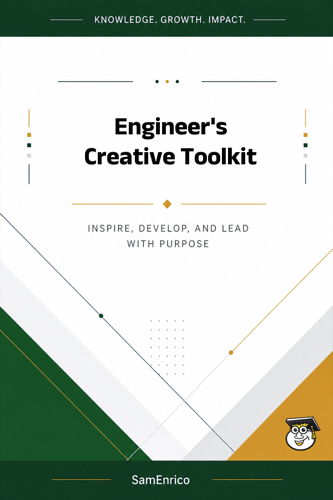
Non-FictionSelf-HelpEngineering
Engineer's Creative Toolkit eBook
Practical creativity methods for technical problem
Practical creativity methods for technical problem solvers.
Formats
Free sample
Chapter 1: The Scissors Paradox...--–- Every engineer I have ever mentored began with the same confession, spoken in the same embarrassed tone, as if admitting to a personal moral failure. They say: "I'm not really creative." They say it quietly, often after a meeting where a colleague suggested something obvious in retrospect. They say it despite having designed bridges that stand, code that compiles, circuits that oscillate, or chemical processes that scale. They say it because they have internalized a definition of creativity that belongs to poets, painters, and musicians—a definition that has nothing whatsoever to do with what they actually do for a living.This chapter exists to correct that error before it costs you another hour of staring at a whiteboard, another sleepless night waiting for a spark that will not come, or another mediocre solution that works but does not delight. The central argument is simple and, I hope, liberating: creativity for engineers is not a mysterious gift bestowed at birth.
It is a trainable skill composed of specific, repeatable, teachable operations. You do not need to become a different person. You need to learn a different process.The Technical Creativity Gap Let us define the problem precisely. Artistic creativity operates with few constraints. A painter chooses any color, any canvas size, any subject, any style.
A poet invents words if existing ones prove insufficient. A musician modulates to any key at any time. The only limits are imagination, skill, and perhaps the patience of the audience. This freedom is wonderful. It is also completely irrelevant to your work.Engineering creativity operates under what I call the Technical Creativity Gap—the chasm between the unbounded space of artistic expression and the brutally constrained space of technical problem-solving.
You cannot ignore physics. You cannot ignore budgets. You cannot ignore safety factors, material properties, thermal limits, electromagnetic interference, manufacturing tolerances, supply chain lead times, regulatory requirements, or the fact that your solution must work at 3:00 AM on a Tuesday in February after six months of vibration and temperature cycling.Most engineers internalize this gap as evidence of their own inadequacy. They look at the artist and think: "I could never be that free." But that is precisely the wrong comparison. The correct comparison is to a chess grandmaster, not a painter.
Chess operates under severe constraints: fixed board, fixed pieces, fixed movement rules, fixed win conditions. Grandmasters are not less creative than poets. They are creative in a different domain—one where constraints are the raw material of novelty, not its enemy.This book bridges the Technical Creativity Gap by providing structured methods that turn constraints into solution pathways. You will learn to treat a budget limit not as a barrier but as a filter. You will learn to treat physical laws not as obstacles but as the grammar of a language you are learning to speak fluently.
You will learn what the best engineers already know: constraints are not the opposite of creativity. They are its engine.The Scissors Analogy: Why Knowledge Alone Is Not Enough I have worked with engineers who possessed encyclopedic knowledge of their domain. They could recite material properties from memory, quote ASME codes by section number, and derive differential equations in their sleep. They were also, frequently, the least creative problem-solvers in the room. Their knowledge sat in their heads like a perfectly organized library with no exit door.
Conversely, I have worked with engineers who generated dozens of wild ideas but lacked the technical depth to recognize which ideas violated the laws of thermodynamics. Their creativity produced nothing buildable.This leads to the central metaphor of this book: the scissors analogy. A pair of scissors has two blades. One blade is knowledge: deep technical expertise in your domain—materials, mechanics, thermodynamics, circuits, software, chemistry, or whatever constitutes your craft. The other blade is creative method: structured heuristics and algorithms for generating novel solutions.
A scissors cannot cut with only one blade. If you have knowledge without method, you can analyze but you cannot invent. If you have method without knowledge, you can generate fantasies but you cannot engineer.Most engineering education focuses almost exclusively on the knowledge blade. This is necessary but insufficient. You graduate knowing how to calculate stress, model heat transfer, or optimize a feedback loop.
You do not graduate knowing how to break an assumption, reframe a problem, or resolve a technical contradiction. That is what this book provides: the missing blade.Throughout this book, you will learn specific tools that constitute the method blade. Some are heuristics—rule-of-thumb strategies that work most but not all of the time. Heuristics are fast, flexible, and excellent for exploration. Examples include the assumption checklist you will learn in Chapter 3 and the random stimuli technique in Chapter 7.
Others are algorithms—deterministic procedures that, given a specific input, produce a reliable output. The Contradiction Matrix in Chapter 4 is the book's primary algorithm: a lookup table that takes a pair of conflicting parameters and returns the inventive principles that have solved that exact conflict thousands of times before.The distinction matters. Heuristics are for when you have time to explore and learn. Algorithms are for when you need a reliable answer now. Both are valid.
Both are part of the method blade. And neither works without the knowledge blade you already possess.The Two Deadly Myths That Keep Engineers Stuck Before we proceed to the tools themselves, we must clear away the debris of false beliefs that block their use. I have observed two myths that do more damage to engineering creativity than any lack of innate talent. They are pervasive, persistent, and wrong.Myth One: Creativity Strikes Like Lightning The first myth holds that creative solutions appear suddenly, unpredictably, and fully formed—like a lightning bolt from a clear sky. Archimedes in his bath.
Newton under the apple tree. Kekulé dreaming of a snake eating its own tail and discovering the benzene ring. These stories are romantic, memorable, and almost certainly false in the way they are told.Archimedes had been thinking about hydrostatics for weeks. Newton had been working on orbital mechanics for years. Kekulé had been struggling with benzene's structure for a decade.
The "sudden spark" was not a beginning. It was the visible culmination of long, deliberate, methodical preparation followed by a period of unconscious incubation. The spark is real. The suddenness is an illusion created by compressing the story.The danger of this myth is that it encourages passivity. If you believe creativity strikes like lightning, you wait for lightning.
You stare at the whiteboard. You hope. You postpone action until inspiration arrives. And because inspiration does not arrive on a predictable schedule, you conclude—falsely—that you lack the creative gift. The truth is exactly opposite: creativity is not a weather event.
It is a manufacturing process with inputs, operations, and outputs. You do not wait for the solution. You build it.Myth Two: Constraints Kill Creativity The second myth holds that creativity requires unlimited freedom. Remove the rules, remove the budgets, remove the deadlines, and creativity will flourish. This myth is seductive because it flatters our desire for ease.
It is also demonstrably false.Study after study in the psychology of creativity has shown the opposite: moderate, well-structured constraints enhance…
This is the end of the free sample. Get the eBook to keep going. Buy now
About this book
Details
- Author
- Merriman Shantel
- Publisher
- SamEnrico
- Language
- English
- Genre
- Non-Fiction, Self-Help, Engineering
- Released
- 2026-06-07
- Pages (approx.)
- 148
- Available as
- eBook, Audiobook

Read better in the ZLOADR app
Your eBooks on your phone or tablet. Sign in with your SamEnrico account and start reading.
More by Merriman Shantel
 HIIT for Athletic PerformanceMerriman Shantel$11.99
 Minecraft Excessive Play WorkbookMerriman Shantel$11.99
 Hearing Loss and Dementia LinkMerriman Shantel$11.99
 E Cigarette Tapering ProtocolMerriman Shantel$11.99
 Silent Diplomacy: The Siege of the Iranian Embassy in London (1980)Merriman Shantel$11.99
 Blood, Sweat, and Lies: The Secret Doping Ring of the 1984 OlympicsMerriman Shantel$11.99
 Ultimate Scaling Faceless TikTok and Reels PagesMerriman Shantel$11.99
 ProctorU Exam Day ChecklistMerriman Shantel$12.99
 Free Zone B2B Selling GuideMerriman Shantel$12.99
 How to Start a Construction of Commercial Buildings Business (Beginners Guide)Merriman Shantel$11.99
You may also like
 Hong Kong Handover 1997Dunn Johnnie$11.99
 Zumba For Postnatal Recovery CourseNeal Christian$11.99
 Zumba for BeginnersLadner Nikia$11.99
 YouTube Comment Mining GuideHumes Pandora$12.99
 Worry Box MeditationCarlin Rudy$11.99
 Workplace Stress MeditationNguyen Lynn$11.99
 Workplace Stress and Sleep RepairHawley Ivory$11.99
 Workplace Perfectionism CureDelaney Jeffry$11.99
 Workplace Injustice Anger GuideWallen Isabelle$11.99
 Work Addiction and Burnout LinkGreenwood Ester$11.99
 Women in Yoga and WellnessBeattie Galina$11.99
 Women in Stand Up ComedyChun Evangeline$11.99