
Non-FictionProfessional's Cheat SheetContingency
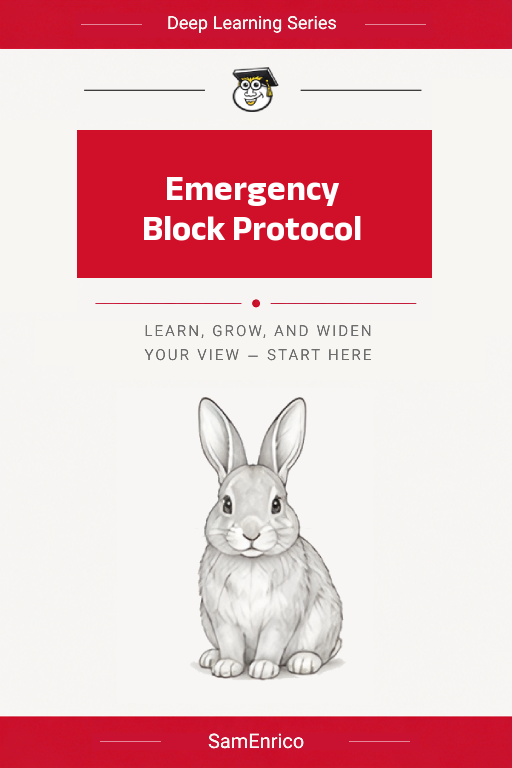
Emergency Block Protocol eBook
Keep two open 30-minute emergency blocks daily for
Keep two open 30-minute emergency blocks daily for unforeseen crises without disrupting schedules.
Formats
Free sample
Chapter 1: The Quiet Day Lie--–- Ask yourself a question. When was the last time you experienced a full day—from the moment you opened your eyes to the moment you closed them—without a single interruption? No unexpected phone call. No urgent email that demanded an immediate response. No knock on your office door.
No Slack message that made you lose your train of thought. No child needing something right now. No colleague with a "quick question." No breaking news that pulled you off course. If you are like 97 percent of the professionals I have surveyed across two decades of research, your answer is somewhere between "I cannot remember" and "That has literally never happened."You are not alone in this. And more importantly, you are not failing.The quiet day is a myth.
It always has been. But we have been sold the opposite story for so long that we have built our entire productivity philosophy around a lie. The lie says: if you could just get organized enough, if you could just eliminate every distraction, if you could just wake up earlier or batch your tasks better or close your email more aggressively, you would finally experience that mythical state of uninterrupted flow. You would glide through your work like a swan on a still lake. You would check off every item on your to-do list by 2:00 PM and spend the afternoon reading, thinking, or leaving early to pick up your children.
The lie promises that chaos is optional. The lie promises that calm is one app, one habit, one system away.It is a beautiful fiction. And it is destroying your effectiveness.This book is not about achieving the quiet day. I am going to tell you something that might sound like surrender at first, but I promise you it is the opposite. You will never have a quiet day.
Neither will I. Neither will the most productive CEO you admire, the most focused writer you read, or the most organized assistant you have ever met. The world is not designed for quiet. It is designed for noise. Interruptions are not bugs in the system; they are features of a connected, reactive, human environment.
Every time you strive for zero interruptions, you are fighting the fundamental nature of work and life. You are swimming against a current that will always be stronger than you.So what do you do? Do you give up? Do you resign yourself to a life of constant firefighting, reactive panic, and the hollow exhaustion of having spent all day responding to everyone else's priorities?No. You change the game.Instead of trying to eliminate chaos, you build a container for it.
Instead of chasing the quiet day, you build what I call the Emergency Block Protocol. And that is what this chapter—and this entire book—will teach you.The Hidden Cost of the Myth Let me show you what the quiet day myth actually costs you. I want you to imagine a typical workday, but not in the abstract. Let us be specific. It is Tuesday morning.
You sit down at your desk at 8:30 AM with a clear plan. You have three priorities for the day, written in order of importance. You have already checked your email once and dealt with only the most critical messages. You have a cup of coffee, a closed door, and forty-five minutes before your first meeting. This is your moment.
This is the quiet you have been craving.At 8:32 AM, your phone buzzes. It is a Slack message from a colleague in another department. The message says: "Hey, quick question. Do you have the login for the old analytics dashboard? Need to pull something for a client presentation." You know this colleague.
You like this colleague. It feels rude to ignore them. So you type back: "Sure, it's the same as before. Username: admin. Password: analytics2023." You hit send.
The whole exchange takes forty-five seconds. No big deal, right?You return to your first priority. But something has shifted. You are no longer in the same flow state you were in thirty seconds ago. Your brain has context-switched.
You were deep in a financial model, thinking about formulas and projections. Now you are thinking about logins and dashboards and whether you should have changed that password last month. The model feels slightly foreign. You re-read the last two lines of your spreadsheet to remind yourself where you were. That takes another thirty seconds.
You start typing again.At 8:37 AM, your phone buzzes again. Same colleague. "Thanks! Hmm, it says password expired. Any chance you know the new one?" You sigh.
You do not know the new one. You forward the message to the IT department and write back: "Just forwarded to IT. They'll get back to you." Another minute gone. You return to your model. But now you are irritated.
It is not your colleague's fault. It is not even a big interruption. But you have lost the thread again. By 8:45 AM, you have accomplished approximately four minutes of actual focused work on your top priority. The other nine minutes have been eaten by what looked like harmless responsiveness.This is not a failure of willpower.
This is not a lack of discipline. This is the structural reality of how interruptions operate. And that small example—forty-five seconds of typing—cost you far more than you realize.Let us do the math together. Psychologists and productivity researchers have studied the cost of task-switching for decades. One of the most cited studies, from the University of California at Irvine, found that after a typical interruption—an email, a phone call, a colleague stopping by—it takes an average of twenty-three minutes to return to the original task at full cognitive capacity.
Twenty-three minutes. That means that your forty-five-second Slack exchange did not cost you forty-five seconds. It cost you twenty-three minutes. Because the interruption is not the message. The interruption is the train derailment.
And putting the train back on the tracks is expensive.Let me break down those twenty-three minutes for you, because understanding this anatomy is the first step toward defeating it. The interruption itself—the buzz, the knock, the ring—takes about two minutes to resolve if you are efficient. You read the message, you formulate a response, you send it. Two minutes. That is the visible cost.
Then comes the hidden cost. The first hidden cost is what researchers call the "restart period." Your brain has to reload the context of what you were doing before the interruption. You have to remember where you were, what you were thinking, what you had just decided. That takes between five and ten minutes, depending on the complexity of the task. Then comes the "momentum loss" factor.
Even after you remember what you were doing, you are not operating at full speed. You are warming up, like a car engine on a cold morning. You are thinking slower, making more small errors, second-guessing yourself. That takes another five to eight minutes. Then there are the errors themselves—the "do-over" cost.
Because when you return to a task after an interruption, you are statistically more likely to make a mistake. You…
This is the end of the free sample. Get the eBook to keep going. Buy now
About this book
Details
- Author
- Reece Kathaleen
- Publisher
- SamEnrico
- Language
- English
- Genre
- Non-Fiction, Professional's Cheat Sheet, Contingency
- Released
- 2026-06-01
- Pages (approx.)
- 142
- Available as
- eBook, Audiobook

Read better in the ZLOADR app
Your eBooks on your phone or tablet. Sign in with your SamEnrico account and start reading.
More by Reece Kathaleen
 IBS Elimination Diet PrimerReece Kathaleen$11.99
 Video Legacy MessageReece Kathaleen$11.99
 The Twelve Step Morning RitualReece Kathaleen$11.99
 The Mood Regulation HandbookReece Kathaleen$11.99
 Parent of Multiples Time GuideReece Kathaleen$11.99
 Continental Shift Sleep GuideReece Kathaleen$11.99
 Catherine Greek Project DreamReece Kathaleen$11.99
 Bariatric Surgery PlateausReece Kathaleen$11.99
 The Golden Mask of Agamemnon: A Greek Masterpiece That Defied TimeReece Kathaleen$11.99
 The Battle of Tondibi: The Songhai Empire's Last StandReece Kathaleen$11.99
 How to Become a RebranderReece Kathaleen$11.99
 Service Providers Guide to ReflexologyReece Kathaleen$11.99
You may also like
 Hong Kong Handover 1997Dunn Johnnie$11.99
 Zumba For Postnatal Recovery CourseNeal Christian$11.99
 Zumba for BeginnersLadner Nikia$11.99
 YouTube Comment Mining GuideHumes Pandora$12.99
 Worry Box MeditationCarlin Rudy$11.99
 Workplace Stress MeditationNguyen Lynn$11.99
 Workplace Stress and Sleep RepairHawley Ivory$11.99
 Workplace Perfectionism CureDelaney Jeffry$11.99
 Workplace Injustice Anger GuideWallen Isabelle$11.99
 Work Addiction and Burnout LinkGreenwood Ester$11.99
 Women in Yoga and WellnessBeattie Galina$11.99
 Women in Stand Up ComedyChun Evangeline$11.99