
Non-FictionInformativeEducational
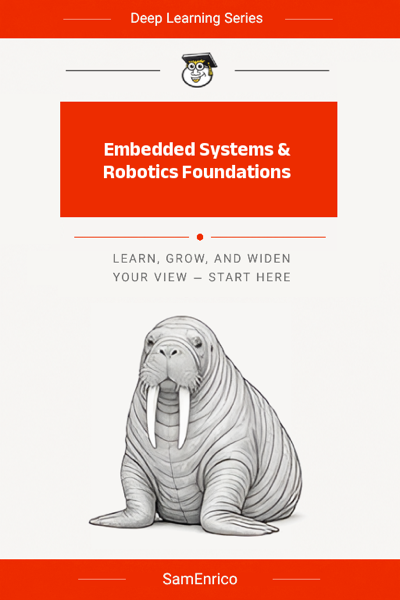
Embedded Systems & Robotics Foundations eBook
A Coursebook on Embedded Systems & Robotics Founda
A Coursebook on Embedded Systems & Robotics Foundations
Formats
Free sample
Chapter 1: The Clockwork Dream...--In the dusty workshop of a medieval cathedral, a monk wound a set of brass gears and released a small angel that walked in a circle, nodded its head, and beat its chest in a crude imitation of penitence. That automaton, built in 1560, was not a robot. It had no sensors, no battery, no line of code. But it represented something profound: the human desire to breathe life into metal, to create the artificial being, to build a machine that could move on its own as if animated by a soul. This clockwork dream is ancient, and it is the true origin of everything you are about to learn in this book.Before you write your first line of Python, before you solder your first PCB, before you tune your first PID controller, you must understand one thing: robotics is not primarily a technical discipline.
It is a humanistic one. The questions that drive robotics forward are not "Can we build a faster microprocessor?" or "Can we write more efficient path-planning algorithms?" The real questions are older and stranger: What does it mean to be alive? What separates a tool from a creature? Where is the line between automation and autonomy? And when a machine makes a decision that harms a person, who is responsible—the engineer, the algorithm, or the robot itself?This chapter will not teach you to program a microcontroller or wire a sensor.
Those skills are coming, and they are essential. But first, you need the context that transforms a competent technician into a true roboticist. You need the history, the philosophy, and the taxonomy of artificial beings. You need to understand why the ancient Greeks dreamed of mechanical servants, why the Industrial Revolution turned humans into machine operators, and why Isaac Asimov’s fictional Three Laws of Robotics remain the most famous ethical framework ever written for a technology that did not yet exist. By the end of this chapter, you will see every line of code and every circuit board as part of a five-hundred-year conversation about what it means to create intelligence.The Ancient Origins: Automata as Wonder and Worship The impulse to build self-moving machines predates written history.
Archaeological evidence suggests that ancient Egyptian and Mesopotamian cultures created simple mechanical figures for religious ceremonies—statues that poured water or moved their arms when hidden priests manipulated levers and pulleys. These were not robots in any modern sense, but they were early examples of the core robotic principle: separating the mechanism from the operator, creating the illusion of independent motion.The first true automata—machines with internal, self-contained power sources and programmed behavior—appeared in ancient Greece around 300 BCE. Ctesibius of Alexandria, a Greek engineer and mathematician, built water clocks that featured moving figures, trumpets that sounded automatically, and pumps that operated without human intervention. His student Philo of Byzantium described a washstand automaton: a maidservant figure that poured water over a guest's hands when they approached, then withdrew. This required a primitive feedback loop—a pressure sensor triggered by the weight of a cup—making it arguably the first robot with sensing and actuation.Hero of Alexandria, writing in the first century CE, compiled descriptions of dozens of automata in his treatise Pneumatica.
His designs included a completely automatic wine server that dispensed fixed amounts of wine and water, a singing bird powered by water pressure, and a temple door that opened automatically when a fire was lit on an altar. Hero understood that compressed air, steam, and water could be used to create sequences of mechanical actions—a form of programming etched in brass and wood.These ancient automata served two purposes. First, they were wonders—demonstrations of engineering prowess that impressed visitors and asserted the superiority of their creators. Second, and more importantly, they served religious functions. A statue that moved or spoke (through hidden tubes) was not seen as a machine; it was seen as possessed by the gods.
The line between engineering and magic was blurred. This conflation of mechanism with the sacred would persist for centuries, and it echoes today in our tendency to anthropomorphize robots, to treat a Roomba as "curious" or a warehouse robot as "aggressive."The Medieval and Renaissance Explosion of Automata After the fall of the Roman Empire, automaton-building continued in the Byzantine Empire and the Islamic world. The Banū Mūsā brothers, working in ninth-century Baghdad, wrote the Book of Ingenious Devices, which contained descriptions of over one hundred automata, including a programmable flute player that used interchangeable pins to change its melody—a literal hardware-programmable music box. This is important: programmability is not a modern invention. The concept of storing a sequence of actions in a physical medium (pins on a cylinder, holes in a punched card) predates the digital computer by over a thousand years.In Europe during the fourteenth through sixteenth centuries, automata reached new heights of complexity.
Clock towers in major cities featured moving figures that struck bells, presented the time, and reenacted biblical scenes. The Strasbourg Cathedral astronomical clock, completed in 1574, featured a rooster that flapped its wings and crowed mechanically, along with a procession of figures representing the ages of man. These clocks were not timekeeping devices; they were public performances of technology, theology, and civic pride.The most famous automaton builder of this era was Leonardo da Vinci, who designed a mechanical knight in 1495. His notebooks contain detailed drawings of a suit of armor filled with gears, pulleys, and cables that could sit up, wave its arms, and move its jaw. The knight was likely never built during Leonardo's lifetime, but in 2002, roboticist Mark Rosheim used Leonardo's notes to construct a working version, demonstrating that the Renaissance mind had conceived of a humanoid robot five hundred years before modern robotics laboratories.During this same period, the word "robot" did not exist.
That would wait until 1920. But the concept was crystallizing: machines could be designed to imitate living beings, and those machines could serve as entertainment, as religious icons, or as status symbols. They were not yet tools. They were dreams.The Industrial Revolution: From Wonder to Work The Industrial Revolution, beginning in the mid-eighteenth century, transformed automata from curiosities into instruments of production. The driving force was not a new theory of intelligence but a new power source: the steam engine.
With steam, a factory could drive dozens of machines from a single central motor. The human worker was no longer a craftsperson making individual objects but an operator tending a machine that performed a single repetitive task.This shift is crucial for understanding robotics. Before the Industrial Revolution, most work was generalist: a weaver made cloth, a blacksmith shaped metal, a farmer grew food. After industrialization, work became specialist and repetitive: a single worker might spend twelve hours a day pulling a lever that punched holes in leather straps. The human body was being asked to behave like a machine—precise, tireless, and interchangeable.The logical next step was to replace the human operator entirely.
If a machine could be made to feed itself, to sense when a part was in place, and to correct its own errors, then the…
This is the end of the free sample. Get the eBook to keep going. Buy now
About this book
Details
- Author
- Irvine Wilber
- Publisher
- SamEnrico
- Language
- English
- Genre
- Non-Fiction, Informative, Educational
- Released
- 2026-06-02
- Pages (approx.)
- 154
- Available as
- eBook, Audiobook

Read better in the ZLOADR app
Your eBooks on your phone or tablet. Sign in with your SamEnrico account and start reading.
More by Irvine Wilber
 Metta for Financial StressIrvine Wilber$11.99
 Rewire Relationship TalkIrvine Wilber$11.99
 Steve Cohen Point72Irvine Wilber$11.99
 Compulsive Spending and OCDIrvine Wilber$11.99
 Gaze Direction and ThinkingIrvine Wilber$11.99
 Meditation For Sleep BeginnersIrvine Wilber$11.99
 Chandrasekhar's Star LimitIrvine Wilber$11.99
 Anapanasati for YogaIrvine Wilber$11.99
 The Last Song of the WhalesIrvine Wilber$11.99
 Love, Lies, and a Royal Scandal: The Untold Story of Prince Andrew and Sarah Ferguson’s Divorce DramaIrvine Wilber$11.99
 How to Produce a Board GameIrvine Wilber$11.99
 Growing ComespermaIrvine Wilber$11.99
You may also like
 Hong Kong Handover 1997Dunn Johnnie$11.99
 Zumba For Postnatal Recovery CourseNeal Christian$11.99
 Zumba for BeginnersLadner Nikia$11.99
 YouTube Comment Mining GuideHumes Pandora$12.99
 Worry Box MeditationCarlin Rudy$11.99
 Workplace Stress MeditationNguyen Lynn$11.99
 Workplace Stress and Sleep RepairHawley Ivory$11.99
 Workplace Perfectionism CureDelaney Jeffry$11.99
 Workplace Injustice Anger GuideWallen Isabelle$11.99
 Work Addiction and Burnout LinkGreenwood Ester$11.99
 Women in Yoga and WellnessBeattie Galina$11.99
 Women in Stand Up ComedyChun Evangeline$11.99