
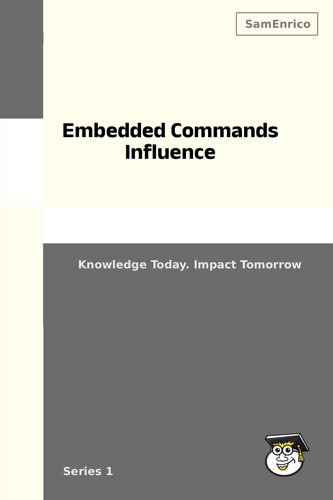
Embedded Commands Influence eBook
Hides commands within sentences using tone and ges
Hides commands within sentences using tone and gesture.
Formats
Free sample
Chapter 1: The Persuasion Paradox...--–- The first time I realized that direct requests fail exactly when you need them most, I was watching a master salesman lose a sale he should have closed in sixty seconds. The customer had walked onto the car lot already convinced he wanted the sedan. He had test-driven it twice. He had brought his own financing. And then the salesman did what ninety-nine percent of people would do: he asked for the sale directly.
"So are you ready to buy today?" The customer’s face changed instantly. His shoulders pulled back. His eyes narrowed. "I need to think about it," he said, and walked off the lot. The salesman had no idea what just hit him.That customer drove to a different dealership twenty minutes away and bought the exact same car from a salesman who never once asked for the sale.
Instead, that second salesman said something odd as they stood near the paperwork. He looked at the hood and said, "I’m not sure when you will decide to take this home, but you’re welcome to sit inside one more time." The customer signed the papers twenty-three minutes later. He never consciously noticed the embedded command hidden in that sentence: when you will decide to take this home. The command was there, marked by a slight drop in pitch and a micro-pause before the phrase, and the customer’s subconscious mind simply followed the instruction.This is the Persuasion Paradox. The more directly you ask for what you want, the less likely you are to get it—when resistance is present.
And the less directly you ask, while still delivering the command below the threshold of conscious detection, the more likely you are to succeed.Every day, millions of people fail to persuade because they believe that clarity and directness are the same thing. They are not. Clarity is about the command being understandable. Directness is about the command being obvious. Embedded commands separate the two.
They allow you to be perfectly clear to the subconscious mind while remaining completely invisible to the conscious mind’s resistance.This book will teach you exactly how to do that.The Myth of the Rational Listener We like to believe that human beings make decisions rationally. We imagine that if we present enough evidence, enough logic, enough compelling arguments, the other person will naturally agree with us. This belief is wrong. It is not merely incomplete; it is actively harmful to anyone who wants to influence others.The psychological literature on persuasion is unanimous on one point: people make decisions emotionally and then justify them rationally. This is not a flaw.
It is a feature of how the human brain evolved. Our ancestors did not have time to run cost-benefit analyses when a predator appeared. They needed to react instantly. The emotional brain—the limbic system—makes decisions in milliseconds. The rational brain—the prefrontal cortex—kicks in afterward to explain why the decision made sense.Here is what this means for persuasion.
When you make a direct request, you are speaking to the rational brain. You are asking the listener to evaluate your proposal logically. But the rational brain is not the decision-maker. It is the press secretary. It announces decisions after they have already been made elsewhere.
So your direct request lands on a desk where no one is home. The emotional brain, which actually makes the decision, never hears your logical argument because it does not process language the same way. It processes tone, gesture, and implied meaning.This is why the car salesman who asked "Are you ready to buy today?" failed. He spoke to the rational brain. The rational brain, having no authority to say yes but plenty of authority to say no, did its job perfectly.
It said, "I need to think about it," which is rational-brain language for "I don't have the authority to decide, so I will refer this upward to a committee that never meets."The second salesman spoke directly to the emotional brain. He used a sentence that had the grammatical shape of a speculation but the tonal shape of a command. The emotional brain heard "decide to take this home" and felt that as an impulse, not an instruction. Because it did not feel like an external demand, the emotional brain did not trigger resistance. It simply complied.The Invention of the Critical Faculty To understand why embedded commands work, you need to understand the psychological mechanism they bypass.
That mechanism is called the critical faculty.The critical faculty is not a part of your brain in the anatomical sense. You cannot point to a region of the cortex and say "there lies the critical faculty." It is a functional description of a filtering process. Every second, your brain receives approximately eleven million bits of information from your senses. Your conscious mind can process only about fifty of those bits. The rest must be filtered, sorted, prioritized, and either stored or discarded.
The critical faculty is the name for the filtering system that evaluates incoming suggestions for two things: threat and logic.Threat filtering asks: "Does this suggestion endanger me physically, socially, or psychologically?" Logic filtering asks: "Does this suggestion make sense given what I already believe?"When you make a direct request, both filters activate simultaneously. The threat filter asks: "If I say yes, what do I lose?" The logic filter asks: "Does this request align with my existing beliefs about myself, the speaker, and the situation?" In most cases, particularly when the request comes from someone perceived as having a self-interest (a salesperson, a manager, a politician), both filters answer in ways that produce a "no."The threat filter says: "If I say yes, I lose autonomy. I am being told what to do." The logic filter says: "I don't have enough information to be certain, and certainty is safer than uncertainty."But here is the crucial insight. The critical faculty only filters conscious suggestions. It only examines language that arrives marked as "this is a request" or "this is a command." If the same instruction arrives marked as "this is just a neutral observation" or "this is a speculative thought," the critical faculty does not activate.
The instruction passes through directly to the subconscious mind, which accepts it as true.This is not speculation. This has been demonstrated experimentally. In a 1977 study by psychologists Ernest Hilgard and colleagues, subjects were given post-hypnotic suggestions embedded in neutral sentences. Those who heard the suggestions delivered with a shifted tone of voice complied at rates significantly higher than those who heard the same words delivered in a flat, unmarked tone. The words were identical.
The only difference was the tonal marking. The critical faculty filtered out the unmarked suggestions as "noise" and accepted the marked suggestions as "signal."Milton Erickson, the psychiatrist who pioneered conversational hypnosis, built his entire career on this insight. Erickson believed—and his clinical outcomes demonstrated—that the critical faculty could be bypassed entirely if the suggestion was delivered in a way that did not trigger it. He would tell long, wandering stories to patients, and within those stories, he would drop…
This is the end of the free sample. Get the eBook to keep going. Buy now
About this book
Details
- Author
- Quiroz Krissy
- Publisher
- SamEnrico
- Language
- English
- Genre
- Non-Fiction, Self-Help, Embedded
- Released
- 2026-06-08
- Pages (approx.)
- 132
- Available as
- eBook, Audiobook

Read better in the ZLOADR app
Your eBooks on your phone or tablet. Sign in with your SamEnrico account and start reading.
More by Quiroz Krissy
 Brand Value Ranking Executive SummaryQuiroz Krissy$11.99
 Benzo Freedom Mindfulness For Withdrawal PrimerQuiroz Krissy$11.99
 Stress and Tension HeadachesQuiroz Krissy$11.99
 Purpose for ChefsQuiroz Krissy$11.99
 Nobel Laureate Rivalries RevealedQuiroz Krissy$11.99
 Lung Cancer Non Smoker StoryQuiroz Krissy$11.99
 Loving Kindness for Victim Impact PanelsQuiroz Krissy$11.99
 The Maori Haka of the Links: New Zealand's Forgotten Golfing WarriorsQuiroz Krissy$11.99
 The Insider's Trial: The Journalist Who Brought Down a DictatorQuiroz Krissy$11.99
 Service Providers Guide to Screen PrintingQuiroz Krissy$11.99
 How to Produce Mailbox Replacement DoorsQuiroz Krissy$11.99
 Mailchimp Multi User Access WorkbookQuiroz Krissy$12.99
You may also like
 Hong Kong Handover 1997Dunn Johnnie$11.99
 Zumba For Postnatal Recovery CourseNeal Christian$11.99
 Zumba for BeginnersLadner Nikia$11.99
 YouTube Comment Mining GuideHumes Pandora$12.99
 Worry Box MeditationCarlin Rudy$11.99
 Workplace Stress MeditationNguyen Lynn$11.99
 Workplace Stress and Sleep RepairHawley Ivory$11.99
 Workplace Perfectionism CureDelaney Jeffry$11.99
 Workplace Injustice Anger GuideWallen Isabelle$11.99
 Work Addiction and Burnout LinkGreenwood Ester$11.99
 Women in Yoga and WellnessBeattie Galina$11.99
 Women in Stand Up ComedyChun Evangeline$11.99