
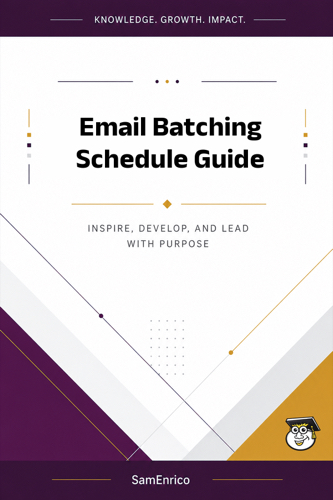
Email Batching Schedule Guide eBook
Check email only two or three times per day in ded
Check email only two or three times per day in dedicated blocks.
Formats
Free sample
Chapter 1: The Hundred-Thousand-Dollar Ping--–- The meeting was supposed to be the highlight of Sarah’s career. Instead, it became the longest thirty minutes of her life.She sat at the head of the conference table, palms damp against the polished mahogany, watching her CEO flip through the contract she had submitted that morning. The client—a Fortune 500 retailer—had given her team six weeks to prepare a logistics proposal worth nearly four million dollars in annual revenue. Sarah had pulled eighteen-hour days, coordinated across four departments, and personally reviewed every clause. She had done everything right.Except one thing.She had checked her email obsessively on the final morning of the deadline.The CEO stopped flipping.
He looked up. His expression was not angry. It was worse. It was confused. “Sarah,” he said, sliding the contract across the table, “page fourteen.
The pricing escalation clause. It still has the placeholder from the first draft. The one that says ‘insert correct percentage here.’”The room went silent. Sarah’s stomach dropped through the floor. She grabbed the contract and stared at the offending paragraph.
There it was, in twelve-point Calibri, as clear as a confession: “Annual price increases shall be [insert correct percentage here] percent.”She had missed it.Not because she was lazy. Not because she was incompetent. But because at 8:15 that morning, she had opened her email “just to check,” and the next four hours had evaporated into a fog of context switching, urgent-but-not-important requests, and the seductive, soul-crushing buzz of the inbox.By the time she returned to the contract, she had eleven minutes to review forty-two pages. She missed the error. The client’s legal team caught it within an hour.
The negotiation imploded. The CEO later calculated the cost: four million dollars in annual recurring revenue, plus the six weeks of payroll her team had burned, plus the reputational damage of appearing sloppy in front of a major account.Total loss: just over one hundred thousand dollars in immediate impact, with years of downstream consequences.All because of a notification ping.The Hidden Tax You Didn’t Know You Were Paying Sarah’s story is not an outlier. It is not a cautionary tale about a single bad day. It is the natural, predictable outcome of a system that has convinced millions of intelligent, hardworking professionals that constant email checking is not only normal but necessary.Here is the truth that Silicon Valley does not want you to know: email is not a productivity tool. It is a distraction machine, disguised as a utility, engineered to hijack your attention and monetize your reaction time.The average knowledge worker checks email seventy-four times per day.
That is once every six and a half minutes, assuming an eight-hour workday. But the real damage is not the thirty seconds you spend reading each message. The real damage is what happens after you close your inbox.Research from the University of California, Irvine, found that after a brief interruption—such as glancing at an email notification—it takes an average of twenty-three minutes and fifteen seconds to return to the original task at full cognitive capacity. Twenty-three minutes. Not to reply to the email.
Not to finish the thought. Just to get back to where you were before the ping.Multiply twenty-three minutes by seventy-four checks. Even if you only open a fraction of those notifications, the cumulative cost is staggering. The average professional loses nearly twenty-eight hours of potential focus time every single week to the aftermath of email interruptions. That is three and a half full workdays.
Every week. Fifty-two weeks per year.You are not managing email. Email is managing you.The Twenty-Three-Minute Heist Let me walk you through what actually happens inside your brain when you succumb to the notification ping.You are working on a complex task—a proposal, a budget model, a piece of code, a strategic plan. This task requires what psychologist Mihaly Csikszentmihalyi called flow: a state of deep, uninterrupted concentration where time disappears and your best work emerges.Your phone buzzes. Or your desktop notification slides into view.
Or you simply decide to check your inbox “real quick.”In that moment, your brain performs what neuroscientists call a task switch. The neural networks that were holding the complex task in working memory begin to dissolve. The context—the spreadsheet cell you were about to edit, the sentence you were about to revise, the variable you were about to debug—starts to fade.You glance at the email. Maybe it is a quick question. Maybe it is a newsletter.
Maybe it is nothing at all. It does not matter. The damage is already done.When you try to return to the original task, your brain does not simply pick up where it left off. It must reload the context—reconstruct the mental model, re-establish the priorities, and re-engage the specific neural circuits required for the work. This reloading process takes an average of twenty-three minutes.Here is the cruelest part: even if you ignore the notification, the damage is partially done.
The mere presence of an unread email notification—the little red badge on your phone, the unread count in your tab—consumes cognitive bandwidth. It is what researchers call an attention residue: a portion of your brain remains tethered to the notification, waiting, wondering, draining resources from the task in front of you.You are paying the twenty-three-minute tax whether you open the email or not.The Hourly Worker Trap There is a second, more insidious cost to constant email checking. It is not measured in minutes or hours. It is measured in professional identity.When you were hired for your current role, you were hired for your judgment, your creativity, your strategic thinking, and your ability to solve problems that cannot be automated. You were hired as a knowledge worker—someone whose primary value comes from your brain, not your hands.But when you spend your day reacting to email, you voluntarily demote yourself to an hourly worker—someone whose primary value comes from processing tasks as they arrive.
You become, in effect, a highly paid administrative assistant for strangers.Think about the actual content of most emails. How many of them require genuine strategic thinking? How many are simply requests for information, meeting scheduling, status updates, or the digital equivalent of tapping someone on the shoulder to say, “Hey, did you see that thing I sent?”The author and productivity expert Tim Ferriss calls this phenomenon “the inbox as a to-do list written by other people.” When you check email constantly, you are outsourcing your priorities to anyone with your email address. Your most important work—the deep, focused, high-leverage activity that justifies your salary—gets pushed aside for the shallow, reactive, low-leverage work of clearing someone else’s queue.This is the Hourly Worker Trap. And it is the reason that the most “available” people in any organization are rarely the top performers.
The top performers are not the ones who reply to emails within minutes. They are the ones who disappear for three hours and emerge with a completed project, a solved problem, or a breakthrough…
This is the end of the free sample. Get the eBook to keep going. Buy now
About this book
Details
- Author
- Naranjo Jeanett
- Publisher
- SamEnrico
- Language
- English
- Genre
- Non-Fiction, Self-Help, Email
- Released
- 2026-06-07
- Pages (approx.)
- 134
- Available as
- eBook, Audiobook

Read better in the ZLOADR app
Your eBooks on your phone or tablet. Sign in with your SamEnrico account and start reading.
More by Naranjo Jeanett
 Affirmations for ShameNaranjo Jeanett$11.99
 Confidence Persuasion TechniqueNaranjo Jeanett$11.99
 The Menopause Cold Flash HandbookNaranjo Jeanett$11.99
 When the World Was a Dream: The Yoruba Orisha's Cosmic DanceNaranjo Jeanett$11.99
 Understanding Kabuki SyndromeNaranjo Jeanett$17.99
 Perl DeveloperNaranjo Jeanett$11.99
 Career Ambition Guilt FixNaranjo Jeanett$12.99
 Angel Investment Regional GuideNaranjo Jeanett$12.99
 How to Become a Novelty WorkerNaranjo Jeanett$11.99
You may also like
 Hong Kong Handover 1997Dunn Johnnie$11.99
 Zumba For Postnatal Recovery CourseNeal Christian$11.99
 Zumba for BeginnersLadner Nikia$11.99
 YouTube Comment Mining GuideHumes Pandora$12.99
 Worry Box MeditationCarlin Rudy$11.99
 Workplace Stress MeditationNguyen Lynn$11.99
 Workplace Stress and Sleep RepairHawley Ivory$11.99
 Workplace Perfectionism CureDelaney Jeffry$11.99
 Workplace Injustice Anger GuideWallen Isabelle$11.99
 Work Addiction and Burnout LinkGreenwood Ester$11.99
 Women in Yoga and WellnessBeattie Galina$11.99
 Women in Stand Up ComedyChun Evangeline$11.99