
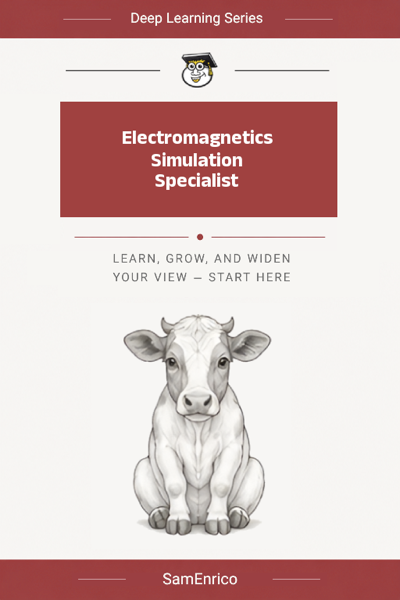
Non-FictionInformativeEducational
Electromagnetics Simulation Specialist eBook
A Coursebook on Electromagnetics Simulation Specia
A Coursebook on Electromagnetics Simulation Specialist
Formats
Free sample
Chapter 1: The Broken Simulation--Every engineer remembers the moment their simulation lied to them.For Mark, a senior RF engineer with ten years of experience, it happened on a Tuesday afternoon in June. He had spent two weeks building a detailed model of a 5G patch antenna array for a new automotive radar system. The geometry was perfect. The materials were correct. The mesh looked fine.
The simulation ran for eighteen hours on a high-performance workstation, consuming thousands of core-hours. When it finished, the results were beautiful—a textbook radiation pattern with perfect gain, pristine return loss, and efficiency numbers that would make any manager smile.Mark presented the results to his director on Friday. The team celebrated. Prototypes were ordered. Eight weeks later, the boards arrived from the fab house.
Mark carried them to the anechoic chamber himself, excited to see his elegant design come to life.The measured return loss was off by 11 d B at the center frequency. The radiation pattern had a massive null where the simulation predicted peak gain. The prototype was a complete failure.The director asked a simple question: "What went wrong?"Mark had no answer. He had trusted the simulation completely. He had used the default settings.
He had never questioned whether his model represented physical reality. He had become, in the worst possible way, a button pusher.This book exists to ensure that never happens to you.The Epidemic of Broken Simulations Mark's story is not unusual. In fact, it is the norm. Across the aerospace, automotive, defense, and telecommunications industries, engineers are producing simulations that look beautiful, run without errors, and deliver completely wrong answers. The problem is not the software.
Modern electromagnetic simulation tools—CST Studio Suite, Ansys HFSS, COMSOL Multiphysics, FEKO, and others—are astonishingly powerful. They can solve problems that would have required supercomputers a decade ago. They can model complex geometries with millions of unknowns. They can simulate everything from a single via on a printed circuit board to the radar cross-section of an entire fighter jet.The problem is not the hardware either. Workstations with dozens of cores and terabytes of RAM are now standard in engineering departments.
Cloud computing has made virtually unlimited simulation resources available on demand.The problem is the engineer between the keyboard and the chair.Most engineers who perform electromagnetic simulation have never been taught how to simulate. They learned by watching a colleague. They learned by clicking through tutorials. They learned by reading software manuals that explain how to set up a simulation but never explain why that setup works—or when it fails catastrophically.They learned to push buttons. They never learned to think like a simulation specialist.Who This Book Is For This book is for the engineer who has realized that button pushing is not enough.
It is for the graduate student who wants to enter industry with more than just a transcript. It is for the working professional who has been burned by a failed simulation and wants to understand why. It is for the manager who needs to evaluate whether a simulation result can be trusted before committing millions of dollars to prototyping and manufacturing.If you have ever looked at a simulation result and wondered, "Is this real, or is this just the solver giving me whatever I asked for?", this book is for you.If you have ever changed a mesh setting, rerun a simulation, and gotten a different answer—and did not know which one to trust—this book is for you.If you have ever read solver documentation and felt lost in a sea of jargon like "basis functions," "impedance matrix conditioning," "CFL stability," and "PML reflection coefficient"—this book is for you.What This Book Will Not Do Before we go further, let me be clear about what this book is not.This book is not a software manual. It will not teach you which menu to click in CST or HFSS. It will not provide step-by-step instructions for every possible simulation type.
Software manuals already exist for that purpose, and they are very good at explaining the mechanics of the tool.This book is not a mathematics textbook. It will not derive Maxwell's equations from first principles. It will not prove the existence of solutions to the wave equation. It will not cover functional analysis or advanced linear algebra. Excellent textbooks already exist for those topics, and you should own at least one of them.This book is not a research monograph.
It will not present cutting-edge methods or new algorithms. It will not focus on the last five percent of simulation accuracy that only matters in academic publications.This book is the bridge between those worlds. It takes the essential concepts from mathematics textbooks and the practical workflows from software manuals and weaves them together into a coherent framework for thinking about simulation. It focuses on the twenty percent of knowledge that delivers eighty percent of the value—the concepts that separate a button pusher from a true specialist.The Four Pillars of the Simulation Specialist Throughout this book, we will return to a simple framework: the Four Pillars of the Simulation Specialist. Every chapter aligns with one or more of these pillars.
Every skill you develop will map to one of them. By the end of the book, you will have built competence in all four.Pillar One: Physical Intuition Physical intuition is the ability to look at a problem and predict the approximate answer before you simulate. It is knowing, without calculation, that a quarter-wave monopole antenna should have an input impedance around 36 ohms. It is knowing that skin depth at 1 GHz in copper is about 2 microns. It is knowing that a slot in an enclosure will leak far more electromagnetic energy than a solid wall of the same thickness.Physical intuition is what separates a simulation specialist from a button pusher.
When you have physical intuition, you can look at a simulation result and immediately know whether it is plausible. You can spot errors that others miss because you know what the answer should look like.Physical intuition cannot be learned from a textbook alone. It is built through practice, through comparison of simulation to measurement, and through the deliberate habit of predicting answers before you compute them. This book will help you build that habit.Pillar Two: Method Literacy Method literacy is the ability to choose the right numerical method for your problem. It is knowing when to use the Finite Element Method (FEM) versus the Finite-Difference Time-Domain method (FDTD) versus the Method of Moments (Mo M).
It is understanding that FEM excels at resonant structures with complex geometries, FDTD dominates for wideband transient problems, and Mo M is unmatched for open-region scattering from large platforms.Method literacy is knowing the strengths and weaknesses of each approach. It is understanding that FEM produces sparse matrices (good for memory) but requires volume meshing (bad for large open regions). It is understanding that FDTD is trivially parallelizable but suffers from numerical dispersion and the Courant stability limit. It is understanding that Mo M produces dense matrices (bad for memory) but only discretizes surfaces (good for large electrical…
This is the end of the free sample. Get the eBook to keep going. Buy now
About this book
Details
- Author
- Schulte Virgil
- Publisher
- SamEnrico
- Language
- English
- Genre
- Non-Fiction, Informative, Educational
- Released
- 2026-06-02
- Pages (approx.)
- 143
- Available as
- eBook, Audiobook

Read better in the ZLOADR app
Your eBooks on your phone or tablet. Sign in with your SamEnrico account and start reading.
More by Schulte Virgil
 Work Addiction And Anger ManagementSchulte Virgil$11.99
 Finance Industry BurnoutSchulte Virgil$11.99
 The Local Business Lead GuideSchulte Virgil$11.99
 IBS Meal Prep HandbookSchulte Virgil$11.99
 Data Breach Customer Email TemplatesSchulte Virgil$11.99
 Whispers of the Vanishing Giants: The Last of the Woolly MammothsSchulte Virgil$11.99
 The Secret Society of the Salk Institute: How a Handful of Scientists Changed the WorldSchulte Virgil$11.99
 How to Start a Hobby in Restoring AntiquesSchulte Virgil$11.99
 Product Photograph DIY GuideSchulte Virgil$12.99
 Break Even Analysis CalculatorSchulte Virgil$12.99
 Understanding Chronic PolyradiculoneuritisSchulte Virgil$17.99
You may also like
 Hong Kong Handover 1997Dunn Johnnie$11.99
 Zumba For Postnatal Recovery CourseNeal Christian$11.99
 Zumba for BeginnersLadner Nikia$11.99
 YouTube Comment Mining GuideHumes Pandora$12.99
 Worry Box MeditationCarlin Rudy$11.99
 Workplace Stress MeditationNguyen Lynn$11.99
 Workplace Stress and Sleep RepairHawley Ivory$11.99
 Workplace Perfectionism CureDelaney Jeffry$11.99
 Workplace Injustice Anger GuideWallen Isabelle$11.99
 Work Addiction and Burnout LinkGreenwood Ester$11.99
 Women in Yoga and WellnessBeattie Galina$11.99
 Women in Stand Up ComedyChun Evangeline$11.99