
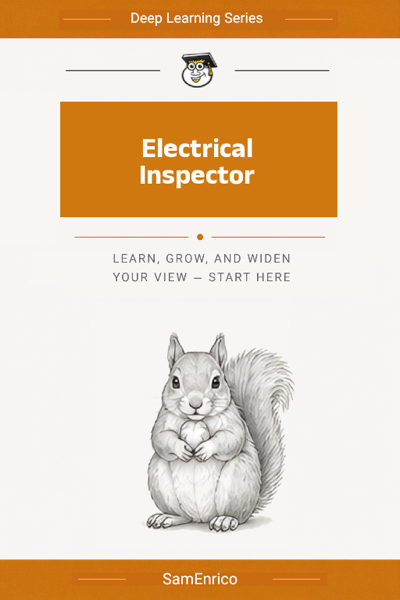
Non-FictionInformativeEducational
Electrical Inspector eBook
A Coursebook on Electrical Inspector
A Coursebook on Electrical Inspector
Formats
Free sample
Chapter 1: The Last Line of Defense...--–- The rain had stopped two hours before dawn, but the service panel in the basement of the Lincoln Street bakery was still sweating. Drops of condensation clung to the metal cover like tears, and the electrician who had called me at 6:00 AM was certain it meant nothing. "It's just an old building," he had said over the phone. "Probably a plumbing leak." But I had learned, across twenty-three years of inspecting electrical installations, that water and electricity are not casual acquaintances. They are enemies that destroy property, injure workers, and end lives.
When I arrived, I did not open the panel immediately. Instead, I stood in the damp basement and asked the electrician a single question: "When was the last time someone calculated the available fault current at this service?" He blinked, confused. That was the moment I knew I had a problem. Not with the panel, but with the understanding of what an electrical inspector actually does. Most people—including many electricians—think we are rule-checkers.
We are not. We are the last line of defense between an installation that works and an installation that kills.The Authority Having Jurisdiction: Who We Are and What We Actually Do The term "Authority Having Jurisdiction" appears hundreds of times in the National Electrical Code, often abbreviated as AHJ. But few people outside the trade understand what it means. The AHJ is the organization, agency, or individual responsible for enforcing the requirements of the NEC within a specific geographic area or project type. For most municipal inspectors, the AHJ is the city or county building department.
For a state hospital inspector, the AHJ might be the state health department. For a third-party inspector hired by an insurance company, the AHJ is the company itself. But regardless of who signs the paycheck, the role is identical: you are the final arbiter of whether an electrical installation is safe enough to be energized.This authority comes with significant legal weight. When you approve an installation, you are essentially certifying that it meets the minimum safety standards adopted by your jurisdiction. When you reject an installation, you are stopping work, potentially costing contractors thousands of dollars per day, and forcing corrections.
This power must be exercised with precision, knowledge, and absolute impartiality.The legal duties of an inspector extend beyond simply knowing the code. You have the right—and in many cases, the obligation—to enter properties during reasonable hours to perform inspections. You have the right to demand that unsafe conditions be corrected. You also have the duty to act without malice, without favoritism toward specific contractors, and without conflicts of interest. Accepting gifts, discounts, or preferential treatment from contractors is not only unethical; in many jurisdictions, it is a criminal offense.Most importantly, every inspection you perform creates a legal record.
Your notes, photographs, and reports can be subpoenaed in lawsuits involving electrical fires, electrocutions, or property damage. In some tragic cases, inspectors have been named as defendants when their approvals later proved to be based on incomplete or incorrect assessments. This is why documentation is not a bureaucratic burden—it is your professional shield.Basic Protection Versus Fault Protection: The Two Pillars of Electrical Safety Before we examine a single wire, we must understand the two fundamental safety concepts that underpin every rule in the NEC. These concepts are basic protection and fault protection, and every inspection you perform will test both.Basic protection refers to the measures that prevent people from accidentally contacting live electrical parts. This includes insulation on wires, barriers inside panels, enclosures around equipment, and the physical separation of live parts from accessible surfaces.
When you open a panel and see that all conductors are properly insulated, that no bare wires are exposed, and that the cover fits securely, you are verifying basic protection. When you check that a receptacle has a faceplate, that a junction box is not missing its cover, and that no wires are pulled tight against a sharp metal edge, you are verifying basic protection. The fundamental question of basic protection is simple: if someone touches this installation under normal conditions, will they receive a shock? The answer must always be no.Fault protection, by contrast, deals with what happens when something goes wrong. Wires can overheat.
Insulation can fail. Someone can drive a nail through a cable hidden in a wall. Fault protection is the system of grounding and bonding that creates a deliberate, low-impedance path for fault current to return to its source, allowing the overcurrent device (breaker or fuse) to open quickly and clear the fault. Without effective fault protection, a damaged wire could energize the metal frame of a refrigerator, an exposed conduit, or a water pipe, creating a deadly shock hazard that might persist for days or weeks.The relationship between basic and fault protection is sometimes misunderstood. Basic protection prevents shocks during normal operation.
Fault protection prevents shocks and fires when basic protection fails. Both are required. Neither is optional. In Chapter 5 of this book, we will spend considerable time teaching you how to visually verify bonding and grounding systems. For now, understand this: the single most common violation found during visual inspections is a missing or improperly installed bonding jumper.
It is also one of the most dangerous.The Hierarchy of Codes: Where the NEC Fits and What You Actually Enforce The NEC is not the only code that governs electrical work, and it is not always the most restrictive. Understanding the hierarchy of codes is essential to avoiding legal trouble and professional embarrassment.At the federal level, the Occupational Safety and Health Administration (OSHA) requires that electrical installations in workplaces be safe, but OSHA generally references the NEC as the standard for what "safe" means. State and local governments adopt the NEC—often with amendments—as law. This is critical: the NEC itself has no legal authority until it is adopted by a governmental body. If your state has adopted the 2023 NEC but your city has amended Article 210.8 to require GFCI protection on all 240-volt receptacles in garages, the city amendment controls.
You must know both the base code and your local amendments.The National Electrical Safety Code (NESC) governs utility-owned lines and equipment, from the power pole to the service point. This is a critical distinction: as a building electrical inspector, you generally do not enforce the NESC. The utility company has its own inspectors for that. However, you must know where the service point is located on a property. In most cases, the service point is at the utility meter or at the first disconnect.
Upstream of that point belongs to the utility and the NESC. Downstream belongs to the building owner and the NEC. Trying to enforce the NEC on a utility transformer, or trying to hold a contractor responsible for a utility-owned conductor, will destroy your credibility and may result in legal challenges.There is also a hierarchy within the NEC itself. Chapters 1 through 4 contain general requirements that apply to all installations unless specifically modified by Chapters 5, 6, or 7. Chapter 8 (communications systems) is largely independent; most of Chapters 1 through…
This is the end of the free sample. Get the eBook to keep going. Buy now
About this book
Details
- Author
- Olivas Fredia
- Publisher
- SamEnrico
- Language
- English
- Genre
- Non-Fiction, Informative, Educational
- Released
- 2026-06-02
- Pages (approx.)
- 127
- Available as
- eBook, Audiobook

Read better in the ZLOADR app
Your eBooks on your phone or tablet. Sign in with your SamEnrico account and start reading.
More by Olivas Fredia
 Remote Review Data Privacy GuideOlivas Fredia$11.99
 Affirmations For Trust Issues CourseOlivas Fredia$11.99
 Stress And Post Surgical PainOlivas Fredia$11.99
 Trauma Response at SchoolOlivas Fredia$11.99
 Renewable Energy Investment StrategyOlivas Fredia$11.99
 The Poisoned Punch: Argentina's Deadly Tango of Deception (1880s)Olivas Fredia$11.99
 Understanding ParagangliomaOlivas Fredia$17.99
 Banking and Finance ESG ComparisonOlivas Fredia$12.99
 LinkedIn Mentor Red Flags GuideOlivas Fredia$12.99
 How to Start a Investment Advice BusinessOlivas Fredia$11.99
You may also like
 Hong Kong Handover 1997Dunn Johnnie$11.99
 Zumba For Postnatal Recovery CourseNeal Christian$11.99
 Zumba for BeginnersLadner Nikia$11.99
 YouTube Comment Mining GuideHumes Pandora$12.99
 Worry Box MeditationCarlin Rudy$11.99
 Workplace Stress MeditationNguyen Lynn$11.99
 Workplace Stress and Sleep RepairHawley Ivory$11.99
 Workplace Perfectionism CureDelaney Jeffry$11.99
 Workplace Injustice Anger GuideWallen Isabelle$11.99
 Work Addiction and Burnout LinkGreenwood Ester$11.99
 Women in Yoga and WellnessBeattie Galina$11.99
 Women in Stand Up ComedyChun Evangeline$11.99