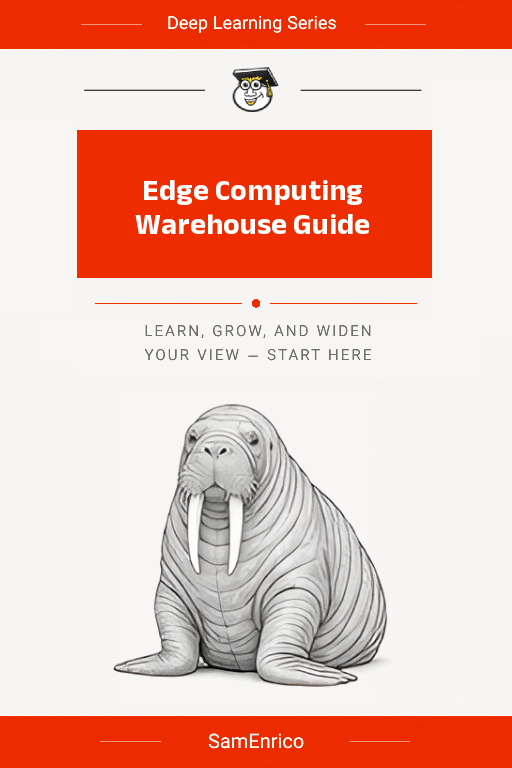
Edge Computing Warehouse Guide eBook
Discover local data processing for real-time inven
by Penny Rich
Discover local data processing for real-time inventory updates, vision analytics, and robot coordination.
Formats
Free sample
Chapter 1: The 200ms Nightmare--–- The robotic arm hovered for 187 milliseconds. In that silent gap between cloud and action, a $47,000 espresso machine slid off the gripper and shattered on the concrete floor. The warehouse manager, watching from the mezzanine, didn't see the latency. He saw a smashed product, a stopped line, and eight workers standing idle. What he didn't know was that the cloud—that magical, unbounded resource everyone had sold him as the future—had just failed him in the most expensive way possible.
The round-trip to the data center took 214 milliseconds. The robot needed 20.This is not a story about broken glass. It is a story about broken promises—the promise that the cloud can run a warehouse in real time. The truth, revealed in the chapters ahead, is that the cloud is essential for planning, analytics, and long-term optimization, but it is catastrophically unsuited for the millisecond-by-millisecond decisions that keep a modern fulfillment center alive.The Latency Tax: What 100ms Costs You Let us begin with a number: 100 milliseconds. That is the blink of an eye, the time it takes a hummingbird to flap its wings once.
In a warehouse, 100 milliseconds of additional latency reduces pick rates by 15 to 20 percent. This is not theoretical. It has been measured on real lines, with real workers, and real robots.Consider a typical pick-and-place operation. A vision system identifies a product, calculates a grasp point, and commands a robotic arm to move. If each of these steps adds 50 milliseconds of cloud round-trip delay, the cumulative effect is devastating.
A robot that could complete 1,200 picks per hour at 20ms latency drops to 900 picks per hour at 120ms latency. Over a 20-hour shift, that is 6,000 fewer picks. At an average order value of 50,thatis50, that is 50,thatis300,000 in lost throughput. Per shift. Per robot line.This is the latency tax, and most warehouse operators pay it without even knowing they are being taxed.
They see slowdowns, jams, and unexplained gaps. They blame the robots, the network, the workers. But the culprit is often invisible: the round-trip to the cloud.Cloud Round-Trip: The Hidden Geography of Delay To understand why the cloud fails warehouses, you must understand the physical reality of data. Light travels through fiber optic cable at about 200,000 kilometers per second. That sounds fast.
It is fast. But geography is relentless. A round-trip from a warehouse in Chicago to a cloud data center in Northern Virginia covers approximately 2,000 kilometers. The speed-of-light travel time alone is 20 milliseconds. Add routing, switching, server processing, and database lookups, and you are easily at 50 to 100 milliseconds.
That is before you have done any useful computation.Now add the variable of congestion. Cloud data centers are shared infrastructure. Your inventory query competes with thousands of other requests. A 50ms baseline becomes 150ms during peak hours. A 150ms baseline becomes 300ms during holiday surges.
The cloud does not fail gracefully. It fails by slowing down just enough to break your real-time operations without triggering any obvious alarms.The chart below illustrates the latency hierarchy that will be used throughout this book. Commit it to memory.Operation Type Cloud Round-Trip Edge Processing Required for Force control loop Impossible (too slow)0.5-5ms Robotic grasping (Chapter 9)Vision inference150-300ms40-80ms Package dimensioning, barcode reading (Chapter 5)Swarm coordination100-250ms10-50ms AMR collision avoidance (Chapter 7)Inventory update50-150ms30-100ms Real-time stock visibility (Chapter 4)Analytics & planning2-10 seconds Not applicable Long-term optimization The Pick-and-Place Disaster: A Case Study in Latency Let us return to that shattered espresso machine. The robotic arm was programmed with a simple cloud-based vision pipeline. A camera captured an image of the incoming product.
That image was compressed and sent to a cloud inference endpoint. The cloud ran a YOLO-based object detection model, identified the product's orientation, and returned a grasp point. The arm then moved, the gripper closed, and the product lifted.The problem was not the model. The problem was the path. The total round-trip took 214 milliseconds.
In that time, the conveyor belt moved the product 17 centimeters. The grasp point calculated on the cloud was for a product location that no longer existed. The gripper closed on air. The product, already shifted, fell.This particular warehouse had a 98.3 percent success rate on the cloud-based system. That sounds good until you calculate the cost.
1.7 percent of 1.2 million picks per month is 20,400 failures. Each failure cost an average of 42indamagedproduct,re−picklabor,andlinedowntime.Thatis42 in damaged product, re-pick labor, and line downtime. That is 42indamagedproduct,re−picklabor,andlinedowntime.Thatis856,000 per month, or over $10 million per year. The cloud was not failing catastrophically. It was failing just enough to drain millions from the bottom line.After migrating to an edge-based system with local inference running on a Jetson Orin NX, the same operation achieved 99.7 percent success.
Latency dropped from 214ms to 62ms. The 0.3 percent failures were due to mechanical issues, not latency. The ROI calculation was simple: 10millionsavedannuallyagainsta10 million saved annually against a 10millionsavedannuallyagainsta45,000 edge hardware investment.Deterministic Versus Best-Effort: Why Your Network is Lying to You The cloud offers what network engineers call "best-effort" delivery. Your packet will probably arrive. It will probably arrive within some range of time.
Probably is not good enough for a robot that must close its gripper at the exact moment a product is centered.Deterministic latency means guaranteed timing. No jitter. No unexplained delays. In a deterministic system, a command sent at time T will be executed at time T plus a known delta, every time. This is the standard for industrial control systems, programmable logic controllers (PLCs), and real-time operating systems.
It is also the opposite of what the cloud provides.Warehouses that try to force cloud architectures into deterministic roles suffer what engineers call the "jitter death spiral." A robot expects a command every 50 milliseconds. Due to network congestion, the command arrives after 30ms, then 80ms, then 150ms, then 45ms. The robot's control loop cannot stabilize. It overshoots, corrects, overshoots again. The result is sluggish, jerky motion that looks like a malfunction but is actually a network problem.Edge computing provides determinism because the compute is local.
The network between camera, edge node, and robot is measured in meters, not kilometers. There are no congestion delays, no routing table lookups, no contention with other tenants. The latency is not just lower; it is predictable. And predictability is the foundation of reliable automation.5G Versus Wi-Fi 6: The Great Warehouse Networking Debate No discussion of warehouse latency is complete without addressing the physical network. The two dominant candidates for warehouse connectivity are 5G (specifically private 5G or CBRS) and Wi-Fi 6.
Each has strengths and trade-offs. Neither replaces edge computing; they complement it.Private 5G (CBRS)Private 5G uses licensed or shared spectrum to create a dedicated cellular network within the warehouse. Latency is excellent: 10-20ms typical, with deterministic options available through 5G URLLC (Ultra-Reliable Low Latency Communication). Coverage is consistent and predictable. The downsides are significant.
Infrastructure costs range from 50,000to50,000 to 50,000to200,000 for a medium-sized warehouse. Deployment requires specialized engineering. And 5G signals have trouble penetrating dense racking and metal shelving.Wi-Fi 6Wi-Fi 6 is the latest generation of wireless LAN. Latency is 10-30ms under good…
This is the end of the free sample. Get the eBook to keep going. Buy now
About this book
Details
- Author
- Penny Rich
- Publisher
- SamEnrico
- Language
- English
- Genre
- Non-Fiction, Forecast & Outlook, Edge Computing
- Released
- 2026-06-01
- Pages (approx.)
- 150
- Available as
- eBook, Audiobook

Read better in the ZLOADR app
Your eBooks on your phone or tablet. Sign in with your SamEnrico account and start reading.
More by Penny Rich
 Loneliness Assessment GuidePenny Rich$11.99
 Dream House Psyche Map CoursePenny Rich$11.99
 Personalized Email Marketing GuidePenny Rich$11.99
 Resistance Band Stretching RoutinePenny Rich$11.99
 The Pillars of Power: How One Family Shaped Modern MedicinePenny Rich$11.99
 The Arsenic Diaries: The Poisoner Who Outwitted the LawPenny Rich$11.99
 Assistant Office ManagerPenny Rich$11.99
 SME ESG Reporting Guide 2025Penny Rich$12.99
 Understanding Hypokalemic Periodic Paralysis Type 1Penny Rich$17.99
 A Beginners Guide to Breaststroke (Volume 1)Penny Rich$11.99