
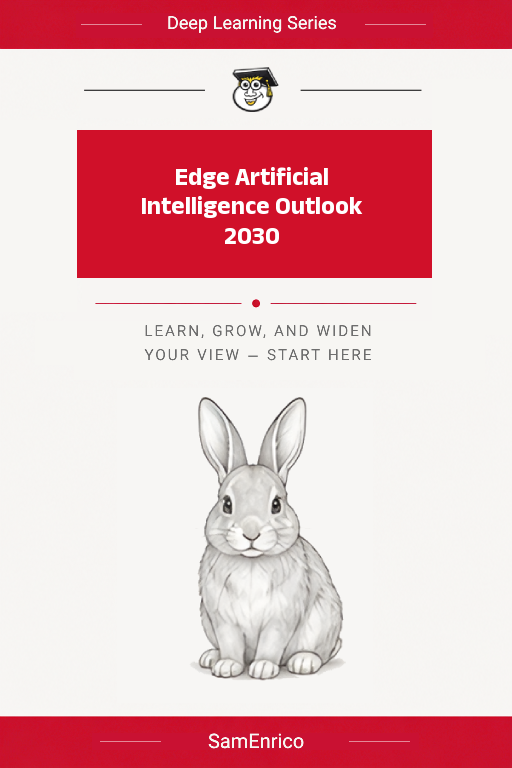
Non-FictionForecast & OutlookEdge Computing
Edge Artificial Intelligence Outlook 2030 Audiobook
Forecast the shift from cloud to on-device AI, pro
by Wixom Graham
Forecast the shift from cloud to on-device AI, projecting growth in edge computing, privacy-preserving models, and latency-sensitive applications.
Formats
Free sample
Chapter 1: The Cloud Ceiling--–- The cloud had a good run. For nearly two decades, the dominant architecture for artificial intelligence was simple: ship data from the edge of the network—your phone, your car, your factory sensor—to a distant data center, let the giant computers think, and send the answer back. This model built trillion-dollar companies. It enabled voice assistants, recommendation engines, and facial recognition. It was, by any measure, a revolution.But revolutions don't end.
They mutate.Sometime between 2025 and 2027, the cloud-centric AI architecture will hit a wall. Not a soft wall—the kind you can push through with more servers or fatter pipes—but a hard wall, etched into the laws of physics, the limits of energy economics, and the rising tide of data sovereignty laws. This book calls that wall the Cloud Ceiling.The Cloud Ceiling is the inflection point where the marginal cost—in time, energy, bandwidth, and carbon—of sending data to the cloud exceeds the cost of processing it locally. Cross that ceiling, and your application breaks. Not because the cloud is slow, but because the cloud is far.
Not because data centers are inefficient, but because moving data is thermodynamically expensive. Not because privacy laws are annoying, but because they carry fines that can bankrupt a company.This chapter dissects the three converging limits that create the Cloud Ceiling. By the end, you will understand why the next decade of artificial intelligence will not be cloud-first or cloud-only, but edge-first—with the cloud as a powerful but secondary player for training, orchestration, and non-urgent batch processing. More importantly, you will have a simple diagnostic to determine whether your own applications are already pressing against the ceiling.The Physics of Distance: Why Light Is Too Slow Let us begin with a fact that seems almost absurdly simple, yet is routinely ignored in cloud architecture reviews: information cannot travel faster than the speed of light. In a vacuum, light travels at 299,792,458 meters per second.
In fiber optic cables, that speed drops to approximately 200,000,000 meters per second—about two-thirds of the theoretical maximum, due to the refractive index of glass.Now consider a transcontinental connection. A data packet traveling from New York to a cloud data center in Northern California travels roughly 4,000 kilometers in each direction. The round-trip distance is 8,000 kilometers. At 200,000 kilometers per second, the absolute physical minimum time for that…
This is the end of the free sample. Get the Audiobook to keep going. Buy now
About this book
Details
- Author
- Wixom Graham
- Publisher
- SamEnrico
- Language
- English
- Genre
- Non-Fiction, Forecast & Outlook, Edge Computing
- Released
- 2026-05-29
- Pages (approx.)
- 155
- Available as
- eBook, Audiobook

Listen in the VoxFlicks app
Audiobooks and audio dramas wherever you go. Sign in with your SamEnrico account and press play.
More by Wixom Graham
 Iranian Revolution CausesWixom Graham$11.99
 GAD Support Group GuideWixom Graham$11.99
 The Self Hypnosis Trance ManualWixom Graham$11.99
 Customer Loyalty PositioningWixom Graham$11.99
 ABCDE Method for ADHD MindsWixom Graham$11.99
 The Dragon’s Gambit: A Spy Among the ScaledWixom Graham$11.99
 The Camel DNA Code: Unlocking the Secrets of the DesertWixom Graham$11.99
 How to Become a ClamperWixom Graham$11.99
 Non Resident LLC Banking Options GuideWixom Graham$12.99
 Understanding Gunal–seber–basaran SyndromeWixom Graham$17.99
 Technical Facility ExecutiveWixom Graham$11.99
You may also like
 Hong Kong Handover 1997Dunn Johnnie$11.99
 Zumba For Postnatal Recovery CourseNeal Christian$11.99
 Zumba for BeginnersLadner Nikia$11.99
 YouTube Comment Mining GuideHumes Pandora$12.99
 Worry Box MeditationCarlin Rudy$11.99
 Workplace Stress MeditationNguyen Lynn$11.99
 Workplace Stress and Sleep RepairHawley Ivory$11.99
 Workplace Perfectionism CureDelaney Jeffry$11.99
 Workplace Injustice Anger GuideWallen Isabelle$11.99
 Work Addiction and Burnout LinkGreenwood Ester$11.99
 Women in Yoga and WellnessBeattie Galina$11.99
 Women in Stand Up ComedyChun Evangeline$11.99