
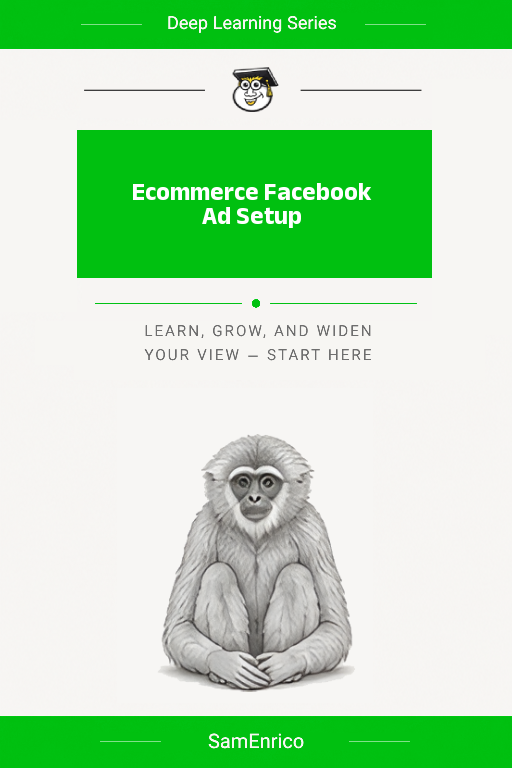
Non-FictionFirst 30 DaysEcommerce
Ecommerce Facebook Ad Setup eBook
Launches first Facebook ad campaign for ecommerce
Launches first Facebook ad campaign for ecommerce store with product catalog, dynamic ads, and purchase objective.
Formats
Free sample
Chapter 1: The Zero-Hour Number––Most ecommerce entrepreneurs launch their first Facebook ad campaign backward.They open Ads Manager, select “Purchase” as their objective, upload a few product photos, enter a budget—usually 20or20 or 20or50 or “whatever feels right”—and click publish. Then they wait. When the first sale comes in, they celebrate. When the second sale comes in, they increase the budget. And somewhere around the third week, they realize something terrible: they are losing money on every single sale, and the more they scale, the faster they go bankrupt.This chapter exists to ensure that never happens to you.Before you write a single headline, before you upload a single image, before you even open Facebook Ads Manager, you must calculate what I call the Zero-Hour Number.
This is the single most important metric in your entire advertising career. Get it right, and profitability is a math problem you can solve. Get it wrong, and Facebook will happily take your money forever while you wonder why “the algorithm isn’t working.”Let me tell you about Sarah.The $2,000 Mistake Sarah launched a print-on-demand store selling motivational posters for home offices. Her posters cost 12toproduce(printing,packaging,shippingincluded).Shesoldthemfor12 to produce (printing, packaging, shipping included). She sold them for 12toproduce(printing,packaging,shippingincluded).Shesoldthemfor29.99.
Simple math, right? 29.99minus29.99 minus 29.99minus12 equals $17.99 profit per poster. She thought she had room to advertise.She set up her first Facebook campaign with a 30dailybudget.Withinaweek,shehadgenerated30 daily budget. Within a week, she had generated 30dailybudget.Withinaweek,shehadgenerated600 in sales. She was thrilled.
She increased her budget to 50perday.Salesclimbedto50 per day. Sales climbed to 50perday.Salesclimbedto1,200 in the second week. She increased again to $75 per day.Then she looked at her bank account. She had less money than when she started.Here is what Sarah missed. Facebook was spending 75perday.Hercostperpurchase(theamount Facebookchargedhereachtimesomeoneclicked“buy”)was75 per day.
Her cost per purchase (the amount Facebook charged her each time someone clicked “buy”) was 75perday.Hercostperpurchase(theamount Facebookchargedhereachtimesomeoneclicked“buy”)was18.50. That sounds fine—18.50tomakea18.50 to make a 18.50tomakea29.99 sale leaves $11.49, right? Wrong. Because Sarah forgot to factor in her true costs.Her 12productioncostatemostofthat12 production cost ate most of that 12productioncostatemostofthat11.49. She was left with negative $0.51 per sale.
Every time Facebook sold a poster, Sarah lost 51 cents. And the more Facebook sold, the more money she lost. She had built a machine that converted ad spend into negative profit with terrifying efficiency.Sarah had never calculated her Zero-Hour Number.What Is the Zero-Hour Number?The Zero-Hour Number is your Break-Even Return on Ad Spend—the exact ROAS at which you make zero profit and zero loss on every sale. It is called the Zero-Hour Number because it is the first thing you must know before you spend hour zero of your ad budget.Here is the formula:Break-Even ROAS = 1 ÷ (Profit Margin Percentage)Or, more simply: Break-Even ROAS = Total Revenue ÷ Total Ad Spend at break-even Let me give you a concrete example. Suppose you sell a product for 100.Yourtotalcosts(productcost,shipping,paymentprocessingfees,packaging)addupto100.
Your total costs (product cost, shipping, payment processing fees, packaging) add up to 100.Yourtotalcosts(productcost,shipping,paymentprocessingfees,packaging)addupto40. Your profit before ads is 60.Yourprofitmarginis6060. Your profit margin is 60% (60.Yourprofitmarginis6060 ÷ $100).If you spend 1on Facebookadstomakethat1 on Facebook ads to make that 1on Facebookadstomakethat100 sale, your ROAS is 100x (100 divided by 1). That is fantastic. But you do not need 100x.
You need to know the minimum ROAS that keeps you profitable.The formula is: 1 ÷ 0.60 = 1.67.Your Break-Even ROAS is 1.67. That means for every 1youspendon Facebookads,youneedtogenerateatleast1 you spend on Facebook ads, you need to generate at least 1youspendon Facebookads,youneedtogenerateatleast1.67 in revenue to break even. Anything above 1.67isprofit.Anythingbelow1.67 is profit. Anything below 1.67isprofit.Anythingbelow1.67 is loss.For Sarah, her product sold for 29.99.Herproductioncostwas29.99. Her production cost was 29.99.Herproductioncostwas12.
Her payment processing fees (Stripe or Pay Pal) added roughly 2.9% plus 0.30,orabout0.30, or about 0.30,orabout1.17. Her true cost per unit was 13.17.Herprofitbeforeadswas13.17. Her profit before ads was 13.17.Herprofitbeforeadswas16.82. Her profit margin was 56% (16.82÷16.82 ÷ 16.82÷29.99).1 ÷ 0.56 = 1.78.Sarah’s Break-Even ROAS was 1.78. But Facebook was delivering a ROAS of 1.62 (29.99sale÷29.99 sale ÷ 29.99sale÷18.50 ad cost = 1.62).
She was losing 16 cents on every ROAS point below break-even. Over 65 sales, she lost more than $500 while thinking she was winning.Why Most Ecommerce Owners Skip This Step I have taught this material to hundreds of store owners, and I have heard every excuse for skipping the Zero-Hour Number. “I’ll figure out profitability later.” “I just need traffic first.” “Facebook’s algorithm needs data before I worry about margins.” “My product has high margins, so I don’t need to calculate.”These are all forms of magical thinking.Facebook’s algorithm does not care about your profitability. It cares about one thing: spending your budget in a way that maximizes the likelihood of hitting your selected objective. If you tell Facebook to optimize for purchases, it will find purchases.
It will find them at any cost. It will happily pay 50toacquireacustomerfora50 to acquire a customer for a 50toacquireacustomerfora20 product if that is what it takes to spend your daily budget.The algorithm is not your partner. It is a machine. You must tell it what “success” looks like in dollar terms, not just event terms.Let me show you what happens when you calculate your Zero-Hour Number before you launch.The Four Layers of Your True Cost Most store owners calculate their product cost and stop. That is like measuring a house by looking at the front door.
You need to account for four distinct cost layers before you can calculate your true Break-Even ROAS.Layer One: Cost of Goods Sold (COGS)This is the obvious one. How much does it cost you to acquire or manufacture the product? For dropshippers, this is the supplier price plus any per-order fees. For print-on-demand, this is the base production cost plus shipping from the printer to the customer. For private label, this is the unit cost from your manufacturer plus freight and customs.Layer Two: Transaction and Platform Fees Payment processors take a cut of every sale.
Stripe and Pay Pal charge roughly 2.9% plus 0.30pertransaction.Shopifyand Woo Commercemaychargeadditionalfeesdependingonyourplan.Fora0.30 per transaction. Shopify and Woo Commerce may charge additional fees depending on your plan. For a 0.30pertransaction.Shopifyand Woo Commercemaychargeadditionalfeesdependingonyourplan.Fora50 product, that is about 1.75.Fora1.75. For a 1.75.Fora20 product, that is about $0.88. These fees scale with revenue, not with profit.
They must be factored into your cost per sale.Layer Three: Shipping and Handling If you offer free shipping, the cost of shipping is part of your COGS. If you charge for shipping, the customer pays it—but the fee the payment processor takes on that shipping charge still comes out of your pocket. Additionally, packaging materials (boxes, tape, inserts) add small but real costs. For a typical ecommerce store, shipping and packaging add 3to3 to 3to8 per order depending on product weight and distance.Layer Four: Overhead and Operational Costs This is the layer most beginners forget. Your monthly Shopify subscription is a cost.
Your email marketing software (Klaviyo, Mailchimp) is a cost. Your customer service software, your returns processing, your chargeback fees, your inventory storage fees—all of these are real expenses that must be covered…
This is the end of the free sample. Get the eBook to keep going. Buy now
About this book
Details
- Author
- Gresham Layla
- Publisher
- SamEnrico
- Language
- English
- Genre
- Non-Fiction, First 30 Days, Ecommerce
- Released
- 2026-05-29
- Pages (approx.)
- 147
- Available as
- eBook, Audiobook

Read better in the ZLOADR app
Your eBooks on your phone or tablet. Sign in with your SamEnrico account and start reading.
More by Gresham Layla
 Stress Allergy Flare GuideGresham Layla$11.99
 Education Break GapGresham Layla$11.99
 Catherine Voltaire FriendshipGresham Layla$11.99
 Down Shift Stress For LongevityGresham Layla$11.99
 The Depression Screening GuideGresham Layla$11.99
 Burke and Wills: The Epic Quest to Cross AustraliaGresham Layla$11.99
 The Breeder's Guide to Aylesbury DucksGresham Layla$11.99
 How to Start a Bean Grinding Business (Beginners Guide)Gresham Layla$11.99
 Impact Accelerator Pitch GuideGresham Layla$12.99
 Btor AdministratorGresham Layla$11.99
You may also like
 Hong Kong Handover 1997Dunn Johnnie$11.99
 Zumba For Postnatal Recovery CourseNeal Christian$11.99
 Zumba for BeginnersLadner Nikia$11.99
 YouTube Comment Mining GuideHumes Pandora$12.99
 Worry Box MeditationCarlin Rudy$11.99
 Workplace Stress MeditationNguyen Lynn$11.99
 Workplace Stress and Sleep RepairHawley Ivory$11.99
 Workplace Perfectionism CureDelaney Jeffry$11.99
 Workplace Injustice Anger GuideWallen Isabelle$11.99
 Work Addiction and Burnout LinkGreenwood Ester$11.99
 Women in Yoga and WellnessBeattie Galina$11.99
 Women in Stand Up ComedyChun Evangeline$11.99