
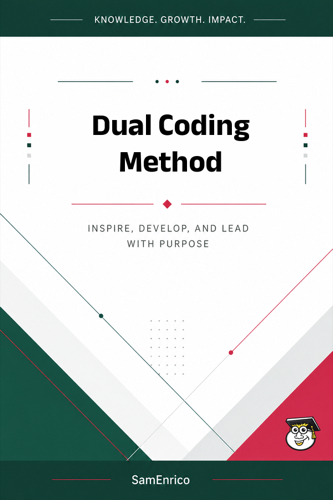
Dual Coding Method Audiobook
undefined
undefined
Formats
Free sample
Chapter 1: The Learning Lie--–- Every time you have sat through a bullet-point presentation, every time you have rewritten your notes word-for-word, and every time you have been told that you are a “visual learner” or a “verbal learner,” you have been lied to. Not maliciously, but persistently. The lie is comfortable, intuitive, and entirely wrong. It has shaped classrooms, corporate training rooms, and self-help books for decades. And it is the single greatest obstacle to understanding how your brain actually learns.The lie sounds like this: “Find your learning style.
If you are a visual learner, use pictures. If you are an auditory learner, listen to lectures. If you are a kinesthetic learner, move around.” This framework, known as VAK or VARK (Visual, Auditory, Reading/Writing, Kinesthetic), has been debunked by cognitive scientists for over a decade. Yet it refuses to die. It survives because it feels true.
When you struggle to understand a diagram, it is easy to say, “I’m just not a visual learner.” When you zone out during a lecture, it is tempting to say, “I need to see it written down.” These explanations are seductive because they excuse difficulty rather than explaining learning.The truth is both simpler and more powerful. You do not have one learning style. You have two processing systems, and they work together whether you like it or not. Every human brain—from the most art-sensitive designer to the most spreadsheet-obsessed accountant—processes information through two distinct but interconnected channels. One channel handles language.
The other channel handles non-verbal images, sounds, and sensory experiences. These channels evolved together, they work in parallel, and they learn best when they are activated simultaneously.This chapter dismantles the learning styles myth, introduces the real architecture of the human mind as discovered by cognitive psychologist Allan Paivio, and establishes the foundational principle that will guide everything else in this book: dual coding is not a technique for visual learners. It is a technique for every learner. By the end of this chapter, you will understand why the “learning styles” industry is built on sand, what replaces it, and why the most effective learning happens when words and images enter the brain together.The Comfortable Lie: How Learning Styles Became Gospel To understand why the learning styles myth persists, you must first understand how it became popular. In 1987, New Zealand educator Neil Fleming developed the VARK…
This is the end of the free sample. Get the Audiobook to keep going. Buy now
About this book
Details
- Author
- Hubbard Isabel
- Publisher
- SamEnrico
- Language
- English
- Genre
- Non-Fiction, Self-Help
- Released
- 2026-06-07
- Pages (approx.)
- 141
- Available as
- eBook, Audiobook

Listen in the VoxFlicks app
Audiobooks and audio dramas wherever you go. Sign in with your SamEnrico account and press play.
More by Hubbard Isabel
 Social Media Stress and CouplesHubbard Isabel$11.99
 Listening In Difficult Talks GuideHubbard Isabel$11.99
 Community Healing CirclesHubbard Isabel$11.99
 Tech Support Distraction GuideHubbard Isabel$11.99
 The Quit Smoking Diabetes GuideHubbard Isabel$11.99
 The Technology DependencyHubbard Isabel$11.99
 The Land of My ParentsHubbard Isabel$11.99
 EQ for Grief and LossHubbard Isabel$11.99
 The Siege of Shimbazu: Okinawa's Last Stand (1609)Hubbard Isabel$11.99
 The Man Who Found Adele: Simon Cowell and the Birth of a Global SuperstarHubbard Isabel$11.99
 The Last Wild Frontier: How a Forgotten Expedition Reshaped AmericaHubbard Isabel$11.99
 China Brazil Dropshipping Invoice RequirementsHubbard Isabel$12.99
You may also like
 Hong Kong Handover 1997Dunn Johnnie$11.99
 Zumba For Postnatal Recovery CourseNeal Christian$11.99
 Zumba for BeginnersLadner Nikia$11.99
 YouTube Comment Mining GuideHumes Pandora$12.99
 Worry Box MeditationCarlin Rudy$11.99
 Workplace Stress MeditationNguyen Lynn$11.99
 Workplace Stress and Sleep RepairHawley Ivory$11.99
 Workplace Perfectionism CureDelaney Jeffry$11.99
 Workplace Injustice Anger GuideWallen Isabelle$11.99
 Work Addiction and Burnout LinkGreenwood Ester$11.99
 Women in Yoga and WellnessBeattie Galina$11.99
 Women in Stand Up ComedyChun Evangeline$11.99