
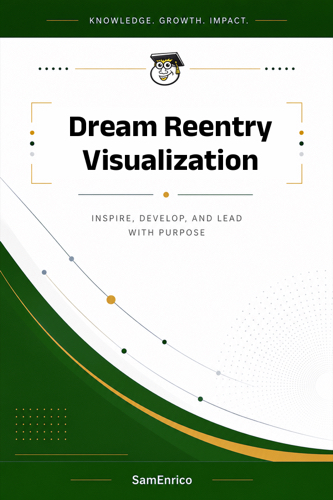
Dream Reentry Visualization eBook
Uses journal entries to re-enter and explore dream
Uses journal entries to re-enter and explore dreams further.
Formats
Free sample
Chapter 1: The Unfinished Door...--–- You wake with a gasp. Your heart is pounding. The dream is already slipping away—edges dissolving, colors fading, voices becoming echoes. You know something important just happened. You felt something real.
But three minutes from now, all that will remain is a vague residue: a sense of unease, a flicker of joy, the ghost of a face you cannot quite remember.You reach for your phone. The blue light floods your pupils. You check messages, scroll, roll over, and get up. The dream is gone. By breakfast, you have forgotten you ever dreamed at all.This is not a failure of memory.
It is a failure of method.Every night, your brain produces a feature-length film of stunning complexity—rich with sensory detail, emotional depth, and narrative surprise. Neuroscientists have confirmed that even during non-REM sleep, the brain remains highly active, consolidating memories, processing emotions, and running simulations of possible futures. The average person spends roughly six years of their lifetime dreaming. Six years. And most of that footage is discarded before the morning coffee.But what if you could not only remember your dreams, but step back inside them?What if the dream that ended too soon—the chase that stopped at the cliff, the conversation cut off mid-sentence, the door that began to open just as you woke—could be resumed exactly where it left off?What if you could interview the figures who populate your dreams, asking them who they are and why they have come?What if you could change the ending of a recurring nightmare, not by suppressing it, but by reentering it as a lucid, empowered participant?This book exists because the answer to all of these questions is yes.
And the key is not a pill, a device, or a special meditation technique available only to monks in mountain monasteries. The key is a journal. Not a passive diary where you record what happened, but an active reentry vehicle—a tool for climbing back into your own subconscious.This is Dream Reentry Visualization. And everything changes starting tonight.The Dream That Changed Everything Let me tell you about a dream I had eleven years ago. I was standing in a long corridor lined with doors—hundreds of them, identical, stretching into darkness.
I knew, with the peculiar certainty of dreams, that behind one of those doors was a room I had been searching for my entire life. Not a treasure room. Not a throne room. Something simpler and more profound: a room where I would finally understand why I kept making the same mistakes, choosing the same wrong people, running from the same invisible fears.I walked for what felt like hours. Then I stopped in front of a door painted a faded, peeling blue.
I reached for the handle. My fingers touched the cool brass. The door began to swing open—And I woke up.For weeks, that unfinished moment haunted me. I tried to return to the dream through sheer willpower. I tried hypnosis tapes.
I read books on lucid dreaming. Nothing worked. The corridor and its thousands of doors remained closed to me. I had captured the dream in my journal—I had written down every detail I could remember—but capturing was not the same as returning. I had a photograph of a place I could no longer visit.Then I discovered something that changed my relationship to dreams forever.I learned that the journal itself could be the portal.Instead of treating my written dream entry as a dead record, I began to use it as a script for reentry.
I read my own words aloud before sleep. I visualized myself standing in that corridor, not by trying to conjure the image from nothing, but by anchoring my attention to one sensory detail from my journal: the smell of old wood and dust. That single scent became my doorway. Within three nights, I was back in the corridor. Within a week, I had opened the blue door.What I found inside is not relevant here.
What matters is that the method worked. And over the following years, as I refined and tested this approach with hundreds of other dreamers, it worked for them too. The journal became a reentry vehicle. The written word became a teleportation device. And the four-step cycle that emerged from this work—Capture, Enter, Explore, Integrate—became the foundation of what I now call the Dream Reentry Visualization method, or DRV.The Great Misunderstanding: Recall vs.
Reentry Before we go any further, we must clear away a fundamental confusion that has hobbled dream work for decades.Most people believe that the goal of keeping a dream journal is recall. You wake up, you write down what you remember, and if you are diligent, your recall improves over time. You build a library of dream records. You can look back and see patterns. This is useful.
But it is also incomplete.Recall is a rearview mirror. It shows you where you have been, but it does not take you back there.Reentry is something else entirely. Reentry is the active, intentional process of stepping back inside a dream scene, resuming the action, and continuing the experience. Where recall is passive, reentry is active. Where recall produces a record, reentry produces a return.
Where recall asks "What happened?", reentry asks "What is happening right now?"Consider the difference between reading a travelogue about Paris and actually walking along the Seine. The travelogue can describe the sound of the water, the taste of a croissant, the feeling of cobblestones underfoot. But it cannot give you those sensations. To feel the mist on your face, you must go to Paris.Your dream journal has been a travelogue. This book will teach you to go to Paris.The distinction is not merely semantic.
It changes everything about how you approach the first moments after waking, how you structure your journal entries, and what you consider a successful night's work. A good recall night might produce three pages of detailed narrative. A good reentry night might produce only a single sentence—but that sentence will be accompanied by the visceral sensation of having been there again.The Four Cycles of DRVThe Dream Reentry Visualization method rests on four interconnected phases. Each phase corresponds to a section of this book, and each builds on the one before.Capture: Before you can reenter a dream, you must preserve it in a form that makes reentry possible. This is not merely writing down what happened.
It is creating a blueprint—a structured record that captures not just the narrative but the sensory texture, the emotional arc, and the precise exit point where the dream ended. Capture is the foundation. Without it, reentry is guesswork.Enter: Once you have a reentry-ready journal entry, you need techniques for crossing back over. This phase teaches the specific visualization and grounding methods that allow you to step from waking consciousness into the dream landscape. You will learn the Static Scene Method, the 45-Degree Rule, and the use of sensory anchors drawn directly from your journal.Explore: Inside the dream, the work truly begins.…
This is the end of the free sample. Get the eBook to keep going. Buy now
About this book
Details
- Author
- Herrington Erich
- Publisher
- SamEnrico
- Language
- English
- Genre
- Non-Fiction, Self-Help
- Released
- 2026-06-06
- Pages (approx.)
- 136
- Available as
- eBook, Audiobook

Read better in the ZLOADR app
Your eBooks on your phone or tablet. Sign in with your SamEnrico account and start reading.
More by Herrington Erich
 Alcoholism and Family HealingHerrington Erich$11.99
 The Absent Parent AdultHerrington Erich$11.99
 Loud Noises RageHerrington Erich$11.99
 The Great Paris Art Swindle: How a Forger Fooled the Elite (1873)Herrington Erich$11.99
 A Beginners Guide to 3x3 (Volume 1)Herrington Erich$11.99
 US Bank Account for Non Residents HandbookHerrington Erich$12.99
 Silver Fox Rabbit BreedingHerrington Erich$11.99
 How to Produce Clarinet PartsHerrington Erich$11.99
You may also like
 Hong Kong Handover 1997Dunn Johnnie$11.99
 Zumba For Postnatal Recovery CourseNeal Christian$11.99
 Zumba for BeginnersLadner Nikia$11.99
 YouTube Comment Mining GuideHumes Pandora$12.99
 Worry Box MeditationCarlin Rudy$11.99
 Workplace Stress MeditationNguyen Lynn$11.99
 Workplace Stress and Sleep RepairHawley Ivory$11.99
 Workplace Perfectionism CureDelaney Jeffry$11.99
 Workplace Injustice Anger GuideWallen Isabelle$11.99
 Work Addiction and Burnout LinkGreenwood Ester$11.99
 Women in Yoga and WellnessBeattie Galina$11.99
 Women in Stand Up ComedyChun Evangeline$11.99