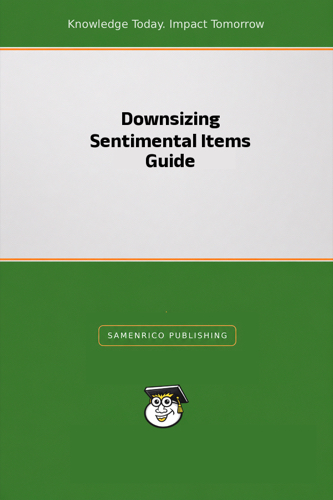
Downsizing Sentimental Items Guide eBook
Keep memories while losing clutter using digitizat
by Mathias Mel
Keep memories while losing clutter using digitization and selective preservation.
Formats
Free sample
Chapter 1: The Ghosts We Keep--Every object in your home that you cannot bear to part with is not actually an object. It is a ghost. It is the ghost of a person you used to be, a person you hoped to become, or a person you lost. Your mother's china is not twelve pieces of glazed porcelain. It is the ghost of the gracious hostess you imagined you would become when you inherited it.
Your child's macaroni art is not dried pasta and white glue. It is the ghost of time standing still, of a toddler's sticky fingers that you desperately wanted to freeze in place. Your wedding dress, sealed in a preservation box in the back of your closet, is not fabric and lace. It is the ghost of a twenty-five-year-old woman who believed in forever.This is the Identity Trap. And until you understand it, you will never downsize a single sentimental item.I have stood in hundreds of spare bedrooms, basements, and attics with clients who are drowning in things they claim to love but never actually touch.
I have watched a sixty-year-old woman weep over a set of candlesticks she had not looked at in thirty-four years. I have watched a grown man defend a box of baseball cards he had not opened since the Reagan administration. When I ask why they keep these items, they always give the same answer: "Because they're part of who I am."But here is the truth that will either make you put down this book or read it twice: They are not part of who you are. They are part of who you were. And confusing the two is the single greatest obstacle between you and a home that feels light.The Psychology of "Someday"Let us begin with a story.
Her name was Margaret, and she was seventy-two years old when she called me. Her husband had died eight years prior. Her children had moved to other states. She lived alone in a four-bedroom house that had once been filled with the noise of family dinners, slamming doors, and teenage arguments. Now it was quiet.
And it was full.Not full in the way a hoarder's house is full. Margaret was not keeping garbage or spoiled food. She was keeping memories. The dining room table was stacked with boxes of her daughter's high school papers. The guest bedroom contained nineteen bins of her son's childhood toys.
The basement held her mother's wedding china, her aunt's silverware, and three boxes of greeting cards dating back to 1972."I'm going to go through them someday," she told me. "I just need the time."We have all heard this word before. Someday. It is the most dangerous word in the English language when it comes to sentimental clutter. Someday I will organize these photos.
Someday I will read these letters again. Someday I will display this china. Someday never comes. Someday is a lie we tell ourselves to avoid the discomfort of admitting that we are keeping things for a version of our lives that no longer exists and never will.The psychologist Daniel Gilbert, in his book Stumbling on Happiness, describes a phenomenon called the "end of history illusion." It is the tendency of human beings to believe that we have changed dramatically in the past but will change very little in the future. We look back at ourselves ten years ago and think, "I was so different then." But we look forward ten years and think, "I will be roughly the same as I am now." This is almost always wrong.
You will not want the same things at sixty that you wanted at forty. You will not want the same things at forty that you wanted at twenty-five. The china you inherited at thirty will not matter to you at sixty-five. But because you cannot imagine your future self as a different person, you keep it.Margaret kept her china because she still believed, against all evidence, that she would host Thanksgiving dinner for twelve people again. She had not hosted a dinner party in seven years.
Her children lived thousands of miles away. Her husband was gone. But the ghost of the woman she had been at forty-five still lived in her mind, and that ghost demanded a dining room set for twelve.We finally made a deal. She would keep two place settings – two plates, two cups, two forks. She would use them for her own breakfast and dinner.
The other ten place settings, we agreed, would be photographed and donated to a local church that hosted community meals for seniors. She wept when we packed them. But two months later, she called me to say that she had eaten her breakfast every morning from her mother's china cup, and that the act of using it daily had brought her more joy than the full set had brought her in three decades of storage.The china had not been a set of dishes. It had been the ghost of a person she no longer was. When she finally saw that, she let the ghost go.The Three Ghosts That Haunt Your Home The Identity Trap manifests in three distinct forms.
I want you to read each one and ask yourself: Which of these ghosts lives in my house?Ghost One: The Person You Used to Be This is the most common and the most painful. These are the objects that belong to your former self – the self who played sports, who traveled, who had a different body size, who was married, who was a parent of young children, who lived in a different city, who had a different career. You keep the hockey jersey from college because you were an athlete then. You keep the hiking boots because you were adventurous then. You keep the size six jeans because you were thin then.The problem is not that you loved those activities.
The problem is that you are using objects to mourn a version of yourself that no longer exists instead of building a life that fits who you are now. The hockey jersey is not a memory. The memory is in your mind. The jersey is a tombstone. And you are the one who died.Here is the test: If you were to meet your twenty-year-old self today, would you want to be friends with them?
Would you want to live in their apartment? Would you want to wear their clothes? If the answer is no, you are allowed to release their belongings. You are not betraying your younger self. You are honoring your current self by making space for the life you actually live.Ghost Two: The Person You Hoped to Become This ghost is quieter but just as heavy.
These are the objects you acquired for a life you imagined but never built. The formal china for dinner parties you never hosted. The bread machine that was going to make you a person who bakes. The language learning software that was going to make you fluent in Italian. The crafting supplies that were going to turn you into someone who makes gifts by hand.You…
This is the end of the free sample. Get the eBook to keep going. Buy now
About this book
Details
- Author
- Mathias Mel
- Publisher
- SamEnrico
- Language
- English
- Genre
- Non-Fiction, Business Brief, Emotional Intelligence
- Released
- 2026-06-07
- Pages (approx.)
- 154
- Available as
- eBook, Audiobook

Read better in the ZLOADR app
Your eBooks on your phone or tablet. Sign in with your SamEnrico account and start reading.
More by Mathias Mel
 The Hydration and Focus GuideMathias Mel$11.99
 Dream Health Indicator LogMathias Mel$11.99
 Bay Village Bludgeoning MysteryMathias Mel$11.99
 Pet Loss and HoardingMathias Mel$11.99
 Addiction Conversation GuideMathias Mel$11.99
 Goal Setting For AnxietyMathias Mel$11.99
 Cope With EmotionsMathias Mel$11.99
 The Black Death's Silent WitnessMathias Mel$11.99
 The Golden Scrolls of Timbuktu: Africa's Forgotten ScholarsMathias Mel$11.99
 Service Providers Guide to Video ProductionMathias Mel$11.99
 How to Produce VacuumsMathias Mel$11.99
 Create a Spreadsheet Product FastMathias Mel$12.99