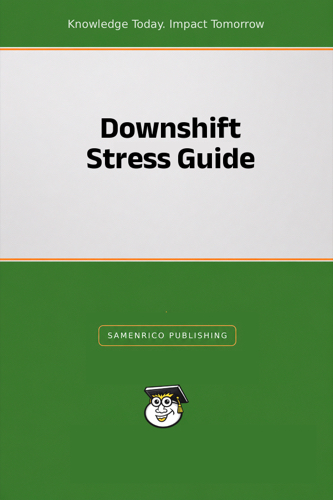
Downshift Stress Guide
Nap, pray, and pause to lower stress hormones.
Nap, pray, and pause to lower stress hormones.
Formats
About this book
Free sample
Chapter 1: The Hormonal Highway--–- You wake up at 6:15 a.m. to the sound of your phone. Before your feet touch the floor, you check email. Three urgent requests. A Slack message from a colleague in London.
A news alert that spikes your heart rate. You haven't even brushed your teeth, and already your body is awash in stress hormones. By 10 a.m., you've had two coffees, snapped at a coworker, and can't remember what you ate for breakfast. By 3 p.m., you're crashing. By 9 p.m., you're too wired to sleep.
And tomorrow, you'll do it all again.This is not a personal failing. This is a physiological pattern—one that you can measure, understand, and change.Most people believe stress is a feeling. An emotion. Something you should "think positive" about or "manage better." But stress is not primarily psychological. It is hormonal.
It is a chemical cascade that evolved over hundreds of millions of years to save your life from predators, not to help you respond to emails. When you understand stress as hormones—cortisol, adrenaline, and their counterbalancing partners—you stop blaming yourself and start working with your biology.This chapter will transform how you see your daily experience. You will learn what the top ten stress-resilience books agree upon: acute stress is adaptive, but chronic stress is toxic. You will map the 24-hour rhythm of cortisol and identify exactly where your habits disrupt it. And you will learn three simple, science-backed methods to measure your personal stress load—without expensive lab tests or wearables (though those help).
By the end of this chapter, you will have turned the vague sense of "being stressed" into quantifiable data. And data, unlike feelings, can be acted upon.The Two Faces of Stress: Acute vs. Chronic Let us begin with a thought experiment. Imagine you are walking through a forest. A bear appears twenty feet away, rising onto its hind legs.
What happens inside your body? Your amygdala—the brain's smoke detector—signals the hypothalamus. The hypothalamus activates the sympathetic nervous system. Your adrenal glands release adrenaline and cortisol. Your heart…
This is the end of the free sample. Get the eBook to keep going. Buy now
Contents
- Chapter 1
- Chapter 2
- Chapter 3
- Chapter 4
- Chapter 5
- Chapter 6
- Chapter 7
- Chapter 8
- Chapter 9
- Chapter 10
- Chapter 11
- Chapter 12
Details
- Author
- Sheridan Roselia
- Publisher
- SamEnrico
- Language
- English
- Genre
- Non-Fiction, Health & Wellness, Stress Reduction
- Released
- 2026-06-08
- Pages (approx.)
- 152
- Available as
- eBook, Audiobook

Read better in the ZLOADR app
Your eBooks on your phone or tablet. Sign in with your SamEnrico account and start reading.
More by Sheridan Roselia
 Probiotic Anxiety TrialSheridan Roselia$11.99
 Functional Fixedness BreakthroughSheridan Roselia$11.99
 Pain Noting TechniqueSheridan Roselia$11.99
 Automatic Anger ThoughtsSheridan Roselia$11.99
 The Taika Waititi BiographySheridan Roselia$11.99
 Power of AttorneySheridan Roselia$11.99
 Pomodoro for ProcrastinationSheridan Roselia$11.99
 Mutiny at Sea: The 2015 Pacific Princess Prisoner RiotSheridan Roselia$11.99
 The Poets of the Jazz Age: A Harlem Renaissance RevivalSheridan Roselia$11.99
 How to Start a Mineral Water Exporter (wholesale) Business (Beginners Guide)Sheridan Roselia$11.99
 The Essential Guide to Original ScoreSheridan Roselia$11.99
 How to Produce Eye MasksSheridan Roselia$11.99