
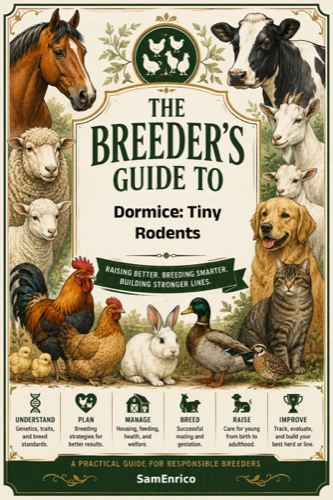
Non-FictionInformativeEducational
Dormice: Tiny Rodents Audiobook
This wildlife publication, published by SamEnrico,
This wildlife publication, published by SamEnrico, covers Dormice: Tiny Rodents
Formats
Free sample
Chapter 1: The Sleep-Climbing Paradox...–- On a damp autumn evening in a古老的 English woodland, a creature no heavier than a handful of feathers emerges from a woven ball of honeysuckle bark. It pauses at the fork of a hazel branch, whiskers twitching, eyes wide and dark as polished jet. In one fluid motion, it hangs upside-down from a twig no thicker than a drinking straw, rotates its hind feet a full 180 degrees, and reaches out to nip a ripe nut still in its green husk. This is a dormouse. It is neither a mouse, nor a squirrel, nor a rat.
And for seven months of the year, it will quite literally cease to be a warm-blooded mammal, dropping its body temperature to within a degree of the cold soil around it. To understand the dormouse is to enter a world where the boundaries between waking and sleeping, climbing and falling, life and death blur into a single, continuous strategy for survival.The first problem any naturalist encounters when studying dormice is not biological but linguistic. The very name "dormouse" carries centuries of misconception. It derives from the Old French dormir (to sleep), with the Anglo-Saxon mus (mouse) grafted onto it, creating a hybrid word that means, roughly, "sleeping mouse." But dormice are not mice. They belong to the family Gliridae (sometimes called Myoxidae in older texts), a lineage so ancient and so distinct that it split from the ancestors of true mice and rats before the Himalayas began their slow collision with the Asian continent.
While the great rodent radiation of the Eocene produced rats, squirrels, beavers, porcupines, and guinea pigs, the dormice held to an older plan: a compact body, a remarkably flexible spine, a tail that doubles as a fifth limb, and a metabolic system that treats energy as a currency to be hoarded, not spent.Dispelling the "big squirrel" myth requires an even closer look. Squirrels are diurnal, aggressive, and built for powered climbing—muscular hind legs that launch them up tree trunks. Dormice are nocturnal, secretive, and built for stealthy, energy-efficient movement through the fine branches of the shrub layer. A squirrel encountering a gap will leap; a dormouse will test the gap, retreat, find a longer route, or simply wait until a tendril of honeysuckle grows across it. This behavioral caution is not timidity.
It is thermodynamics in action. Every unnecessary movement costs calories, and for an animal that must pack on 30 to…
This is the end of the free sample. Get the Audiobook to keep going. Buy now
About this book
Details
- Author
- Hawthorne Taunya
- Publisher
- SamEnrico
- Language
- English
- Genre
- Non-Fiction, Informative, Educational
- Released
- 2026-06-02
- Pages (approx.)
- 114
- Available as
- eBook, Audiobook

Listen in the VoxFlicks app
Audiobooks and audio dramas wherever you go. Sign in with your SamEnrico account and press play.
More by Hawthorne Taunya
 Influence Techniques for Product ManagersHawthorne Taunya$11.99
 Legal Marijuana Road RageHawthorne Taunya$11.99
 Comparison Trap PostpartumHawthorne Taunya$11.99
 Breast Health For Non Binary PeopleHawthorne Taunya$11.99
 People Pleasing Fawn ResponseHawthorne Taunya$11.99
 Tech Layoff RecoveryHawthorne Taunya$11.99
 Cloud Floating RelaxationHawthorne Taunya$11.99
 Group Creativity for Social WorkersHawthorne Taunya$11.99
 Bloodhounds of the Penitentiary: The K9 War Against 19th-Century Prison GangsHawthorne Taunya$11.99
 When the World Was a Dream: The Navajo EmergenceHawthorne Taunya$11.99
 How to Start a Agricultural Machinery and Equipment Rental With Operator Business (Beginners Guide)Hawthorne Taunya$11.99
 EU Export Eco Certification HandbookHawthorne Taunya$12.99
You may also like
 Hong Kong Handover 1997Dunn Johnnie$11.99
 Zumba For Postnatal Recovery CourseNeal Christian$11.99
 Zumba for BeginnersLadner Nikia$11.99
 YouTube Comment Mining GuideHumes Pandora$12.99
 Worry Box MeditationCarlin Rudy$11.99
 Workplace Stress MeditationNguyen Lynn$11.99
 Workplace Stress and Sleep RepairHawley Ivory$11.99
 Workplace Perfectionism CureDelaney Jeffry$11.99
 Workplace Injustice Anger GuideWallen Isabelle$11.99
 Work Addiction and Burnout LinkGreenwood Ester$11.99
 Women in Yoga and WellnessBeattie Galina$11.99
 Women in Stand Up ComedyChun Evangeline$11.99