
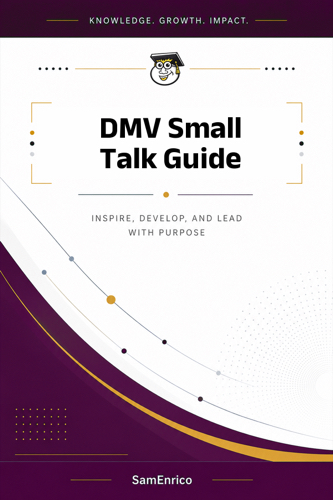
Non-FictionSelf-HelpGovernment
DMV Small Talk Guide eBook
Passes long wait times with fellow applicants.
by Espino Esta
Passes long wait times with fellow applicants.
Formats
Free sample
Chapter 1: The Silence Tax--You are about to spend 127 full days of your adult life waiting in lines. Not in traffic. Not on hold with customer service. In actual lines—standing, sitting, slumped against a wall, or perched on the world’s most unforgiving plastic chair. That is nearly four months of your waking life.
And if you are like most people, you will spend those 127 days staring at a ticket dispenser, a clock that appears to be moving backward, or a phone screen displaying the same three apps you checked thirty seconds ago.The DMV is not the only place you wait. But it is the worst place you wait. It is the undisputed heavyweight champion of American waiting—the place where time doesn’t just slow down but seems to develop a personal vendetta against you. Airport security lines are stressful but efficient. Doctor’s waiting rooms have magazines from this decade.
The Department of Motor Vehicles has none of these things. What it has is fluorescent lighting that makes everyone look like a suspect, a numbering system that feels deliberately cruel (“Now serving B-12. You are B-87”), and an atmosphere so devoid of stimulation that you can actually feel your brain cells retiring one by one.But here is the secret that former DMV employees know and that most applicants never discover: the people who get through the wait fastest are not the ones who arrive early, or bring the correct paperwork, or know which form to fill out. The people who get through the wait fastest are the ones who talk to strangers.This is not a metaphor. Research in environmental psychology has demonstrated that perceived time slows by thirty to forty percent when people are socially isolated in boring environments.
Put simply: silence makes the wait longer. Not actually longer—the clock keeps the same pace—but longer in your head, which is the only clock that matters. A ninety-minute wait in silence feels like two hours and ten minutes. A ninety-minute wait filled with casual conversation feels like fifty minutes. You do the math.
Silence is not free. Silence is a tax you pay with your own attention span.This book exists because that tax is optional. You do not have to pay it. You can stop paying it today, in your next DMV visit, and in every other waiting room you will ever enter. But first, you need to understand why you have been paying it for so long without realizing it.The Invention of Not Seeing People There is a term in sociology for what happens when strangers sit in the same room and pretend not to notice each other.
It is called civil inattention. The phrase was coined by the sociologist Erving Goffman in the 1960s, and it describes the polite fiction that allows crowded public spaces to function. When you enter an elevator, you do not stare at the other passengers. You look at the floor numbers, or your phone, or that little crack where the doors meet. You are not being rude.
You are being civil. You are signaling, “I see that you are a person, but I am not a threat, and I trust that you are not a threat either.” Civil inattention is the glue that holds crowded cities together.But civil inattention has a dark side. What starts as politeness becomes habit. What becomes habit becomes autopilot. And what becomes autopilot becomes a wall between you and every other human being in the room.
By the time you reach the DMV, you have been trained by a thousand elevators, a thousand subway cars, a thousand waiting rooms to look at anything except the person sitting three feet away from you. You are not avoiding them because you dislike them. You are avoiding them because that is what civilized people do.Except civilized people also complain about long waits. Civilized people also feel their blood pressure rise when the ticket number hasn’t changed in fifteen minutes. Civilized people also leave the DMV exhausted and swear they will renew online next time.
The contradiction is this: the very behavior that makes the wait bearable—talking to the person next to you—is the behavior that civil inattention forbids. You are trapped in a prison of good manners.The Bystander Effect Has a Brother You have probably heard of the bystander effect. It is the psychological principle that people are less likely to help someone in distress when other people are present. Everyone assumes someone else will call for help, so no one calls. The DMV has its own version of this phenomenon, and it is even more pervasive.
Let us call it the conversational bystander effect.Picture a typical DMV waiting room. Forty people. Forty different reasons for being there. One ticket number flashing on the screen. The room is silent except for the occasional cough, the rustle of paperwork, and the distant sound of a clerk calling “Next.” Every single person in that room would probably enjoy a brief conversation with the person next to them.
Every single person is bored out of their skull. And every single person assumes that if conversation were appropriate, someone else would start it.So no one starts it.The silence is not a collective decision. It is a collective failure of imagination. Each person thinks, “If that person wanted to talk, they would say something.” And each person thinks the exact same thing about you. The result is a room full of people who are all waiting for someone else to break the ice, unaware that everyone else is waiting for them.This is where the opportunity lies.
The person who speaks first is not being rude. They are not violating civil inattention. They are simply being the one who notices that the waiting game is rigged, and they are choosing to play a different game. That person could be you.What Former DMV Employees Know Before we go any further, let us hear from the people who have watched this dynamic play out thousands of times. I interviewed former DMV employees from three states, and their observations were remarkably consistent.
Here is what they want you to know.First, chatty sections of the waiting room are always the calmest. Not the quietest—the calmest. When people are talking, they are not watching the clock. They are not standing up every thirty seconds to check if their number has been called. They are not sighing loudly, shuffling their feet, or glaring at the clerk behind the counter.
They are simply… waiting. The employees notice this. They know which sections of the room are going to be a problem before the problems start. And it is never the section where people are laughing.Second, the most patient applicants are almost always the ones who arrived with someone else. A married couple, two friends, a parent and a teenager—they have built-in conversation.
Their wait feels shorter to them, and they are less likely to complain. The solo applicant is the wild card. The solo applicant is the one who has been staring at the same spot on the wall for forty-five…
This is the end of the free sample. Get the eBook to keep going. Buy now
About this book
Details
- Author
- Espino Esta
- Publisher
- SamEnrico
- Language
- English
- Genre
- Non-Fiction, Self-Help, Government
- Released
- 2026-06-10
- Pages (approx.)
- 136
- Available as
- eBook, Audiobook

Read better in the ZLOADR app
Your eBooks on your phone or tablet. Sign in with your SamEnrico account and start reading.
More by Espino Esta
 The Emergency Placement NightEspino Esta$11.99
 Calendar Zero MethodEspino Esta$11.99
 Retirement Housing Co-op MembershipEspino Esta$11.99
 Parent Loss and AddictionEspino Esta$11.99
 Personal Branding for ResearchersEspino Esta$11.99
 Chief Joseph BiographyEspino Esta$11.99
 Remote Work Vacation PlanningEspino Esta$11.99
 The Lens and the Light: How a 15th-Century Persian Photographer Revolutionized VisionEspino Esta$11.99
 The Opium Wars of the Russian Underworld: Moscow’s Shadow Trade in AsiaEspino Esta$11.99
 How to Produce Linesman FlagsEspino Esta$11.99
 A Collector's Handbook to the Mercedes-benz Mercedes 300sl CoupeEspino Esta$11.99
 User Generated Content ClauseEspino Esta$12.99
You may also like
 Hong Kong Handover 1997Dunn Johnnie$11.99
 Zumba For Postnatal Recovery CourseNeal Christian$11.99
 Zumba for BeginnersLadner Nikia$11.99
 YouTube Comment Mining GuideHumes Pandora$12.99
 Worry Box MeditationCarlin Rudy$11.99
 Workplace Stress MeditationNguyen Lynn$11.99
 Workplace Stress and Sleep RepairHawley Ivory$11.99
 Workplace Perfectionism CureDelaney Jeffry$11.99
 Workplace Injustice Anger GuideWallen Isabelle$11.99
 Work Addiction and Burnout LinkGreenwood Ester$11.99
 Women in Yoga and WellnessBeattie Galina$11.99
 Women in Stand Up ComedyChun Evangeline$11.99