
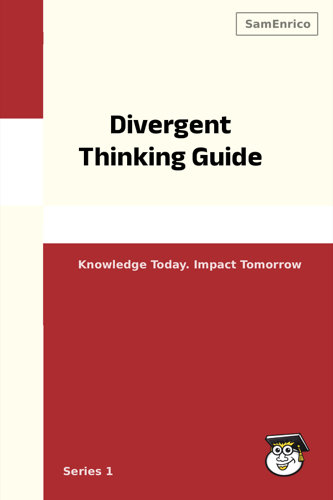
Divergent Thinking Guide eBook
Generate many possible solutions before converging
Generate many possible solutions before converging on one.
Formats
Free sample
Chapter 1: The First Rabbit--–- Every failed project, every wasted million, every team that built something nobody wanted—they all share the same secret origin story. It doesn't start with bad execution. It doesn't start with lazy employees or incompetent managers. It starts in the first ten seconds after someone states a problem. In those ten seconds, someone speaks.
And the world shrinks.This is the story of the First Rabbit.Imagine a hunting dog that picks up a scent. The dog doesn't immediately chase the first animal it smells. It tests the air. It moves in a circle. It identifies multiple possibilities.
Only then, with information, does it run. Humans do the opposite. We smell one rabbit, and we sprint. We don't circle. We don't test.
We commit. And then we spend weeks, months, or years chasing a rabbit that was never the right one to begin with.This book is about learning to stop chasing the First Rabbit. It is about building the discipline to generate a hundred possibilities before choosing one. It is about delaying closure in a world that rewards speed over sense. And it begins with a simple, uncomfortable truth: most of the solutions you have passionately defended were probably wrong—not because you aren't smart, but because you decided too fast.The Elevator That Cost Nothing and Fixed Everything In the early 1980s, a large office building in New York City faced a crisis.
Tenants were furious. The elevators were too slow. Complaints flooded the management office. Some tenants threatened to break their leases. The building was losing reputation and, soon, would lose revenue.The building owners called in an engineering firm.
The engineers studied the problem for two weeks. Their conclusion was technically flawless, financially terrifying, and completely predictable: the elevators needed new motors, upgraded cables, and a complete control system overhaul. The price tag was $2 million. The work would take six months. During that time, elevator access would be severely limited, which meant tenants would be even angrier.The owners were about to write the check.
They had done their due diligence. They had hired experts. They had a solution. It was expensive, painful, and probably the best they could do.Then someone asked a different question.Not an engineer. Not a manager.
Someone whose job title no one remembers. They asked: "Why are people angry?"The obvious answer: the elevators are slow.Then they asked: "What if we didn't make the elevators faster? What if we just made the wait feel shorter?"This is the moment most teams never reach. The moment when you stop asking "how" and start asking "why." The moment when you refuse to accept the first problem definition and instead go one level deeper.The solution they implemented cost $50. They installed mirrors next to the elevator doors on every floor.
That was it. No new motors. No construction. No six-month disruption. Just mirrors.Why did it work?
Because when people wait for an elevator, they have nothing to do but stare at the doors and count the seconds. Every second feels like three. But give them a mirror, and suddenly they are checking their hair, adjusting their tie, looking at the person next to them. The objective wait time didn't change. The subjective experience did.
Complaints dropped by nearly ninety percent.The engineering solution would have worked. It would have cost $2 million and caused six months of misery. The mirror solution worked better, cost almost nothing, and took a weekend to install. The difference wasn't technical expertise. It wasn't budget.
It was the willingness to ask a divergent question before committing to a convergent answer.This is the First Rabbit problem. The engineers saw a slow elevator and immediately chased the "faster elevator" rabbit. It was obvious. It was logical. It was also the wrong rabbit.The Neuroscience of Premature Commitment Why do we chase the First Rabbit?
The answer lies deep in the human brain, in a region called the ventral striatum. This is part of the brain's reward system, and it is ancient. It evolved to solve a very specific problem: survival.Imagine your ancestor on the savanna. They hear rustling in the grass. It could be a rabbit (food).
It could be a lion (death). They have approximately half a second to decide: flee or investigate. The brain that hesitated, that generated five possibilities and evaluated each one, did not survive. The brain that acted immediately, that grabbed the first plausible interpretation, lived to reproduce.This is called the "adaptive unconscious." It is fast, automatic, and remarkably effective for simple, immediate threats. It is also completely wrong for complex, modern, strategic problems.The ventral striatum releases dopamine when we make a decision.
It feels good to choose. It feels even better to be right. And because our brains are wired to seek reward, we rush to the feeling of decision-making. We don't wait for more information. We don't generate alternatives.
We grab the First Rabbit, and we run.This is not a character flaw. It is a hardware feature. Every human brain does this. The question is not whether you have this bias. You do.
The question is whether you have built systems to override it.Organizations make it worse. Companies praise decisiveness. They reward speed. They promote people who have answers, not people who have questions. A CEO who says "I don't know yet" is seen as weak.
A manager who says "let's explore five options" is seen as slow. The culture reinforces the biology. The result is a world where the First Rabbit wins almost every time, even when it is clearly the wrong rabbit.The Hi PPO in the Room There is a second reason we chase the First Rabbit, and it is not biological. It is political. It is called the Hi PPO effect.
Hi PPO stands for Highest Paid Person's Opinion.The pattern is so common that it has become a cliché in every industry. A team gathers to solve a problem. The most senior person in the room speaks first. They offer an idea. It might be good.
It might be terrible. It doesn't matter. Because as soon as the Hi PPO speaks, the meeting is over.Everyone else nods. Everyone else offers supporting evidence. Everyone else works backward from the Hi PPO's idea to find a justification.
The team does not explore. The team does not diverge. The team validates. This is not malice. It is self-preservation.
Challenging a senior leader's idea is risky. Agreeing is safe. And so the First Rabbit is not just the first idea that occurs to anyone. It is the first idea that occurs to the most powerful person in the room.I once consulted for a technology company that had spent eighteen months building a product feature that absolutely no customer wanted. When I asked how they had chosen that feature, the product manager looked at his shoes and said, "The CTO suggested it in the first ten minutes of the kickoff meeting."They knew it was a bad idea.
The team had data showing customers wanted something else. But the CTO had spoken first, and no one felt safe saying…
This is the end of the free sample. Get the eBook to keep going. Buy now
About this book
Details
- Author
- Kessler Evelina
- Publisher
- SamEnrico
- Language
- English
- Genre
- Non-Fiction, Self-Help, Thinking
- Released
- 2026-06-07
- Pages (approx.)
- 130
- Available as
- eBook, Audiobook

Read better in the ZLOADR app
Your eBooks on your phone or tablet. Sign in with your SamEnrico account and start reading.
More by Kessler Evelina
 Domestic Dispute De escalationKessler Evelina$11.99
 Glaucoma Lifestyle ManagementKessler Evelina$11.99
 YouTube Binge Breaker GuideKessler Evelina$11.99
 Tobacco Chewing Quit StrategyKessler Evelina$11.99
 Cracking the Earth's Puzzle: The Scientists Who Mapped a Shifting WorldKessler Evelina$11.99
 The Berlin Tunnel: A Cold War Heist Beneath the Iron CurtainKessler Evelina$11.99
 Student Accommodation EuropeKessler Evelina$12.99
 Qatar B2B Sales PlaybookKessler Evelina$12.99
 Music TherapistKessler Evelina$11.99
 Understanding Carcinoma, Squamous CellKessler Evelina$17.99
 How to Start a Hobby in Model AirplanesKessler Evelina$11.99
You may also like
 Hong Kong Handover 1997Dunn Johnnie$11.99
 Zumba For Postnatal Recovery CourseNeal Christian$11.99
 Zumba for BeginnersLadner Nikia$11.99
 YouTube Comment Mining GuideHumes Pandora$12.99
 Worry Box MeditationCarlin Rudy$11.99
 Workplace Stress MeditationNguyen Lynn$11.99
 Workplace Stress and Sleep RepairHawley Ivory$11.99
 Workplace Perfectionism CureDelaney Jeffry$11.99
 Workplace Injustice Anger GuideWallen Isabelle$11.99
 Work Addiction and Burnout LinkGreenwood Ester$11.99
 Women in Yoga and WellnessBeattie Galina$11.99
 Women in Stand Up ComedyChun Evangeline$11.99