
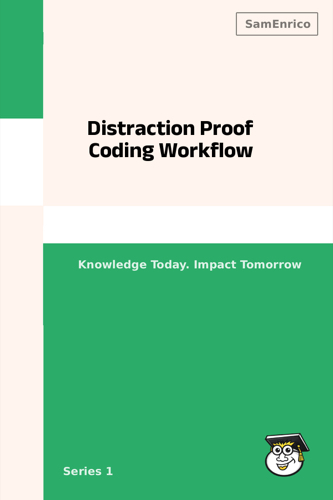
Distraction Proof Coding Workflow eBook
Sets up IDE focus modes, notification blockers, an
Sets up IDE focus modes, notification blockers, and pairing practices for uninterrupted programming.
Formats
Free sample
Chapter 1: The Broken Window...--–- The first time Sarah watched a junior developer quit, she thought it was about salary. The second time, she blamed burnout. By the third resignation in six months, she had to face an uncomfortable truth: her team wasn't broken because they worked too hard. They were broken because they could never actually work at all.Sarah was a staff engineer at a mid-sized fintech company, responsible for a team of eight developers maintaining a critical payment processing system. On paper, her team had everything: competitive pay, flexible hours, a modern tech stack.
But something was quietly killing their productivity, and no one could name it.Every morning, Sarah would open her laptop to twenty-seven Slack messages, fourteen emails, three calendar invites, and a pull request review request from a developer in London. By the time she cleared the notifications, it was 10:30 AM. She would open her IDE, find the function she was refactoring yesterday, and then—ping. A question from product. She answered.
Another ping. A code review request. She skimmed it. Another ping. A build failure notification.
By noon, she had written four lines of code.She wasn't lazy. She wasn't unfocused. She was a casualty of a system designed to destroy attention.And she had no idea that the problem had a name, a cost, and a cure.The Billion-Dollar Bottleneck This book argues a simple, controversial, and liberating proposition: your inability to focus is not your fault. It is a design flaw in your environment, your tools, and your team habits. And like any design flaw, it can be engineered away.The average software developer spends less than three hours per day in what this book calls Deep Coding—a state of fluid, uninterrupted concentration where complex problems yield to logical reasoning.
The remaining five hours are consumed by context switching, notification handling, meeting overhead, and the slow psychological bleed of digital noise.That five-hour leak is not a rounding error. It is the single largest drag on software productivity in the modern economy. And it is almost entirely preventable.This chapter establishes the economic, cognitive, and psychological rationale for the book that follows. You will learn why distraction is not a minor annoyance but a catastrophic tax on your work. You will see the research that proves context switching destroys intelligence.
And you will encounter the core thesis that will guide every subsequent chapter: You cannot will yourself to focus. You must engineer your environment to make distraction impossible.The Broken Window Theory of Software In 1982, criminologists James Wilson and George Kelling proposed the "Broken Windows Theory." They argued that visible signs of disorder—a broken window, graffiti, abandoned trash—invite more disorder. A building with one broken window, left unrepaired, will soon have all its windows broken. The signal of neglect encourages further neglect.Software development has its own broken windows. A noisy Slack channel that no one silences.
An IDE cluttered with toolbars and popups. A team culture where interrupting a colleague is considered faster than reading documentation. A code review process that takes three days and four back-and-forth comments.These small distractions are the broken windows of your workflow. They seem minor in isolation. A single notification costs only a second to dismiss.
A single question from a teammate takes only a minute to answer. But each broken window sends a signal: This is not a place where focus matters.And so more broken windows appear. The team stops respecting "do not disturb" statuses. Meetings run over. Code reviews become endless threads.
The IDE becomes a carnival of flashing icons. The developer, surrounded by digital decay, stops trying to focus at all. They learn to stay perpetually shallow, responding to whatever screen is brightest, because deep work has become impossible.This book is about boarding up every broken window in your coding environment. Not one at a time, but systematically. Because a single overlooked distraction does not cost a single second.
It costs the possibility of flow.The 23–25 Minute Wound To understand the true cost of distraction, you must understand context switching.In the early 2000s, researchers at UC Irvine and Microsoft began measuring how long it takes knowledge workers to return to a task after an interruption. The results were startling. After even a brief interruption—a phone call, an email notification, a colleague tapping your shoulder—it takes an average of 23 to 25 minutes to fully re-engage with complex work.Let me repeat that: twenty-three to twenty-five minutes. Not to complete the task. Just to get back to the same level of cognitive focus you had before the interruption.Why so long?
Because complex intellectual work is not a single thread. It is a vast web of associations, partial solutions, variable names, edge cases, and mental breakpoints. When you are deep in code, your working memory holds a delicate architecture of relationships. Interrupt that architecture, and the whole structure collapses. Rebuilding it takes time.Consider what happens when a notification appears while you are debugging a race condition.
You glance at Slack. The message is not urgent—a teammate asking about a deployment schedule. You reply quickly. The whole exchange takes fifteen seconds.But you have just inflicted a 23-minute wound on your own productivity. Because when you turn back to the race condition, you have forgotten which thread you were tracing.
You scroll up. You re-read the logs. You re-establish the mental model. Fifteen seconds of distraction cost you nearly half an hour of recovery.Now multiply that by the average developer's daily interruptions. A 2022 study by the software analytics firm Code Time found that developers experience an average of 87 interruptions per day.
Not all of them are notifications—some are self-interruptions (checking email, opening social media, switching to documentation). But each one carries the same recovery tax.Eighty-seven interruptions. Twenty-three minutes each. Do the math. That is over thirty hours per week of potential recovery time.
Even if only half of those interruptions are external, the loss is catastrophic.The IQ Point Drop The damage is not just time. It is intelligence.In 2005, researchers at the University of London conducted a now-famous study on the cognitive costs of multitasking. They asked participants to perform complex problem-solving tasks while occasionally responding to incoming emails and instant messages. The researchers measured IQ scores before and after the multitasking sessions.The result: participants who multitasked showed a temporary IQ drop of 10 points. For context, that is more than double the cognitive impairment caused by smoking marijuana.
It is equivalent to losing a full night of sleep. It is the difference between scoring in the top 10% of the population and scoring in the average range.Why does multitasking—really, rapid context switching—lower intelligence? Because working memory has a hard limit. Cognitive psychologists estimate that working memory can hold approximately four discrete "chunks" of information at once. When you switch contexts, you flush those chunks and load new ones.
But the flush is never clean. Residual attention lingers on the previous task, consuming mental bandwidth.This is why toggling between a browser and an IDE feels so exhausting. You are not just moving your eyes. You are forcing your…
This is the end of the free sample. Get the eBook to keep going. Buy now
About this book
Details
- Author
- Ballard Ronald
- Publisher
- SamEnrico
- Language
- English
- Genre
- Non-Fiction, Self-Help, Software Development
- Released
- 2026-06-08
- Pages (approx.)
- 134
- Available as
- eBook, Audiobook

Read better in the ZLOADR app
Your eBooks on your phone or tablet. Sign in with your SamEnrico account and start reading.
More by Ballard Ronald
 Addiction Recovery Self TalkBallard Ronald$11.99
 Insurance Dividend StocksBallard Ronald$11.99
 Public Commitment StrategyBallard Ronald$11.99
 Consequence Systems Against DelayBallard Ronald$11.99
 Polish Zygmunt SzendzielarzBallard Ronald$11.99
 Grief and Music After Child LossBallard Ronald$11.99
 Burnout Prevention For TherapistsBallard Ronald$11.99
 The Last Broadcast: How a 1930s Radio Station Predicted the FutureBallard Ronald$11.99
 The Last Stand: How Vince Lombardi Built a Dynasty from ScratchBallard Ronald$11.99
 How to Produce Wireless Access PointsBallard Ronald$11.99
 How to Produce Medical ProductsBallard Ronald$11.99
 Gumroad Seller Setup GuideBallard Ronald$12.99
You may also like
 Time Blocking For Developers GuideHook Kena$11.99
 Flow in Programming CodingTeeter Rosita$11.99
 Listening In Software Dev GuideEllison Lavona$11.99
 Software Developer Interruption GuideBurton Ricky$11.99
 Weekly Review for Software DevelopersGoforth Deandra$11.99
 Working Memory For ProgrammersWeller Alec$11.99
 Developer Flow State ProtectionSells Ressie$11.99
 Pomodoro for Coding FocusPatterson Elisa$11.99
 Flow For ProgrammersLemon Jim$11.99
 The Software Engineer CreativityFerry Desmond$11.99
 Pomodoro For ProgrammersBaugh Jung$11.99
 Developer Code Review RitualSpivey Suellen$11.99