
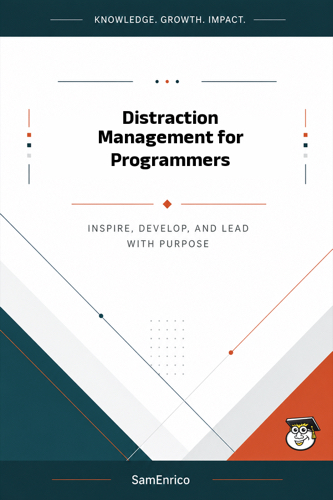
Distraction Management for Programmers eBook
Protects coding flow from context switching.
by Jacob Leann
Protects coding flow from context switching.
Formats
Free sample
Chapter 1: The Compilation Cost--–- The notification arrives at 10:17 AM. You are forty-five minutes into a complex refactoring, deep in the mental model. Six classes interact in your head like a well-rehearsed jazz quartet. You know exactly where the data flows, where the edge cases lurk, and what the next three lines of code will be. Your fingers move without conscious thought.
This is flow.A Slack message from your product manager appears: “Quick question when you have a sec.”You glance at it. One second. Maybe two.You dismiss it and return to your editor.Forty-five minutes later, you are still not back. You have been staring at the same line of code, scrolling through files you already visited, and wondering why you feel so foggy. The jazz quartet has left the building.
In its place is a dull hum of frustration.You have just experienced the compilation cost of a ping. And you are not alone.The Twenty-Three-Minute Thief For decades, programmers have been told that distraction is a personal failing. “Just focus harder.” “Close your tabs.” “Turn off notifications.” These admonitions come from well-meaning colleagues, managers, and productivity gurus who have never held a complex stack trace in their working memory while a deadline loomed.The truth is far more insidious, and far more liberating: distraction is not a character flaw. It is a performance penalty baked into the architecture of the human brain. And like any performance penalty, it can be measured, analyzed, and optimized.In 2014, researchers at the University of California, Irvine conducted a landmark study on interruption recovery.
They followed knowledge workers—including software engineers—and timed exactly how long it took to return to a focused state after a brief interruption. The results were staggering.After a distraction lasting less than three seconds—the time it takes to glance at a Slack message or a calendar notification—workers took an average of twenty-three minutes and fifteen seconds to return to their original task with the same level of focus.Twenty-three minutes.Not five minutes. Not ten. Twenty-three.That single ping at 10:17 AM did not cost you one second. It cost you nearly half an hour of productivity.
And if you receive ten such pings in a day—a conservative estimate for many programmers—you have lost nearly four hours. An entire working morning. Every single day.But the cost is not merely time. The UC Irvine study also measured error rates. After an interruption of just 2.8 seconds, participants made twice as many mistakes on their primary task.
For programmers, this means bugs. Off-by-one errors. Forgotten null checks. Deployed code that works in the happy path but crashes in production when the moon is full and the load balancer sneezes.Attention Residue: The Silent Killer Why does such a brief glance cause such catastrophic damage? The answer lies in a phenomenon called Attention Residue, first named by cognitive scientist Sophie Leroy.When you focus on a task, your brain builds a rich, dynamic mental model.
This model includes not just the code in front of you, but the entire context: the call stack, the data flow, the edge cases, the naming conventions, the bug you fixed yesterday, the architectural constraint you discovered last week. This model is fragile. It exists in your working memory, which neuroscientists often compare to a very small whiteboard. You can only hold four to seven distinct chunks of information at once.When you switch your attention—even for a split second to glance at a notification—part of your brain remains stuck on the previous task. Leroy called this “attention residue.” Your cognitive resources are split.
A portion of your working memory is still tied up with the interrupted task, leaving less capacity for the task you are trying to return to.The result feels like wading through honey. You read the same line of code three times. You open a file and cannot remember why. You type a variable name and then delete it. Your brain is not broken.
It is simply carrying residue.For programmers, attention residue is magnified because coding is not assembly-line work. An assembly line worker who is interrupted while attaching a bolt can look at the bolt, remember where they were, and continue within seconds. The context is physical and visible.Code is invisible. The mental model of a microservice architecture, a recursive algorithm, or a race condition in a multi-threaded system exists entirely in your head. There is no physical bolt to look at.
When you lose that model, you cannot simply “see” where you were. You have to rebuild it from scratch, line by line, stack frame by stack frame.The Cache Miss Model of Focus To make this concrete—and because you are a programmer—let us model the problem in terms you already understand.Think of your brain’s working memory as an L1 cache. It is extremely fast, extremely small, and holds exactly what you are working on right now. When you are in flow, your L1 cache is hot. Every variable, every relationship, every next step is loaded and ready.An interruption—a Slack message, an email, a colleague tapping your shoulder—acts like a cache flush.
All that hot data is evicted. Your L1 cache is now empty.When you return to your editor, your brain must perform a cache reload. It has to fetch the mental model from a slower storage system: your long-term memory. This is the cognitive equivalent of a page fault in an operating system. It is expensive.
It is slow. And it happens every single time you switch contexts.The UC Irvine study measured the average latency of this cache reload at twenty-three minutes. But here is the crucial insight: that number is your baseline. It is the cost you pay when you have no system in place. It is the equivalent of running your code without any optimization, without any caching, without any awareness of the performance penalty.Throughout this book, you will learn to reduce that latency dramatically.
You will learn to stash your mental state like a git stash, to externalize complexity, and to architect your environment for cognitive immunity. By the time you finish Part II, you will be able to return from an interruption in under ninety seconds.But first, you must accept the true cost of the ping.Why “Just Ignore It” Does Not Work Every programmer has been told to “just ignore notifications” or “just close Slack.” This advice fails for three reasons.First, it ignores the reality of modern software development. You work on a team. Your team communicates via Slack, Jira, email, and Zoom. Pull requests need reviews.
Deployments need coordination. Production incidents need immediate response. Absolute digital asceticism is not a viable strategy for most developers. It is a luxury for academics and solo founders, not for engineers at scale.Second, “just ignore it” confuses the symptom with the cause. The problem is not the notification itself.
The problem is the context switch that the notification triggers. Even if you ignore the notification, you have still switched your attention. You have still flushed your cache. You have still incurred attention residue.…
This is the end of the free sample. Get the eBook to keep going. Buy now
About this book
Details
- Author
- Jacob Leann
- Publisher
- SamEnrico
- Language
- English
- Genre
- Non-Fiction, Self-Help, Software
- Released
- 2026-06-05
- Pages (approx.)
- 126
- Available as
- eBook, Audiobook

Read better in the ZLOADR app
Your eBooks on your phone or tablet. Sign in with your SamEnrico account and start reading.
More by Jacob Leann
 Functional Analysis for ProductsJacob Leann$11.99
 Anki For GRE VerbalJacob Leann$11.99
 Zumba Choreography MasterclassJacob Leann$11.99
 The High Functioning AlcoholicJacob Leann$11.99
 Australian Outback WalkaboutJacob Leann$11.99
 Forgiving a BullyJacob Leann$11.99
 Mindfulness for Decision MakingJacob Leann$11.99
 Whispers in the Sawdust: The Curse of the Black PineJacob Leann$11.99
 The Trollwife’s Lament: A Nordic Mountain BalladJacob Leann$11.99
 How to Produce Radiology Equipment and AccessoriesJacob Leann$11.99
 How to Produce an Entertainment CenterJacob Leann$11.99
 US Business Credit Portfolio Management WorkbookJacob Leann$12.99
You may also like
 Outsourcing for Software DevelopersSands Breanne$11.99
 The OKR Software GuideRoller Lyman$11.99
 Team Creativity for DevelopersMoses Katia$11.99
 Daily Review for ProgrammersMoon Ouida$11.99
 The Remote Developer Time GuideMaldonado Jorge$11.99
 Remote Software Development CommunicationGomez Sadie$11.99
 Delegation Software ToolsDunbar Maple$11.99
 Constraints for CodersHarter Elisha$11.99
 Chunking API DocumentationRoyster Ying$11.99
 The Software Engineer Creative CodeSisk Rosalva$11.99
 Pomodoro for CodingZimmer Blaine$11.99
 NVC In Tech Teams GuideMessina Larita$11.99