
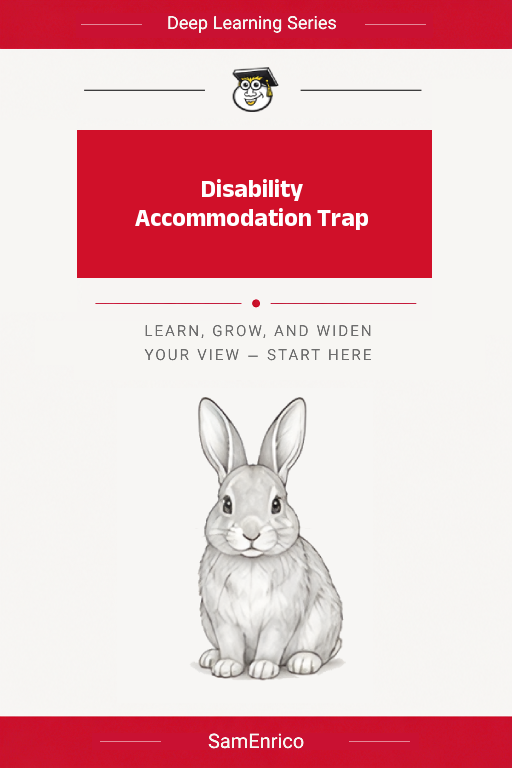
Non-FictionBusiness BriefADA Compliance
Disability Accommodation Trap eBook
Engage interactive process for reasonable accommod
Engage interactive process for reasonable accommodations including undue hardship analysis with first employee disability requests.
Formats
Free sample
Chapter 1: The First Speaker...–- The warehouse floor was quiet that Tuesday morning when David, a seventeen-year veteran shift supervisor, noticed Maria struggling to lift a fifty-pound box onto a pallet. She was wincing, favoring her right side, and taking twice as long as usual. David considered himself a good manager—the kind who solved problems before they escalated. So he walked over, quietly told a younger employee to help Maria with her heavy lifts, and went back to his office feeling satisfied. He had been kind.
He had been efficient. He had just cost his company $1.2 million.Eighteen months later, David sat in a deposition. Maria had sued for failure to accommodate a back condition she had never explicitly disclosed. Her lawyer asked David a single devastating question: "Did you ever ask Maria what she needed?" David admitted he had not. "Did you ever document a conversation about her limitations?" No.
"Did you ever explain why you reassigned her lifting duties instead of discussing alternatives?" No. The case settled on the courthouse steps. David’s company paid $1.2 million—not because they refused an accommodation, but because they never held the conversation.This book is about that conversation. It is about the single most expensive silence in American workplaces today.The opening scenario above is not an outlier. It is a composite of four real cases from 2022 to 2024, all of which resulted in six- or seven-figure settlements.
In each case, the employer did something superficially reasonable—reassigned tasks, granted time off, bought ergonomic equipment—but did so unilaterally, without dialogue, without documentation, and without following the four-step interactive process required by the Americans with Disabilities Act (ADA). And in each case, the employer lost not because the accommodation was wrong, but because the process was absent.The Central Argument of This Book The "disability accommodation trap" is the false belief that acting unilaterally is faster, kinder, or more efficient than talking. The trap is the manager who says, "I'll just handle this myself." The trap is the HR professional who assumes that because an employee never used the words "reasonable accommodation," no duty exists. The trap is the executive who thinks that buying an expensive piece of equipment is enough, without ever asking the employee what they actually need.The thesis of this book is simple: The interactive process is not a bureaucratic hurdle. It is your primary defense.When you engage in the interactive process—a structured, documented, good-faith dialogue with the employee about their limitations and possible accommodations—you accomplish three things simultaneously.
First, you actually identify the most effective accommodation, which improves employee performance and retention. Second, you create a contemporaneous record that defeats any future claim of bad faith. Third, you shift the burden of proof; once you have engaged in good faith, the employee must prove that you acted unreasonably, rather than you proving that you did not.The failure to engage, by contrast, is the single fastest path to liability. According to the Equal Employment Opportunity Commission (EEOC) Charge Data for fiscal years 2023 and 2024, "failure to engage in the interactive process" is now the most frequently alleged ADA violation, surpassing both failure to accommodate and retaliation. In fiscal year 2024 alone, the EEOC received over 28,000 disability-related charges.
Of those, approximately 62% included a failure-to-engage allegation. The median settlement for such charges when the EEOC finds reasonable cause is 475,000.Forcasesthatproceedtolitigation,themedianjuryverdictis475,000. For cases that proceed to litigation, the median jury verdict is 475,000.Forcasesthatproceedtolitigation,themedianjuryverdictis1.8 million.Those numbers should terrify you. But they should also empower you, because the failure to engage is entirely preventable. It does not require expensive consultants or complex legal analysis.
It requires a single skill: the willingness to start a conversation and document it.The First Speaker Rule This chapter introduces a concept that will appear throughout the book, always by the same name and never as a verbatim repetition: The First Speaker Rule.The First Speaker Rule states: The first person to initiate a structured, documented dialogue about workplace limitations wins. That person must be the employer.Here is what the First Speaker Rule means in practice. When a supervisor notices an employee struggling, the supervisor does not solve the problem. The supervisor does not reassign tasks, grant leave, or buy equipment. The supervisor initiates a conversation using a specific, repeatable protocol that this book will teach.
The conversation has four components:A neutral, private setting.An open-ended question: "I've noticed you're having difficulty with [specific task]. Can you tell me about what's happening?"A request for functional information, not medical diagnosis: "What limitations are you experiencing? What would help you perform this task?"A written summary sent within 48 hours, memorializing what was discussed and what the parties agreed to do next.That is it. That is the entire first step. It takes fifteen minutes.
It costs nothing. And it is the difference between a $1.2 million settlement and a closed file.The First Speaker Rule is not merely a best practice. It is a legal necessity because of how courts interpret the ADA's interactive process requirement.The Legal Foundation: Why the Conversation Matters The ADA was signed into law in 1990 and amended in 2008. Its core employment provision, Title I, prohibits discrimination against qualified individuals with disabilities. But the ADA is not primarily a prohibition statute; it is a process statute.
Unlike Title VII of the Civil Rights Act, which prohibits discrete acts of discrimination (refusing to hire, firing, harassing), the ADA imposes an affirmative duty on employers to engage in an interactive process to determine whether a reasonable accommodation exists.The statutory text is sparse. 42 U.S.C. § 12112(b)(5)(A) merely states that discrimination includes "not making reasonable accommodations to the known physical or mental limitations of an otherwise qualified individual with a disability." The regulations, however, have fleshed out this requirement. 29 C.F.R. § 1630.2(o)(3) provides that "to determine the appropriate reasonable accommodation, it may be necessary for the covered entity to initiate an informal, interactive process with the individual with a disability in need of the accommodation."Courts have transformed this "may be necessary" language into an affirmative legal duty.
In every federal circuit, the failure to engage in the interactive process is independently actionable, even if no reasonable accommodation ultimately exists. This is the critical point that most employers misunderstand.The Critical Distinction: Two Scenarios, Two Outcomes Because this point is the source of enormous confusion and the original source of inconsistency in earlier drafts of this book, let me state it with absolute clarity.Scenario A: Good-Faith Engagement with No Solution. The employer identifies a potential disability (either through explicit request or constructive notice). The employer initiates the interactive process, holds meetings, requests medical documentation of functional limitations, brainstorms accommodations, and documents every step. After all of this, the employer concludes that no reasonable accommodation exists that would allow the employee to perform essential functions without undue hardship.
The employer denies the accommodation in writing, explaining the hardship with specific calculations. The employee sues.Outcome: The employer wins. The interactive process was the employer's defense. The court will grant summary judgment because the employer fulfilled its duty to engage, even though no accommodation was possible. The employer does not…
This is the end of the free sample. Get the eBook to keep going. Buy now
About this book
Details
- Author
- Prescott Christian
- Publisher
- SamEnrico
- Language
- English
- Genre
- Non-Fiction, Business Brief, ADA Compliance
- Released
- 2026-05-30
- Pages (approx.)
- 153
- Available as
- eBook, Audiobook

Read better in the ZLOADR app
Your eBooks on your phone or tablet. Sign in with your SamEnrico account and start reading.
More by Prescott Christian
 Bedtime Meditation GuidePrescott Christian$11.99
 The Desert Oasis RestPrescott Christian$11.99
 Sugar Free Meal PrepPrescott Christian$11.99
 Burnout Recovery Sense Of HumorPrescott Christian$11.99
 Meiji Freedom and Rights GuidePrescott Christian$11.99
 The Rift That Shook the World: Africa's Hidden Tectonic RevolutionPrescott Christian$11.99
 Tangaroa's Shadow: The Navigator Spies of the PacificPrescott Christian$11.99
 How to Start a Printing Onto Wood Business (Beginners Guide)Prescott Christian$11.99
 Learn an InstrumentPrescott Christian$11.99
 Panel Data Excel GuidePrescott Christian$12.99
 Understanding Glucocorticoid Sensitive HypertensionPrescott Christian$17.99
You may also like
 Hong Kong Handover 1997Dunn Johnnie$11.99
 Zumba For Postnatal Recovery CourseNeal Christian$11.99
 Zumba for BeginnersLadner Nikia$11.99
 YouTube Comment Mining GuideHumes Pandora$12.99
 Worry Box MeditationCarlin Rudy$11.99
 Workplace Stress MeditationNguyen Lynn$11.99
 Workplace Stress and Sleep RepairHawley Ivory$11.99
 Workplace Perfectionism CureDelaney Jeffry$11.99
 Workplace Injustice Anger GuideWallen Isabelle$11.99
 Work Addiction and Burnout LinkGreenwood Ester$11.99
 Women in Yoga and WellnessBeattie Galina$11.99
 Women in Stand Up ComedyChun Evangeline$11.99